Something fundamental is shifting inside software development teams worldwide — and most business leaders are only just beginning to notice it. AI driven software development services are no longer an emerging experiment confined to Silicon Valley engineering departments. They are actively reshaping how enterprise software is planned, built, tested, and shipped — across every industry, at every scale, from Singapore to San Francisco. If you are evaluating technology partners, planning a new product, or simply trying to understand where the industry is heading, this guide is your starting point.
We will walk you through what AI-driven development actually means in practice (not in marketing language), the real trends redefining the software delivery landscape, and the questions every informed buyer should be asking before engaging any AI software development services provider.
The Quiet Revolution Happening Inside Software Teams
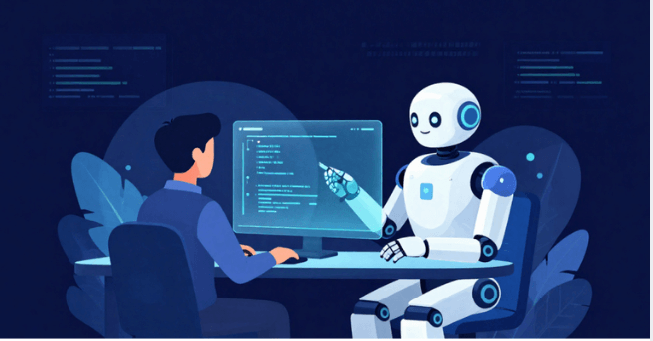
A few years ago, AI tools in software development meant autocomplete features in a code editor — useful, but incremental. In 2026, the picture is dramatically different. AI is now embedded across the entire software development lifecycle: writing and reviewing code, generating test cases, flagging security vulnerabilities, predicting project risks, and even producing production-ready features from natural-language descriptions.
This shift is not theoretical. A 2024 GitHub survey found that developers using AI-assisted tools completed tasks up to 55% faster than those working without them. McKinsey research put the productivity gain from AI coding assistants at 20–45% depending on task complexity. These numbers are large enough that any software development partner who is not actively integrating AI into their workflows is already operating at a structural disadvantage.
For business leaders, this creates both an opportunity and a risk. The opportunity: faster delivery, lower cost, and higher-quality software than was previously achievable at comparable budgets. The risk: not all vendors claiming to offer AI driven software development services have actually rethought their processes — some have simply added an AI buzzword to a traditional delivery model.
Knowing the difference is what this guide is about.
What “AI Driven Software Development” Actually Means
The term gets used loosely, so let us be precise. AI driven software development services refers to a delivery model where artificial intelligence tools are systematically integrated into one or more stages of the software development lifecycle — not as a gimmick, but as a core operational method that changes how teams work, how fast they deliver, and what quality benchmarks they can achieve.
This is meaningfully different from a developer occasionally using ChatGPT to write a function. True AI-driven development involves deliberate toolchain design, prompt engineering discipline, workflow integration, and — critically — quality controls that ensure AI-generated output meets production standards before it ever reaches your codebase.
Beyond Autocomplete: How AI Is Reshaping the Entire SDLC
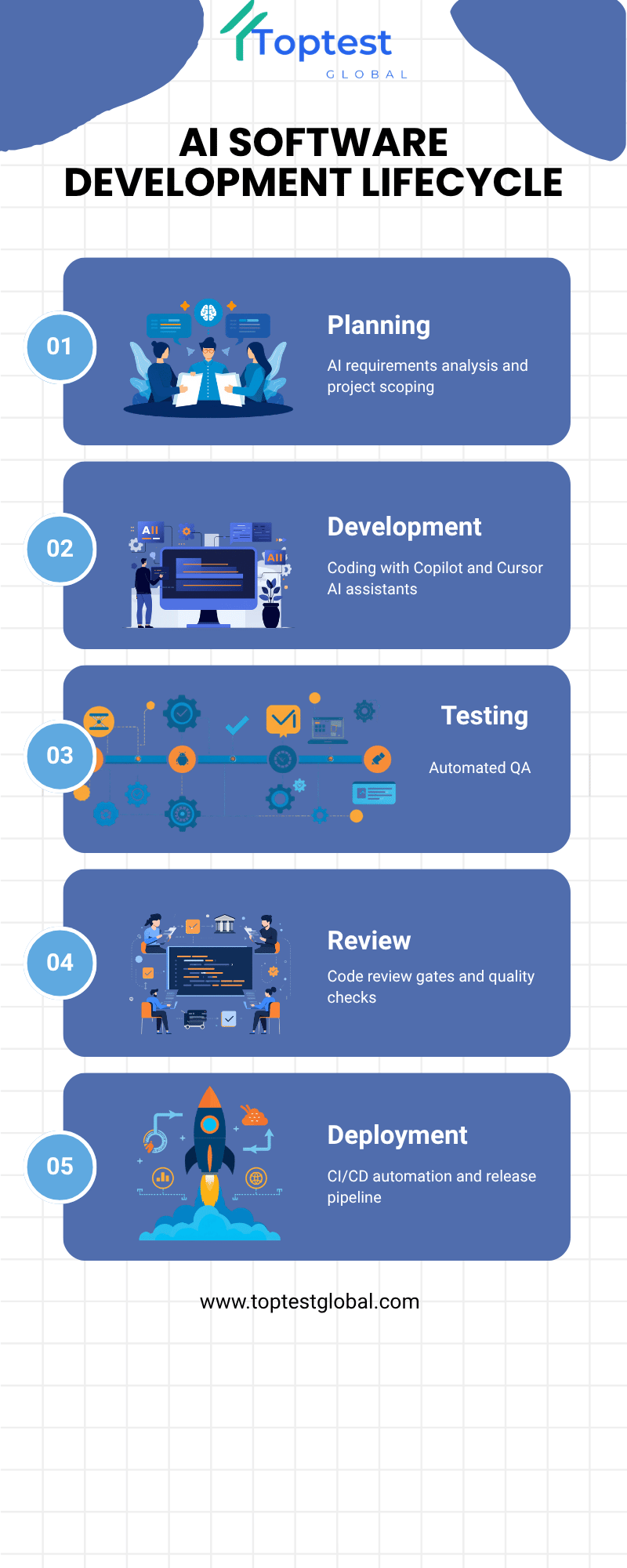
The most significant misconception about AI in software development is that it only affects the coding phase. In practice, mature AI software development services now apply intelligence across the full software development lifecycle:
- Requirements analysis: AI tools parse stakeholder documents, user research, and business process descriptions to surface ambiguities and generate structured requirement sets — reducing the most common source of project failure before a line of code is written.
- Architecture & design: Large language models assist senior architects in evaluating design patterns, identifying integration risks, and generating system diagrams from plain-language briefs.
- Code generation & review: AI pair-programming tools generate functions, modules, and boilerplate at speed — with senior engineers reviewing and validating output rather than writing from scratch.
- QA & test automation: AI tools generate comprehensive test cases from user stories, identify edge cases that human testers routinely miss, and create automated regression suites that grow with the codebase.
- Deployment & monitoring: Intelligent pipeline tools predict deployment risks, auto-generate rollback plans, and surface anomalies in production before they become user-facing incidents.
When all of these capabilities are working together under disciplined engineering leadership, the result is a fundamentally faster, more reliable, and more cost-effective delivery model than traditional approaches can match.
The Rise of Vibe Coding: From Experiment to Enterprise Reality
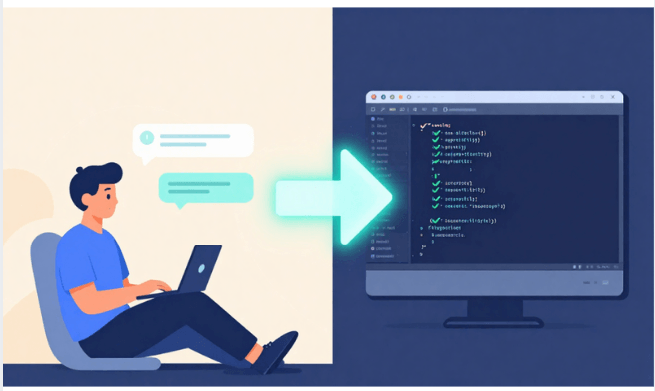
One of the most discussed — and most misunderstood — trends in AI-driven development right now is what the industry is calling “vibe coding.” The term, popularised by AI researcher Andrej Karpathy, describes the practice of building software by describing intent in natural language and letting an AI model generate the implementation.
At its most experimental, vibe coding means a non-developer describing a web feature in plain English and watching an AI tool produce working code. IBM’s overview of vibe coding describes it as a paradigm shift in how humans interact with machines to build software — one that lowers the barrier to prototyping while raising important questions about code quality, security, and maintainability.
For enterprise buyers, the practical implication is nuanced. Vibe coding tools can dramatically accelerate early-stage prototyping and reduce the time to a testable MVP. But — as detailed prompt engineering guides make clear — getting AI to produce genuinely production-ready code requires sophisticated prompt strategies, rigorous output validation, and human engineering oversight that most business leaders do not see behind the scenes.
The bottom line: vibe coding is a real and powerful productivity technique in the hands of experienced engineers who know how to validate AI output. It is not a replacement for software engineering expertise — it is a force multiplier for it. Any AI driven software development services provider that cannot explain how they validate and quality-control AI-generated code is not yet operating at a production-safe standard.
Core Capabilities That Define Mature AI Software Development Services
Not all AI software development services are built equally. The following three capabilities are the clearest indicators that a provider has genuinely rethought their delivery model — rather than simply rebranded a traditional one.
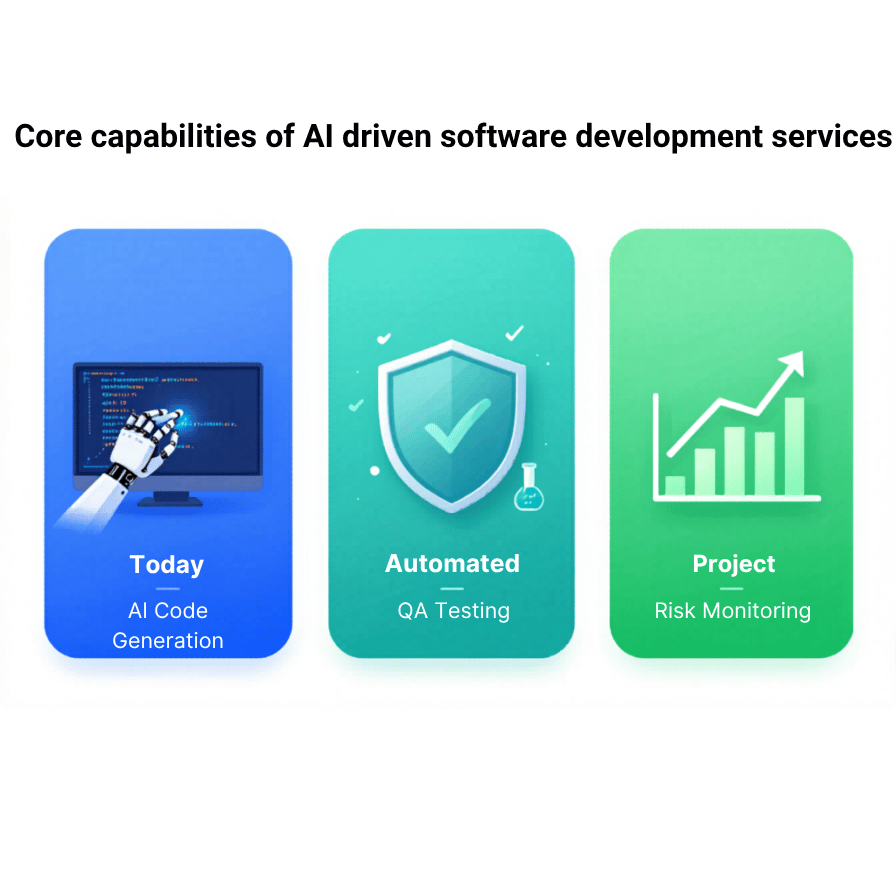
1. AI-Assisted Code Generation With Human Engineering Oversight
The strongest AI-driven teams use code generation tools — GitHub Copilot, Cursor, Claude, and others — not to replace engineers but to fundamentally change how engineers allocate their time. Instead of writing boilerplate from scratch, senior engineers review, validate, and refine AI output. The result is that your development budget is spent on engineering judgment — the highest-value activity — rather than on repetitive implementation tasks.
At Toptest Global, our engineers bring this discipline to every engagement: AI-generated code is treated as a draft, not a deliverable. It passes through our standard code review and automated QA gates before it is merged into any shared environment.
2. AI-Generated Test Cases & Automated QA Pipelines
This is the capability that most directly protects your investment. AI tools can now generate test cases from user stories with a coverage breadth that would take a manual QA team days to produce in hours. Combined with automated execution frameworks like Playwright, these test suites continuously validate your application as it evolves — catching regressions the moment they are introduced rather than when a user discovers them.
In our 100+ software and QA projects delivered from our development centres in Singapore and Vietnam, this is consistently the capability that produces the most visible client ROI: fewer post-launch defects, faster release cycles, and dramatically lower rework costs.
3. Intelligent Project Risk Flagging & Progress Visibility
AI-native project management tools now surface patterns that predict delivery risk weeks before they materialise: sprint velocity drops, dependency bottlenecks, test failure rate trends, and scope creep signals. For business leaders who want genuine visibility into a project’s health — not just a green-light RAG status in a weekly meeting — this capability is transformative. It means problems are discussed when they are still small, not escalated when they are already expensive.
What Makes AI-Driven Development Different From Traditional Approaches?
If you have worked with software development partners before, the clearest way to understand the difference is through two specific lenses: speed and quality discipline.
Speed Without Sacrificing Quality
Traditional software development is constrained by a fundamental trade-off: move faster and accumulate technical debt, or move carefully and accept longer timelines. AI driven software development services do not eliminate this trade-off — but they push the constraint significantly. AI-assisted code generation handles the repetitive implementation work that previously consumed the most developer hours, freeing senior engineers to focus on architecture, integration design, and the judgment calls that actually determine a product’s long-term quality.
The practical result: teams that have integrated AI effectively are consistently delivering projects in 30–50% less elapsed time compared to equivalent traditionally-staffed teams — without the quality regression that speed usually implies.
The QA Question Nobody Asks Until It Is Too Late
Here is the question most buyers forget to ask: “How does your team validate AI-generated code before it enters your codebase?”
AI code generation tools are powerful, but they produce output that is statistically confident rather than architecturally considered. An AI model does not know your integration constraints, your security requirements, or your team’s coding standards. Without rigorous review and automated testing, AI-generated code introduces a new category of risk — subtle, hard-to-trace defects that surface weeks after deployment.
The providers that genuinely deserve the label of AI software development services treat automated QA as non-negotiable infrastructure. Every AI-generated code contribution passes through the same automated test suite, the same security scanning, and the same code review process as human-written code. This is what separates production-safe AI-driven development from impressive demos that fail in the real world.
What to Look For When Evaluating AI Software Development Services
The awareness stage is the right time to build your evaluation criteria — before you are in a commercial conversation with a vendor and time pressure distorts your judgment. Here are the five questions that separate genuinely AI-driven providers from those who are AI-branded:
- “Which AI tools are integrated into your development workflow, and at which stages?”
A confident answer names specific tools (Copilot, Cursor, Codeium, AI-assisted testing platforms) and maps them to specific lifecycle phases. A vague answer about “leveraging AI” is a red flag. - “How do you validate and review AI-generated code before it enters the codebase?”
The answer should describe an automated QA pipeline, a code review process, and explicit quality gates — not just “we check it manually.” - “What is your automated test coverage baseline, and which frameworks do you use?”
Mature providers can answer this immediately. They have standards (e.g., 80%+ automated coverage) and they can name their testing frameworks (Playwright, Jest, Appium, etc.). - “Can you show me a project where AI tooling meaningfully reduced delivery time or defect rate?”
Look for specific numbers and verifiable context — not generic capability statements. - “How do your AI-assisted processes handle security and IP considerations?”
AI code generation tools interact with your codebase. Understanding how a vendor manages data privacy, IP ownership, and code security in an AI-augmented workflow is non-negotiable for enterprise buyers.
If you are also evaluating partners for mobile product development, our guide to selecting a mobile app development service in Singapore walks through a parallel evaluation framework for that context — including how QA discipline translates directly to mobile delivery quality.
Why Awareness Is the Most Valuable Stage to Get Right
Most buying mistakes in enterprise software services happen not during vendor selection, but in the weeks before it — when leaders form premature opinions based on incomplete information, impressive demos, and cost comparisons that ignore quality variables. The awareness stage is where the mental model gets built. Get it right, and every subsequent decision — RFP criteria, shortlisting, contracting — is sharper and better-protected.
AI driven software development services are not a commodity yet. The gap between the best and worst providers is large, and the consequences of choosing poorly are expensive. Taking the time now to understand what you are evaluating — what genuine AI integration looks like, what the QA discipline requirements are, what questions to ask — is the single highest-ROI activity a technology decision-maker can do in this space before entering a commercial process.
At Toptest Global, we have been delivering software and QA projects from our centres in Singapore and Vietnam for years. Our integration of AI-assisted development tools is grounded in the same QA-first philosophy that has produced our 98% client retention rate — because speed without quality discipline is not delivery, it is deferred rework.
Frequently Asked Questions About AI Driven Software Development Services
What is the difference between AI driven software development and traditional software development?
Traditional software development relies entirely on human engineers to write, test, and review code. AI driven software development services integrate artificial intelligence tools at multiple stages of the lifecycle — code generation, test creation, code review, project risk analysis — to increase delivery speed, reduce repetitive work, and surface quality issues earlier. The key distinction is that AI augments engineering judgment rather than replacing it: the best AI-driven teams still have senior engineers making architectural and quality decisions at every stage.
Is vibe coding the same as AI driven software development?
Not exactly. Vibe coding is a specific technique within the broader category of AI-assisted development — it refers to generating code from natural-language descriptions. It is one tool in the AI-driven development toolkit, and a powerful one for prototyping and early-stage builds. However, mature AI software development services go far beyond vibe coding to include AI-assisted QA, intelligent project management, security scanning, and deployment automation. Vibe coding without these surrounding quality controls is not suitable for production enterprise software.
Will AI software development services produce lower-quality code?
Only if the provider has weak quality controls. AI-generated code that passes through rigorous automated testing pipelines, code review, and security scanning is production-safe. The risk is not AI generation itself — it is insufficient validation of AI output. When evaluating any AI driven software development services provider, always ask how they validate AI-generated code before it reaches your codebase. The answer to that question tells you more about their quality maturity than their portfolio does.
How do I know if a vendor genuinely uses AI in their development process?
Ask for specifics: which tools, at which lifecycle stages, with what validation processes. Credible AI-driven providers can name their toolchain, describe their prompt engineering practices, quantify their test automation coverage, and show measurable outcomes — reduced defect rates, faster delivery timelines, lower rework costs — from real projects. Generic statements about “harnessing the power of AI” without supporting detail are a reliable signal that the capability is more marketing than methodology.
What types of projects are best suited to AI driven software development?
Almost all modern software projects benefit from AI-assisted development when implemented correctly. The impact is highest for projects with well-defined requirements (where AI code generation is most accurate), high test coverage requirements (where AI-generated test suites add the most value), and iterative roadmaps (where AI-assisted velocity compounding delivers the greatest long-term ROI). Projects with highly novel, research-heavy architecture requirements may rely more on senior human engineering judgment — but even there, AI tools accelerate the supporting work significantly.
The Smartest First Step in Your AI Software Development Journey
The software development landscape is changing faster than at any point in the past decade. AI driven software development services represent not just a new set of tools, but a fundamentally different operating model — one that rewards buyers who understand what they are evaluating and penalises those who make decisions on surface-level signals. The awareness you build now, before you are in a vendor selection process, is the foundation of every good technology decision that follows.
If you are ready to take the next step — whether that is understanding how AI-driven QA works in practice, exploring what a project engagement would look like, or simply stress-testing your current vendor’s AI capability claims — we are here to have that conversation without a sales agenda.
🔵 Book a Free 45-Minute AI & QA Strategy Audit — A no-obligation session with a senior Toptest consultant. We will review your current technology situation and give you an honest picture of where AI-driven development could move the needle for your business.
📥 Download the Free AI Software Development Services Evaluation Checklist — The 20 questions every business leader should ask before engaging an AI-driven development partner.