Every organization eventually hits the same wall: growth that was once manageable becomes operationally unsustainable. What worked at 50 employees breaks at 200. What ran smoothly with 10 clients becomes chaotic at 100. The bottlenecks aren’t caused by bad people or bad strategy — they’re caused by systems that were never designed to scale. Process automation software is what closes that gap. It transforms the manual, people-dependent processes that constrain growth into structured, reliable systems that perform consistently regardless of transaction volume, team size, or organizational complexity.
In our 100+ automation and QA projects, the organizations that achieve genuine, sustained scalability share a defining characteristic: they chose the right process automation software for their architecture, deployed it with QA discipline from the start, and treated it as a production system — not an IT experiment. This guide examines what scalable systems actually require from an automation platform, how to build them right, and why QA-driven workflow automation is the non-negotiable foundation of any automation program built to last.
The Scalability Problem: Why Manual Systems Break Under Growth
The scalability failure of manual processes is not a question of if — it’s a question of when. Manual systems fail under growth because they are fundamentally people-dependent: every additional transaction requires proportionally more human time, every new employee adds coordination complexity, and every new system integration creates a new manual bridging task. The organization doesn’t scale — it multiplies its labor requirements.
The specific breaking points we see most consistently in organizations that haven’t deployed process automation software yet:
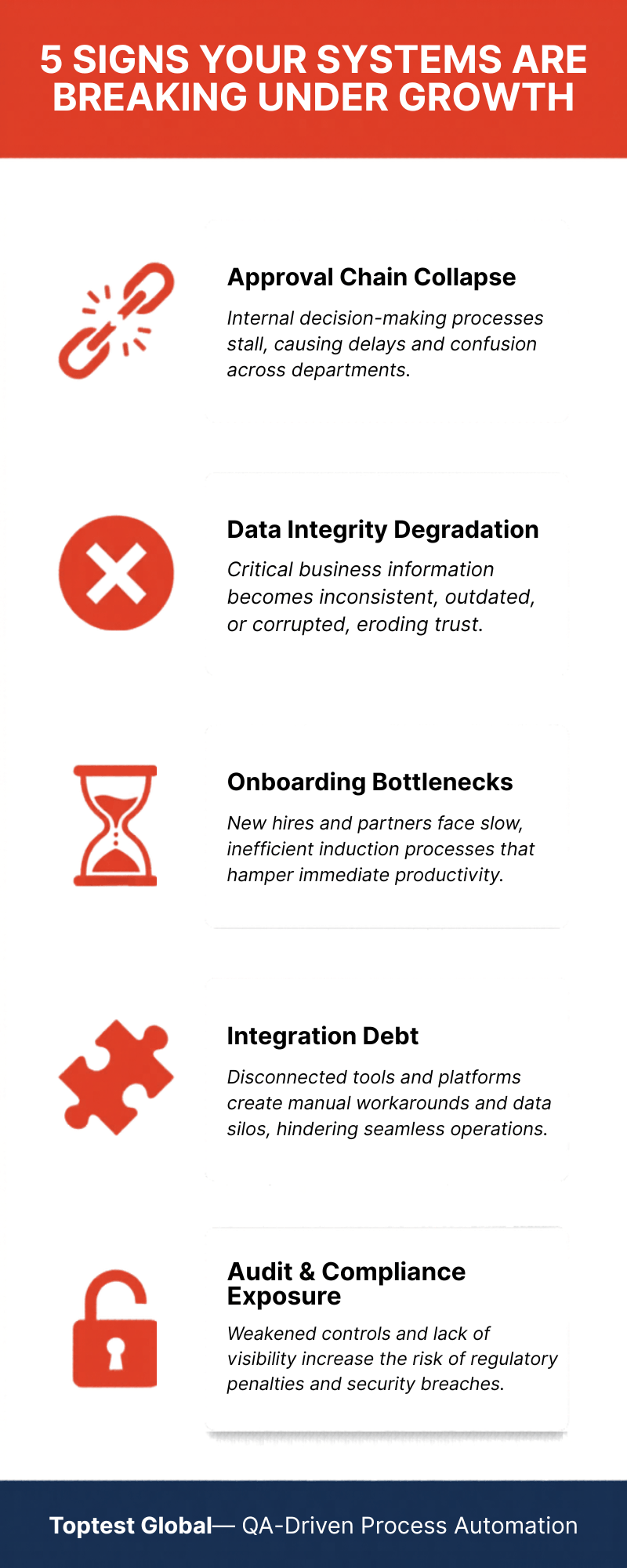
- Approval chain collapse: Multi-tier approval processes that worked via email at low volume become unmanageable at scale — requests are lost, SLAs are invisible, escalations happen reactively rather than proactively
- Data integrity degradation: Manual data entry across multiple systems generates error rates that compound over time — a 2% error rate on 100 transactions is 2 errors; on 10,000 transactions it’s 200 errors with downstream consequences
- Onboarding bottlenecks: Rapid hiring creates onboarding backlogs when the process is manual — IT provisioning queues, HR paperwork delays, and compliance gaps that create first-impression failures for new employees
- Integration debt: Every new tool added to the stack without a process automation software integration layer creates a new manual data transfer task that someone has to perform repeatedly, forever
- Audit and compliance exposure: Manual processes leave gaps in audit trails that become regulatory liabilities as the organization grows into more heavily scrutinized operational territory
Choosing the right process automation software architecture early is the single highest-leverage decision in an organization’s operational growth strategy. The pattern is consistent: organizations delay deploying process automation software during early growth because the pain is manageable. By the time the pain becomes acute, the remediation cost — unwinding manual workarounds, cleaning corrupt data, and re-engineering processes that should have been automated years earlier — is significantly higher than proactive automation would have cost.
What Makes an Automation Platform Truly Scalable — and What Doesn’t
Not all process automation software is designed for scale. Many platforms are excellent for small teams and simple workflows but reveal architectural limitations when transaction volumes grow, process complexity increases, and integration demands multiply. Understanding the difference between a scalable automation platform and one that will become a bottleneck itself is the most important evaluation decision you’ll make.
The 5 Architectural Properties of a Scalable Process Automation Software Platform
Based on our hands-on experience implementing QA-driven automation across high-growth organizations, these are the five architectural properties that determine whether a process automation software platform actually scales:
1. Stateless Workflow Execution: The First Requirement of Scalable Process Automation Software
Scalable process automation software platforms execute workflows statelessly — meaning the execution engine doesn’t hold workflow state in memory. State is stored externally (in a database or object store), allowing the execution engine to be replicated horizontally as transaction volumes grow. Platforms with stateful execution engines hit capacity ceilings that can’t be resolved without architectural changes — a rebuilding problem, not a configuration problem.
2. Asynchronous Processing: How Process Automation Software Handles Volume Spikes
At scale, synchronous process execution creates bottlenecks: each step waits for the previous one to complete before the next can begin, and system-to-system calls become latency chains. Scalable automation platforms use asynchronous, event-driven processing — workflow steps are triggered by events, execute independently, and communicate completion through queues rather than synchronous calls. This architecture handles volume spikes without degradation and recovers gracefully from system failures without data loss.
3. Integration Resilience: The Fault-Tolerance Layer Every Process Automation Software Needs
A scalable process automation software platform treats every external integration as a potential failure point — because at scale, they will fail. Platforms built for enterprise-grade scalability include: retry logic with exponential backoff, dead-letter queues for failed transactions, circuit breakers that prevent cascading failures when a downstream system is degraded, and integration health monitoring with automated alerts.
This is where n8n integration as a middleware layer provides significant architectural value. n8n‘s open-source workflow orchestration engine is designed for exactly this resilience requirement — providing configurable retry logic, error routing, and conditional execution paths that many native connectors lack. For organizations with complex, heterogeneous tool stacks, n8n between your process automation software and your integrated systems adds an isolation layer that protects your automation program from the instability of any single upstream or downstream system.
4. Process Versioning: Zero-Downtime Updates for Production Process Automation Software
Scalable systems require the ability to update running automation without downtime. A process automation software platform that requires stopping all active workflow instances to deploy a process update is operationally incompatible with 24/7 business operations. Enterprise-grade automation platforms support process versioning — active instances continue on the version they started on, while new instances pick up the latest published version — with rollback capability if a new version introduces unexpected behavior.
5. Multi-Environment Architecture: Governance Infrastructure for Scalable Process Automation Software
As automation programs mature, they require structured environment separation: development, staging, UAT, and production — each with its own data isolation, configuration management, and deployment pipeline. Process automation software that conflates environments — or makes environment promotion painful — creates a governance problem that compounds as the number of automated processes grows. Scalable platforms treat environment management as a first-class capability, not an afterthought.
Process Automation Software vs. Point Solutions: Why Integration Architecture Matters for Scale
One of the most consequential architectural decisions in building scalable systems is whether to use a unified process automation software platform or a collection of point solutions — individual automation tools for specific departments or processes that operate independently and don’t share a common data or process layer.
Point solutions are seductive early in growth: they’re fast to deploy, low-commitment, and solve an immediate problem cleanly. But they create an automation architecture that looks like this at scale:
- HR using one automation tool for onboarding
- Finance using a different tool for purchase order approval
- Sales using a third tool for client onboarding automation
- IT using a fourth for provisioning workflows
- None of these sharing data, triggering each other, or providing cross-functional process visibility
The result is automation sprawl: multiple vendor contracts, multiple integration layers, multiple support responsibilities, and a process landscape that’s more complex and fragile than the manual processes it replaced. Cross-functional workflows — which are often the highest-value automation targets — become impossible to implement because the underlying systems can’t communicate. Our complete guide on how to automate workflows for zero bottlenecks covers the cross-functional integration architecture in detail.
A unified process automation software platform with a robust integration layer eliminates this fragmentation. Cross-functional workflows — where an employee onboarding trigger in the HRIS kicks off simultaneous IT provisioning, payroll setup, compliance documentation, and manager notification workflows — execute as a single orchestrated process rather than four separate point-solution automations that someone coordinates manually between.
For a comprehensive framework on how unified automation architecture delivers operational results, our guide on business process automation covers the full technology and governance landscape in detail.
The No-Code/Low-Code Imperative: Scaling Automation Without Scaling Your Engineering Team
One of the most common growth traps in automation programs is creating an engineering bottleneck: every new workflow, every rule change, every process update requires developer involvement. The result is an automation roadmap that’s perpetually backlogged — not because the business doesn’t want to automate, but because the process automation software selected requires engineering resources that are already constrained.
Genuine no-code/low-code workflow automation solves this. When business operations teams can build, modify, and maintain their own automated workflows through a visual workflow builder — without writing code — the automation program scales with the business rather than with the engineering headcount. The bottleneck shifts from “waiting for developer bandwidth” to “identifying the next process to automate.”
What Genuine No-Code Automation Capability Looks Like
The critical distinction is between marketed no-code capability and genuine no-code depth. Virtually every process automation software vendor claims no-code — but the ceiling of that no-code capability varies enormously. Platforms like Cflow are specifically engineered for genuine no-code depth — enabling operations teams to build complex multi-tier approval workflows, configure conditional routing logic based on live data, set SLA thresholds with automated escalation, and manage the full workflow lifecycle without engineering involvement.
Test no-code depth during evaluation by building a representative real-world workflow: an automated purchase order approval process with budget-based routing tiers, a live ERP check, and an escalation path for missed SLA windows. If the vendor’s platform requires developer support to complete it, the no-code ceiling is lower than the marketing suggests — and you’ve found a future bottleneck.
The scalability implication is significant: with genuine no-code capability, a single automation champion in each department can own and evolve that department’s automated workflows without creating engineering dependencies. At 5 processes, this is a convenience. At 50 processes, it’s the difference between an automation program that scales and one that stalls.
BPMN Process Mapping: The Blueprint for Scalable Workflow Automation
Scalable process automation software deployments don’t start with tools — they start with process maps. Specifically, with BPMN process mapping (Business Process Model and Notation), the international standard notation that provides a shared visual language for defining business processes at the precision level required for reliable automation.
The value of BPMN for scalable automation programs is structural: it forces process precision before automation begins. Every decision node, every parallel execution path, every exception route, every integration dependency, and every SLA boundary must be defined explicitly in the BPMN map. There is no room for the ambiguity that produces silent automation failures at scale.
Why BPMN Maps Are the Foundation of Scalable Process Automation Software Deployments
In our project delivery model, BPMN process mapping precedes every automation build — regardless of process complexity. The returns are consistent:
- Exception paths surfaced before build: BPMN mapping almost always reveals exception scenarios that stakeholders hadn’t articulated — paths that, if not handled in the automation, would become manual workarounds that undermine the entire process
- Integration requirements clarified: BPMN diagrams make integration dependencies explicit — what data is needed, from which system, at which process step, in which format — eliminating the ambiguity that produces integration failures in production
- QA scenario library derived directly from the map: Every decision node in a BPMN map is a test case. Every exception path is a QA scenario. Building from a BPMN map means your test coverage is structurally complete rather than ad hoc
- Process ownership clarity: BPMN maps establish unambiguous ownership of every process step — critical when automated workflows cross departmental boundaries and accountability needs to be defined before exceptions occur
- Future-proofing: BPMN is a platform-neutral standard. If your process automation software changes, your BPMN process maps don’t — they migrate to the new platform and preserve your process design investment
The Business Rules Engine: Intelligence That Scales Without Developer Dependency
The business rules engine is the decision-making layer of any serious process automation software platform — and it’s the component that most directly determines how well automation scales as business complexity grows.
A powerful business rules engine decouples decision logic from workflow structure. Business rules — approval thresholds, routing conditions, SLA parameters, compliance checkpoints — are managed independently of the workflows that use them. When a rule changes (because a spending policy updates, an organizational structure changes, or a compliance requirement evolves), business owners update the rule in the rules engine without touching the underlying workflow automation. The change propagates automatically to every process that depends on that rule.
This decoupling is what makes automation genuinely scalable. Without it, every rule change requires a workflow rebuild — turning what should be a five-minute business configuration into a two-week engineering project. At scale, with dozens of automated processes each containing multiple business rules, this creates a governance problem that compounds faster than the organization can manage it.
| Scenario | Without Business Rules Engine | With Business Rules Engine |
|---|---|---|
| Spending policy threshold changes | Developer rebuilds and redeploys affected workflows (2–5 days) | Business analyst updates rule in engine — change live in minutes |
| New approval tier added for org restructure | Engineering sprint required to remap workflow logic | Operations team adds new routing condition via visual rule editor |
| Compliance requirement changes routing | All affected workflows must be rebuilt and regression-tested individually | Rule updated centrally; regression tests run automatically against all consumers |
| New market entry with different approval logic | Duplicate and rearchitect workflows for each market | Market-specific rule set configured in engine; existing workflows consume new rules |
Real-World Applications: Process Automation Software That Scales Across the Organization
Scalable process automation software programs don’t stay confined to a single department. They expand — from the initial pilot process to adjacent processes, then across departments, and ultimately into cross-functional workflows that were previously impossible to automate because the underlying systems and processes weren’t connected. Here’s how that expansion typically plays out across the highest-value use cases.
Automated Employee Onboarding: The Scalability Test Case for HR Automation
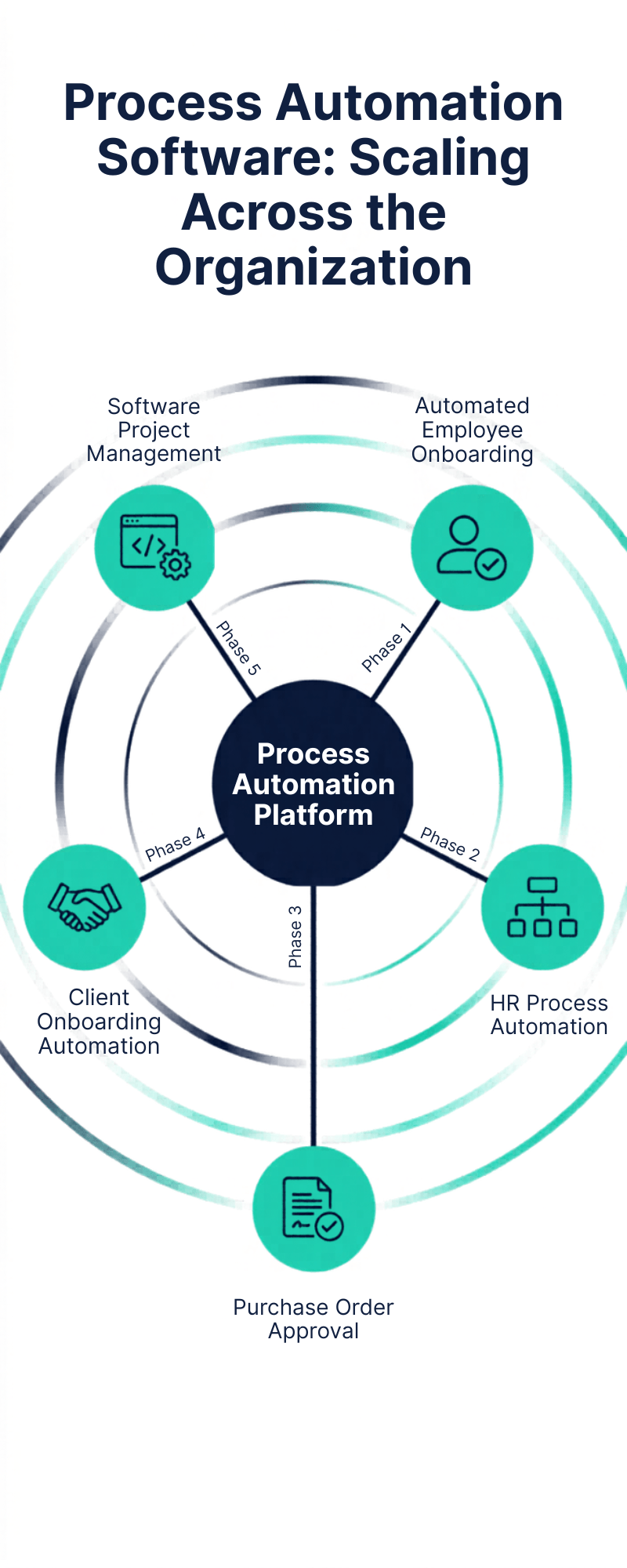
Automated employee onboarding is not just a high-ROI first automation project — it’s a direct test of your automation platform’s cross-functional scalability. Onboarding is inherently multi-departmental: HR triggers the process, IT provisions the systems, finance configures payroll, compliance routes the documentation, and the manager receives the scheduling and briefing tasks. Each of these is a different team, using different systems, with different SLA requirements.
A platform that can orchestrate this cross-functional sequence reliably — triggering each department’s workflow automatically, tracking completion status in real time, escalating missed SLAs without manual intervention, and logging every action for compliance — has proven its scalability in one of the most demanding coordination environments any organization faces. If the process automation software can handle automated employee onboarding at scale, it can handle almost any cross-functional workflow the business needs.
HR process automation then naturally extends: leave approval and balance management, performance review cycle orchestration, offboarding and asset recovery, compliance training assignment and tracking, and salary change approval chains — all running on the same automation platform, managed by the same operations team, with the same governance model. This is what scalable automation programs look like in practice.
Automated Purchase Order Approval: Scaling Financial Governance
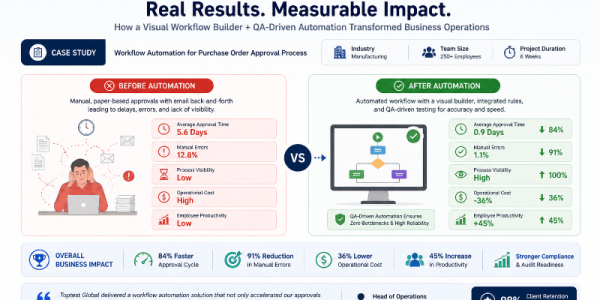
As organizations grow, automated purchase order approval workflows face compounding complexity: more spend categories, more cost centers, more approval tiers, more vendors, and more compliance requirements. Manual email-based approval chains that worked for 50 purchase orders a month become operationally unsustainable at 500 — and carry escalating audit risk as spend volumes increase.
A scalable process automation software deployment handles this complexity through a combination of a robust business rules engine (managing the conditional routing logic), real-time ERP integration (validating budget availability before routing), and automated SLA management (escalating overdue approvals without manual chasing). The workflow adapts to organizational complexity through rule configuration rather than workflow rebuilds — making it as manageable at 5,000 purchase orders per month as it was at 50.
Client Onboarding Automation: Scaling Service Delivery Without Scaling Headcount
Client onboarding automation is the scalability imperative for professional services, SaaS, fintech, and consulting firms that need to grow their client base without proportionally growing their operational headcount. A manual client onboarding process is a direct headcount constraint: each new client requires the same manual coordination hours regardless of how many clients you already have.
With the right process automation software, client onboarding becomes a structured, reproducible system: KYC/AML document collection and routing, CRM record creation and stakeholder assignment, contract generation and e-signature sequencing, resource provisioning, and welcome communication sequences — all executing automatically from a single trigger, tracked with real-time visibility, and logged for compliance. The process quality doesn’t degrade as client volume grows; it remains consistent because it’s governed by the automation platform rather than individual human judgment.
Process Automation in Software Project Management: Scaling Engineering Delivery
Process automation in software project management is the use case where Toptest Global’s cross-functional expertise — spanning workflow automation and software QA automation — delivers the most compounding value. Software delivery workflows are among the highest-frequency, most repetitive process environments in any technology organization: sprint ceremonies, code review routing, automated test execution triggers, defect escalation workflows, release approval chains, deployment notification sequences, and post-deployment validation checks.
Automating these workflows eliminates the coordination overhead that fragments engineering team focus across every sprint. When combined with automated QA testing software — continuous test execution, defect routing, and regression validation built into the delivery pipeline — the result is an engineering delivery process that scales in throughput without requiring proportional increases in coordination effort or manual quality gatekeeping.
QA-Driven Automation: The Non-Negotiable Foundation of Scalable Process Automation Software
Scalable systems require reliable systems. And reliable automation requires QA discipline that most process automation software deployments ignore until something breaks at production scale.
The operational reality: as automation programs scale — more processes, more integrations, more rule complexity, more transaction volume — the surface area for failure grows proportionally. Every new workflow is a new failure surface. Every integration update is a potential breaking change. Every rule modification is a regression risk. Without a systematic QA approach embedded in the automation program itself, scale amplifies fragility rather than reliability.
This is the foundational principle behind Toptest Global’s QA-driven workflow automation model: treating every automated workflow as a production software artifact that requires the same testing discipline as any other system that your business depends on.
The QA-Driven Automation Framework for Scalable Systems
In every process automation software deployment we deliver, QA is not a phase — it’s a continuous practice embedded from the first workflow design session through every subsequent change in production:
- Pre-deployment scenario testing: Every workflow is tested against a comprehensive scenario library — happy path, edge cases, exception paths, failure states, and boundary conditions — before any production transaction runs through it. Test coverage is derived directly from the BPMN process map, ensuring structural completeness rather than ad hoc spot-checking
- Integration contract testing: Every API connection is tested independently against its contract — expected inputs, outputs, error responses, and latency thresholds — before the workflow that consumes it is validated end-to-end
- Business rules regression testing: Every rule change triggers an automated regression suite that validates the behavior of every workflow that consumes the modified rule — catching unintended side effects before they reach production
- Load and performance validation: Every process automation software deployment is load-tested at 2× expected peak volume before go-live — validating that the execution engine, integration layer, and business rules engine all perform within acceptable thresholds under realistic stress conditions
- Playwright automation for UI-layer validation: For every web-facing workflow component — approval portals, self-service dashboards, client-facing onboarding interfaces — Playwright test suites run after every deployment to validate that UI behavior is correct across all supported browsers. A broken approval button doesn’t just affect one user — it stalls every pending approval in that queue until it’s detected and fixed
Playwright automation — Microsoft’s enterprise-grade end-to-end testing framework — is one of the most powerful tools in our QA stack precisely because it tests automation at the layer where humans interact with it. At scale, silent UI failures in web-based workflow components are among the most impactful failure modes — high blast radius, low immediate visibility, and disproportionate downstream effect on process throughput.
This complete QA discipline is what zero-bottleneck automation actually means: not just workflows that run, but workflows that are continuously proven to run correctly — at production volume, after every change, with full audit visibility.
For the operational framework behind zero-bottleneck automation, see The Ultimate Guide to Automate Workflows for Zero Bottlenecks.
Implementation Roadmap: Scaling Your Process Automation Software Program in 4 Phases
Scaling a process automation software program from a single pilot process to an organization-wide automation capability is not an event — it’s a phased program that requires deliberate sequencing, governance investment, and compounding discipline at each stage. Here is the four-phase roadmap we use to guide clients from first automation to scaled automation program.
Phase 1: Foundation — One Process, Done Right
The first phase of any scalable automation program is not about scope — it’s about standards. Select one high-volume, rules-based process with clear before/after metrics. Map it in BPMN. Build it in your chosen process automation software platform with full QA integration. Define your monitoring thresholds. Deploy it with governance protocols in place.
The goal of Phase 1 is not just a live automated process — it’s a deployment methodology that can be replicated. The BPMN-to-automation workflow, the QA test harness, the monitoring configuration, and the change governance protocol established in Phase 1 become the templates for every subsequent automation. This is what makes Phase 1 investment compound: you’re building the factory, not just the first product.
Ideal Phase 1 candidates: Automated employee onboarding, automated leave approval, or automated purchase order approval workflows — high volume, clear rules, measurable cycle time reduction, cross-departmental visibility.
Phase 2: Expansion — Adjacent Processes, Same Governance Model
Phase 2 expands the automation program to adjacent processes using the methodology established in Phase 1. Adjacent means processes that share integration dependencies or process owners with the Phase 1 deployment — minimizing the incremental work required to add them. If Phase 1 automated employee onboarding, Phase 2 might add offboarding, leave management, and performance review cycles — all using the same HRIS integration, the same governance model, and the same QA framework.
The compounding effect of using established integration connections and governance templates means each Phase 2 automation takes significantly less time to deliver than the Phase 1 process — even if it’s more complex. This is the scalability dividend of building the foundation correctly in Phase 1.
Phase 3: Cross-Functional Integration — Breaking Departmental Silos
Phase 3 is where process automation software programs deliver their highest strategic value: cross-functional workflows that couldn’t be automated at all without the integration foundation established in Phases 1 and 2. Client onboarding automation that spans sales, legal, finance, and operations. New product launch workflows that coordinate marketing, engineering, compliance, and customer success. Cross-functional project delivery workflows that integrate JIRA, Slack, HR systems, and finance platforms into a single orchestrated process.
These cross-functional automations are the ones that produce the most visible organizational impact — because they eliminate the coordination overhead that no single department can solve alone, and they make process delays visible across the organization for the first time.
Phase 4: Intelligence — Continuous Improvement and Agentic Process Automation Software
Phase 4 introduces process intelligence capabilities: using the monitoring data generated by your running process automation software to identify optimization opportunities, predict bottlenecks before they develop, and — increasingly in 2026 — deploy AI agents that handle exception routing and process adaptation without requiring explicit rule configuration for every scenario.
The foundation for Phase 4 is the data quality established in Phases 1–3: reliable process logs, consistent data structures, and clean integration histories are the prerequisites for any meaningful process intelligence layer. Organizations that skip governance in early phases find their Phase 4 ambitions constrained by data they can’t trust.
Measuring Scalable Automation: The KPIs That Prove Process Automation Software ROI
Scalable process automation software programs are measurable programs — and measurement is what enables continuous improvement, justifies further investment, and demonstrates organizational value to leadership. These are the KPIs that matter most across the four phases of a scaling automation program:
| KPI Category | Metric | Typical Benchmark |
|---|---|---|
| Process efficiency | End-to-end cycle time (automated vs. manual) | 60–80% reduction |
| Data quality | Manual error rate reduction | 85–95% reduction |
| Automation reliability | Straight-through processing rate | >90% of instances complete without manual intervention |
| SLA performance | SLA compliance rate across all automated processes | >95% within defined SLA windows |
| Operational cost | FTE hours reallocated from manual coordination | 30–50% cost reduction for automated categories |
| Program scale | Number of automated processes and monthly transaction volume | Track quarterly; 20–40% growth per phase |
| QA health | Production error rate and regression detection speed | <1% production error rate; regressions caught pre-deployment |
Our 98% client retention rate at Toptest Global reflects consistent delivery against these benchmarks — because we build measurement frameworks into every process automation software deployment from the start, not as a reporting afterthought. Clients who see measurable results expand their automation programs. Clients who can’t measure results don’t.
Conclusion: Process Automation Software Is the Infrastructure of Scalable Organizations
The organizations that scale successfully in 2026 — that grow their client base without proportionally growing their headcount, that add operational complexity without adding coordination failure, that expand into new markets without rebuilding their operational infrastructure from scratch — share a common foundation: process automation software that was selected thoughtfully, deployed with QA discipline, and governed as a production system from the start.
Scalability is not an emergent property of growth. It’s a designed property of systems — and process automation software is the primary tool for designing it intentionally. The right process automation software platform, built on a foundation of BPMN process mapping, genuine no-code capability, a powerful business rules engine, integration resilience, and continuous QA-driven validation, is what transforms an organization’s operational processes from a growth constraint into a competitive advantage. That’s the standard every automation investment should be built to — and that’s the standard Toptest Global delivers across every engagement.
Ready to Build a Scalable Automation System?
Book a Free 45-Minute Automation & QA Audit
Our senior automation strategists will assess your current process landscape, identify your highest-scalability automation opportunities, and map a QA-driven implementation roadmap — at no cost and no obligation.
Frequently Asked Questions About Process Automation Software and Scalable Systems
How does process automation software enable organizational scalability?
Process automation software enables scalability by transforming people-dependent manual processes into system-governed automated workflows that perform consistently regardless of transaction volume, team size, or organizational complexity. Instead of adding headcount to handle growth — which adds coordination overhead and error risk — organizations with mature process automation software deployments absorb increased volume through their automation infrastructure. Cross-functional workflows, approval chains, data integrations, and compliance processes all run at scale without proportional increases in manual labor or management overhead.
What is the difference between a scalable and non-scalable automation platform?
The architectural differences are specific and consequential. Scalable process automation software platforms use stateless execution engines that can be horizontally replicated, asynchronous event-driven processing that handles volume spikes without degradation, integration resilience with fault tolerance and retry logic, process versioning for zero-downtime updates, and multi-environment architecture for structured deployment pipelines. Non-scalable platforms hit capacity ceilings at higher transaction volumes, degrade under integration failures, require downtime for updates, and conflate environments in ways that create governance problems as the program grows.
When should an organization start deploying process automation software?
The right time to deploy process automation software is earlier than most organizations think. The typical inflection point where manual processes begin creating visible operational problems is around 50–100 employees or a similar growth threshold in transaction volume. But the optimal time to start is before that inflection point — when process design is easier, integration complexity is lower, and the cost of building the right automation foundation is a fraction of what it costs to remediate manual workarounds and data inconsistencies after they’ve accumulated at scale.
How do no-code workflow automation tools support scalable programs?
Genuine no-code workflow automation tools remove the engineering bottleneck from automation program expansion. When business operations teams can build, modify, and maintain their own workflows through a visual workflow builder — without developer support — the automation program scales with business need rather than with engineering bandwidth. At scale, with dozens of automated processes across multiple departments, the operational independence that genuine no-code capability provides is the difference between a program that expands continuously and one that stalls in a developer backlog.
Why is QA automation critical for scalable process automation software programs?
As automation programs scale, the surface area for failure grows proportionally. More processes, more integration dependencies, more business rules, and higher transaction volumes all increase the complexity that QA must manage. Without systematic QA — pre-deployment scenario testing, integration validation, business rules regression testing, and UI-layer Playwright automation — scaling an automation program means scaling the potential blast radius of undetected failures. QA-driven automation is the discipline that makes the reliability of a single well-tested workflow extend to a portfolio of dozens of workflows running at production volume.
What is the first process I should automate to build a scalable automation foundation?
The ideal first automation is a high-volume, rules-based process with clear before/after metrics and cross-departmental visibility. Automated employee onboarding and automated purchase order approval are consistently the strongest starting points — they have high transaction volume, clear conditional logic, measurable cycle time improvements, and visibility across multiple departments that makes the results undeniable to leadership. More importantly, both processes require the integration foundation (HRIS, ERP, finance tools) and governance discipline (BPMN maps, QA test suites, monitoring thresholds) that will serve as the template for every subsequent automation in the program.