
Most enterprise leaders assume that replacing legacy software or migrating data to the cloud constitutes the core role of digital transformation. It does not. That assumption is precisely why so many large-scale initiatives stall within 18 months of launch.
The true role of digital transformation is a fundamental reimagining of how an organization creates value, serves customers, and competes in its market. It requires rethinking processes, culture, and technology simultaneously.
For IT managers and enterprise decision-makers, understanding the role of digital transformation is not academic. It is the difference between incremental improvement and genuine competitive advantage. This article clarifies the true role of digital transformation in modern business ecosystems.
Based on our experience delivering 100+ projects, we observe that leveraging the role of digital transformation properly is crucial. You can explore our guide to automate workflows to see these principles in action and discover what it takes to make it work across different industries.
Key Takeaways
| Focus Area | Core Insight |
| Beyond Technology | True role of digital transformation involves people, processes, and culture as much as technology. |
| Efficiency Through Automation | Process automation and digital tools significantly improve business efficiency and decision-making. |
| Customization is Critical | Industry-specific challenges and compliance demands require highly tailored digital strategies. |
| Overcoming Resistance | Leadership buy-in and communication are vital to conquering transformation hurdles. |
| Expert Support Matters | Partnering with specialized providers accelerates and derisks your technology deployment. |
What the Role of Digital Transformation Really Means
The terms digitization, digitalization, and the role of digital transformation are often used interchangeably. They are not the same thing, and confusing them leads to misallocated budgets and failed initiatives.
Digitization is the simple process of converting analog information into digital formats. Scanning paper invoices into PDFs is a standard example of digitization.
Digitalization takes that a step further by using digital data to improve existing processes. Automating invoice approval workflows using scanned data is digitalization.
The role of digital transformation, however, is the broadest and most strategic of the three. As Salesforce defines it, the role of digital transformation goes beyond technology adoption to completely change how organizations operate and deliver value.
This distinction matters enormously at the enterprise scale. An organization can digitize every document it owns and still operate with the same inefficiencies, silos, and slow decision cycles it always had.
The true role of digital transformation requires changing the underlying logic of how work gets done. Several forces are accelerating the urgency of this shift. Organizations must recognize the role of digital transformation in addressing these market dynamics:
-
Rising customer expectations: Enterprise buyers and end consumers alike now expect real-time responses and seamless digital interactions.
-
Market agility demands: Competitive markets punish slow-moving organizations that cannot pivot quickly to capture new trends.
-
Operational efficiency pressure: Margin compression pushes enterprises to optimize workflows and automate processes at scale.
The core components of the role of digital transformation include process automation, data integration, platform modernization, and cultural change management. Of these, cultural change is consistently underestimated. Technology is the enabler. People and process are the foundation.
How the Role of Digital Transformation Enhances Operational Efficiency
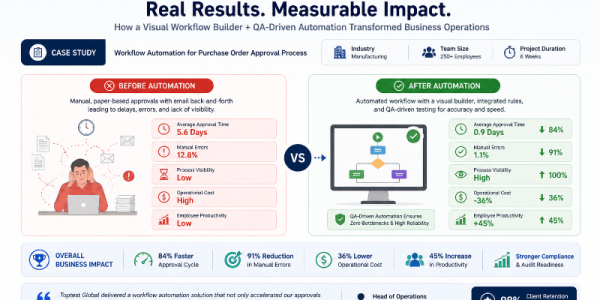
Operational efficiency is where the role of digital transformation produces its most tangible and measurable results. When processes are redesigned around digital tools rather than simply supported by them, the gains in speed, accuracy, and cost are substantial.
Consider a typical enterprise procurement cycle. In a manual environment, purchase requests move through email chains, require physical signatures, and depend on individual employees tracking status in spreadsheets. A single approval delay can stall an entire supply chain.
When that same process is redesigned digitally, requests are routed automatically based on predefined rules. Approvals happen via mobile interfaces, and real-time dashboards show bottlenecks before they become crises.
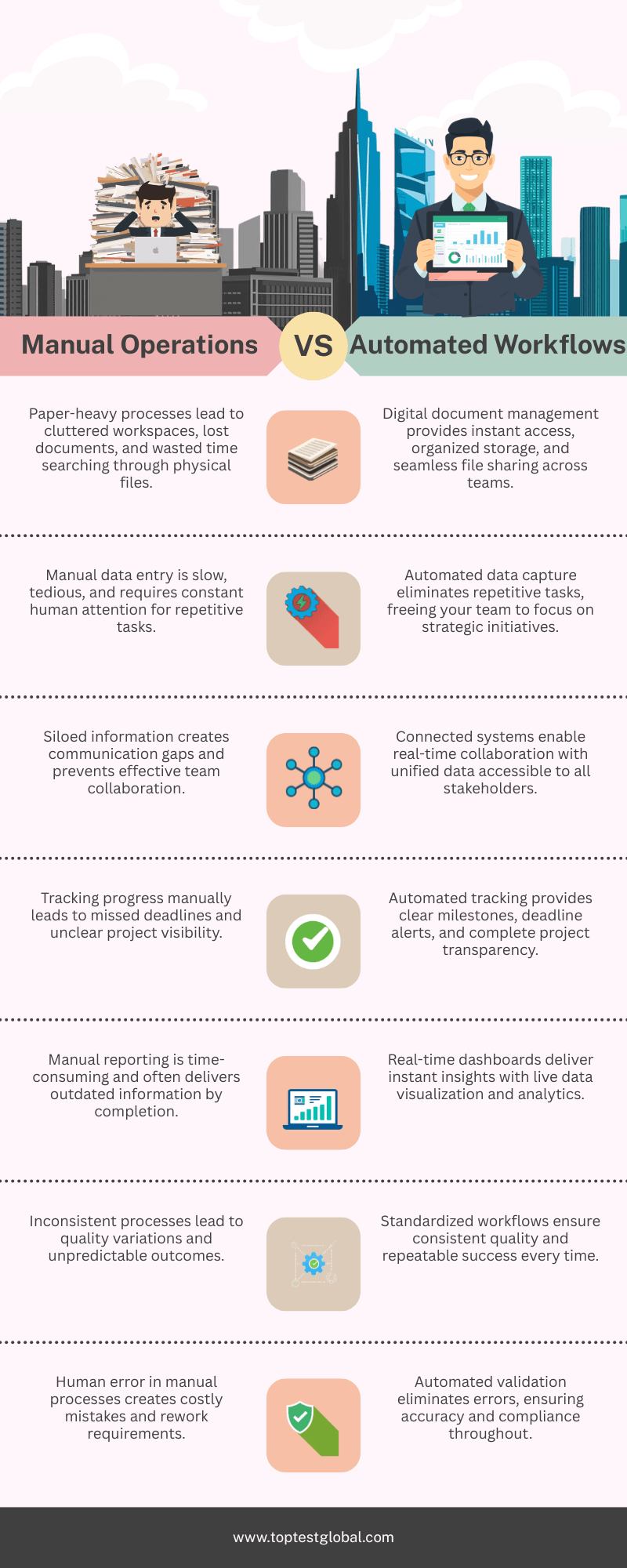
The performance gap between manual and automated workflows is not marginal. Enterprises utilizing the role of digital transformation see significant improvements in productivity and cost savings.
| Process Area | Manual Workflow | Automated Workflow |
| Invoice processing | 5 to 10 days average | Under 24 hours |
| Compliance reporting | Weekly manual compilation | Real-time dashboards |
| Customer onboarding | 7 to 14 days | 1 to 3 days |
| IT incident resolution | 48 to 72 hours | Under 4 hours |
| Data reconciliation | Monthly batch process | Continuous sync |
Beyond speed, accuracy improves dramatically across large transaction volumes. Human data entry carries an error rate that compounds over time. Understanding the role of digital transformation helps enterprises eliminate these entire categories of error.
Key efficiency improvements enterprises consistently report after implementing new technology include:
-
Reduced headcount dependency for routine, rules-based tasks.
-
Faster time-to-market for new products and services.
-
Improved resource allocation through real-time data visibility.
-
Lower operational costs through process consolidation.
Exploring real-world automation results across industries reveals a consistent pattern. Organizations that align technology investments with specific business outcomes outperform those that adopt technology for its own sake.
Pro Tip: Before selecting any automation platform, map your current process end-to-end and identify the three highest-friction points. Technology should solve those specific problems first.
The efficiency case for the role of digital transformation is well established. The more nuanced challenge is ensuring that efficiency gains are sustainable and scale across the enterprise, not just within isolated pilot projects.
Customizing the Role of Digital Transformation for Industry-Specific Needs
A financial services firm and a mid-size manufacturer face fundamentally different regulatory environments, customer relationships, and operational rhythms. Applying the same framework to both is not just inefficient. It is a recipe for failure.
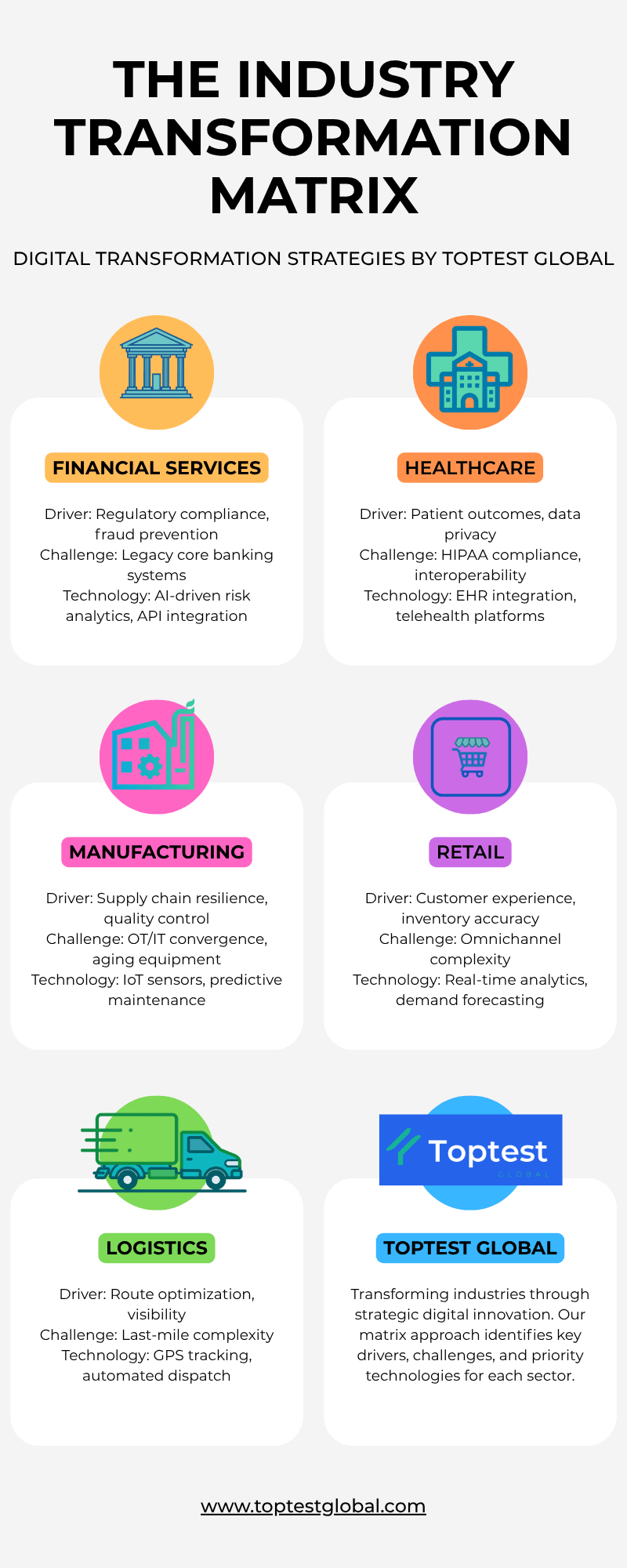
Understanding these differences is essential for building a transformation plan that actually delivers results. The role of digital transformation varies depending on operational and regulatory factors.
| Industry | Primary Transformation Driver | Key Challenge | Priority Technology |
| Financial services | Regulatory compliance, fraud prevention | Legacy core banking systems | AI-driven risk analytics, API integration |
| Healthcare | Patient outcomes, data privacy | HIPAA compliance, interoperability | EHR integration, telehealth platforms |
| Manufacturing | Supply chain resilience, quality control | OT/IT convergence, aging equipment | IoT sensors, predictive maintenance |
| Retail | Customer experience, inventory accuracy | Omnichannel complexity | Real-time analytics, demand forecasting |
| Logistics | Route optimization, visibility | Last-mile complexity | GPS tracking, automated dispatch |
In financial services, the role of digital transformation must navigate strict regulatory frameworks. Any new system touching customer data or transaction processing requires rigorous audit trails, encryption standards, and often explicit regulatory approval before deployment. The transformation roadmap must account for these constraints from the outset, not as an afterthought.
Healthcare organizations face a dual mandate: improve patient outcomes while protecting sensitive data under frameworks like HIPAA. Legacy electronic health record systems often resist integration with modern platforms, creating data silos that undermine clinical decision-making. Successful transformation in healthcare typically requires a phased approach that prioritizes interoperability and secure data sharing.
Manufacturing presents a different challenge: the convergence of operational technology (OT) and information technology (IT). Factory floor equipment often runs on decades-old proprietary systems that were never designed to communicate with modern cloud platforms. Bridging that gap requires specialized integration expertise and careful change management to avoid production disruptions.
Building a tailored transformation plan requires a structured, multi-step approach:
-
Conduct an industry-specific maturity assessment: Benchmark your current digital capabilities against sector peers, not generic enterprise standards.
-
Map regulatory and compliance requirements first: Identify every constraint that will shape your technology choices before evaluating vendors.
-
Audit legacy system integration complexity: Understand which existing systems must be preserved, which can be replaced, and which require middleware bridges.
-
Define industry-relevant success metrics: Customer wait times matter in healthcare, while throughput rates matter in manufacturing. Use the right KPIs.
-
Sequence initiatives by risk and impact: Start with high-impact, lower-risk processes to build momentum and organizational confidence.
The pattern that emerges across case studies is consistent: the organizations that succeed treat their industry context as a design input, not an obstacle.
Overcoming Common Challenges in the Role of Digital Transformation
Even well-funded, strategically sound transformation initiatives fail. The reasons are rarely technical. They are almost always organizational.
Over 70% of digital transformation efforts fail, often due to cultural inertia or a lack of clear vision. That statistic should give every enterprise leader pause. It means the majority of organizations investing in transformation are not achieving the operational outcomes they expected.
The most common barriers include:
-
Change resistance at the employee level: When frontline workers perceive digital tools as threats to their roles rather than support for their work, adoption rates collapse. Training programs that focus on compliance rather than empowerment make this worse.
-
Misaligned leadership: When the CIO pursues a technology-driven roadmap while the COO prioritizes cost reduction and the CMO focuses on customer experience, transformation initiatives become fragmented.
-
Legacy system inertia: Core systems that have accumulated years of customization and workarounds are expensive and risky to replace. Many organizations underestimate this complexity and encounter budget overruns.
-
Talent gaps: Digital transformation requires skills that many enterprises do not have internally. Data engineering, cloud architecture, and change management expertise are consistently in short supply.
Addressing these barriers requires a deliberate strategy. Communication must be continuous and specific, not a single launch announcement. Leaders should articulate not just what is changing, but why it matters for each team’s daily work.
Pro Tip: Identify two or three early wins that are visible to frontline employees within the first 90 days of any transformation initiative. Small, tangible improvements build the trust and momentum that sustain longer-term change.
The technical components of transformation are solvable with sufficient expertise and budget. The human components require sustained leadership attention, consistent communication, and a genuine commitment to bringing people along rather than leaving them behind.
Why the Role of Digital Transformation Succeeds Only with Genuine Cultural Buy-In
Here is the uncomfortable truth that most transformation consultants understate: technology is the easy part. Selecting the right automation platform, integrating APIs, and migrating data are complex engineering challenges, but they are solvable. Culture is not solvable with a project plan.
We have observed, across enterprise engagements in multiple sectors, that the organizations which sustain transformation share one characteristic that has nothing to do with their technology stack. They have leadership teams that genuinely believe in the change they are asking their people to make. Not as a cost-reduction exercise. Not as a competitive necessity framed in boardroom language. But as a real commitment to working differently.
This sounds straightforward. It is not. Most executive teams support digital transformation in principle while continuing to reward behaviors that contradict it. Managers who protect their team’s manual processes because automation threatens headcount. Finance leaders who cut the change management budget because it is harder to quantify than software licenses. These contradictions are visible to every employee watching from below.
The practical implication is that transformation roadmaps must include explicit cultural milestones alongside technical ones. Who is accountable for adoption rates? How are middle managers being supported through the transition? What happens when a pilot fails?
Organizations that treat these as soft questions pay for it in hard outcomes. Sustaining transformation over a multi-year horizon requires building internal capability, not just deploying external tools. Understanding how sustaining transformation becomes a repeatable organizational competency is the real differentiator between enterprises that transform once and those that build continuous improvement into their operating model.
Partner with Experts for the Role of Digital Transformation
Understanding the strategic, operational, and cultural dimensions of the role of digital transformation is the first step. Executing it with precision is where most enterprises need experienced partners.
At Toptest Global, we work with enterprise clients to design and implement transformation strategies that are grounded in your specific industry context, operational realities, and business objectives. Our capabilities span custom software solutions built for your exact workflow requirements, intelligent workflow automation services that deliver measurable efficiency gains, and rigorous quality assurance to ensure every system performs reliably at scale.
We do not offer generic frameworks. We build tailored digital ecosystems that reduce operational bottlenecks and accelerate delivery. If you are ready to move from strategy to execution, Toptest Global experts are ready to support your next initiative with the technical depth and consulting experience your transformation requires.
Frequently Asked Questions
-
What is the biggest barrier to successful digital transformation? Cultural resistance and lack of leadership alignment are the primary barriers, consistently outweighing technical limitations. Over 70% of transformations fail due to culture and leadership challenges rather than technology shortcomings.
-
How can enterprises measure digital transformation ROI? ROI is best tracked through operational efficiency gains, cost reduction, improved customer satisfaction scores, and faster decision-making cycles. The role of digital transformation is to boost enterprise efficiency, productivity, and long-term competitiveness.
-
Why should digital transformation strategies be customized by industry? Each industry faces unique regulatory, operational, and customer challenges that generic frameworks cannot address. Industry-specific needs drive fundamentally different digital transformation approaches, timelines, and technology priorities.
-
What’s the difference between digital transformation and digitization? Digitization converts paper-based or analog processes into digital formats, while digital transformation redefines entire business models and operating logic using technology. Understanding this distinction is central to realizing the role of digital transformation.