Workflow automation for universities has evolved from a back-office convenience into a strategic imperative. In our 100+ automation and QA projects across Singapore, Hanoi, and global academic institutions, we’ve witnessed a consistent reality: universities that cling to manual, paper-driven administrative processes hemorrhage faculty time, student satisfaction, and institutional agility.
At Toptest Global, we don’t merely deploy process automation software and disappear. We engineer QA-driven workflow automation systems that undergo rigorous validation with automated QA testing software before they ever process a real student record. This is why our academic clients achieve zero-bottleneck automation — and why we sustain a 98% client retention rate across our cross-border delivery centers in Singapore and Hanoi.
This guide reveals how workflow automation for universities transforms admissions, faculty onboarding, research grant management, and student services. You’ll discover why most education automation initiatives fail without proper quality assurance, and how our QA-first methodology ensures your campus workflows scale from hundreds to tens of thousands of users without breaking.
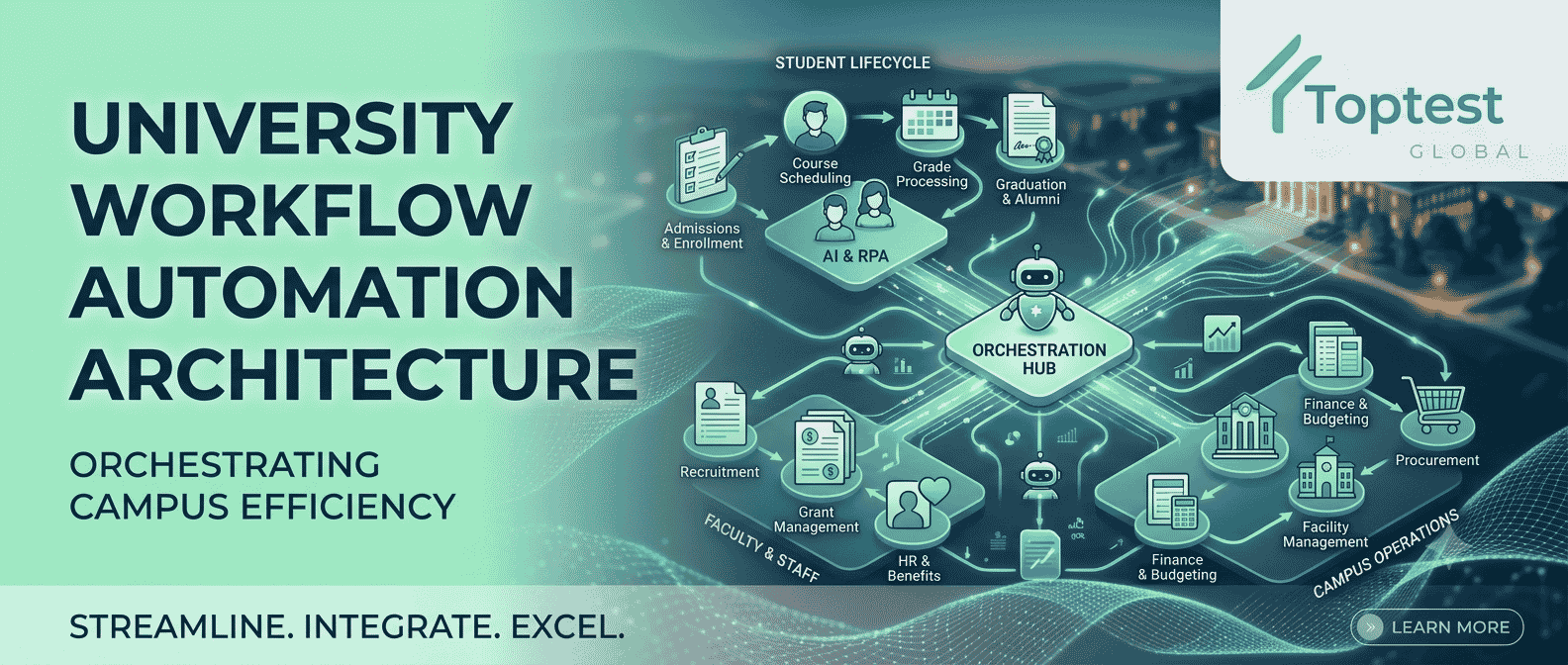
The Hidden Crisis in University Administration
Before exploring solutions, let’s confront what manual processes actually cost modern universities. In our audits at academic institutions across Asia-Pacific and beyond, we consistently find that administrative staff spend 40–50% of their productive hours on repetitive, rule-based tasks that should execute automatically.
These aren’t minor inefficiencies. They’re systemic vulnerabilities:
- Admissions bottlenecks — Manual application review, document verification, and enrollment confirmation stretch decision cycles to 6–8 weeks, causing admitted students to commit to competing institutions.
- Faculty onboarding paralysis — New professors wait 2–4 weeks for system access, office allocation, and course scheduling, delaying research output and teaching effectiveness.
- Research compliance exposure — Grant proposal routing, ethics approval workflows, and expenditure tracking managed through email chains create audit gaps that jeopardize funding.
- Student service fragmentation — Transcript requests, financial aid appeals, and accommodation applications trapped in departmental silos generate frustration and negative NPS scores.
- Scalability ceiling — Every enrollment surge requires proportional administrative hiring when processes remain manual.
The fundamental issue isn’t lack of technology. Universities have invested heavily in Student Information Systems (SIS), Learning Management Systems (LMS), and ERP platforms. The gap is workflow orchestration — connecting these systems into coherent, self-executing processes validated by software QA automation.
That’s where QA-driven workflow automation transforms university operations.
What Is Workflow Automation for Universities? A QA-Driven Definition
Workflow automation for universities is the strategic application of business process automation (BPA) and digital process automation to eliminate manual handoffs, enforce academic business rules, and create self-executing administrative processes across the entire student lifecycle and institutional operations.
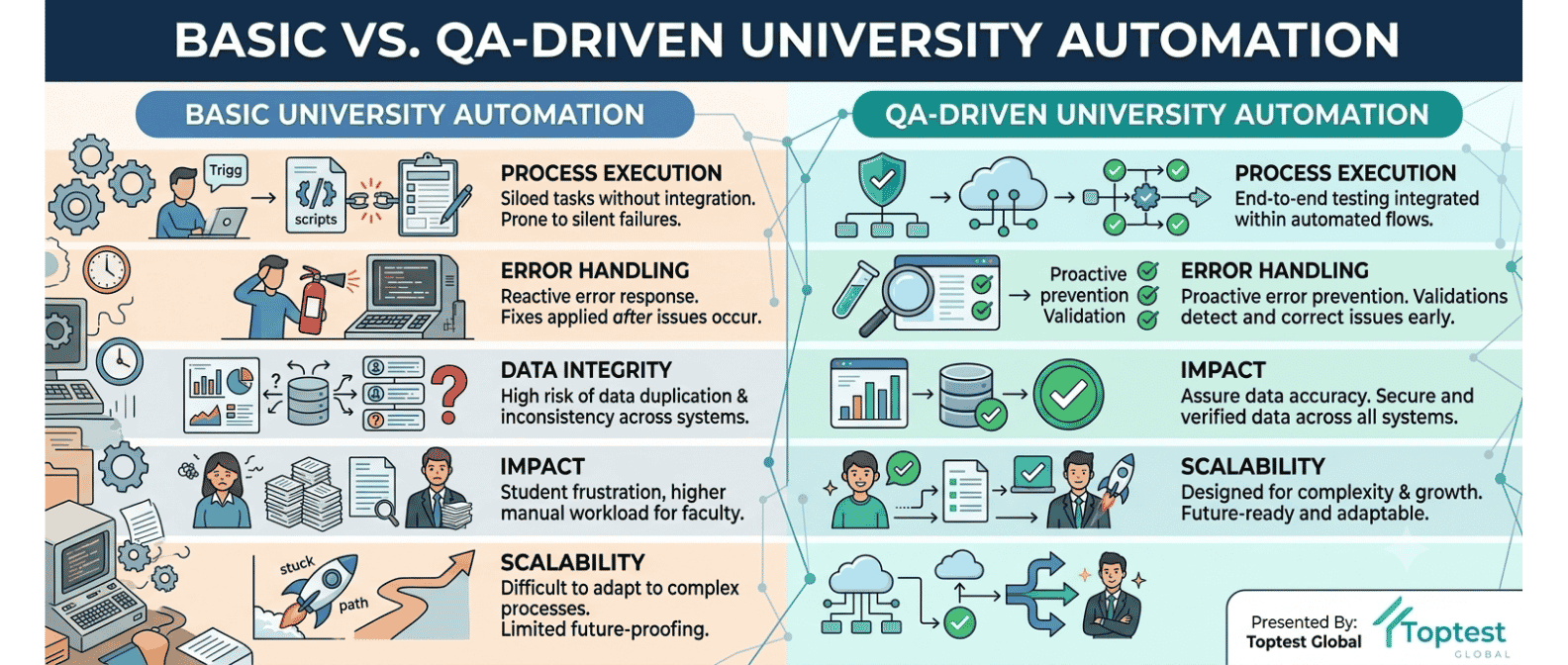
But here’s what distinguishes enterprise-grade university automation from basic task scripting:
| Basic Campus Automation | QA-Driven University Workflow Automation |
|---|---|
| Single-step triggers (e.g., auto-send welcome email) | End-to-end process orchestration with multi-system integration |
| Fixed, hardcoded logic for one department | Business rules engine configurable per faculty, program, and regulatory requirement |
| Deployed without systematic testing | Rigorously validated with automated QA testing software and Playwright automation |
| Collapses during peak periods (enrollment, grading) | Load-tested zero-bottleneck automation architecture |
| Isolated from SIS, LMS, and finance systems | Native n8n integration, API connectivity, and BPMN process mapping |
| High technical debt and maintenance overhead | Continuous monitoring and optimization framework |
At our development centers in Singapore and Hanoi, every workflow automation deployment for academic clients follows this QA-first methodology. We refuse to accept “good enough” when accreditation compliance, student data privacy, and institutional reputation are at stake.
Why Traditional University Automation Fails (And How QA Prevents It)
We’ve been called in to rescue too many “automated” university systems that were fundamentally broken from deployment day. The symptoms follow a predictable pattern:
- Workflows that stall silently during peak load — An admissions approval sits unprocessed because a conditional branch failed, and no alert was triggered.
- Data sync failures between SIS and LMS — Student enrollment records updated in the SIS don’t propagate to course access provisioning, locking out paying students.
- Permission drift across academic years — Faculty access rights become inconsistent as roles change, creating security vulnerabilities.
- Audit trail gaps for accreditation — Critical academic decisions lack timestamped, tamper-proof documentation required by quality assurance agencies.
- Integration fragility — A minor update to the finance system breaks the scholarship disbursement workflow.
These failures share one root cause: automation deployed without software QA automation. When universities treat workflow logic as “IT configuration” rather than “mission-critical code requiring testing,” they guarantee production failures during the moments that matter most.
The Toptest QA-First Deployment Model for Higher Education
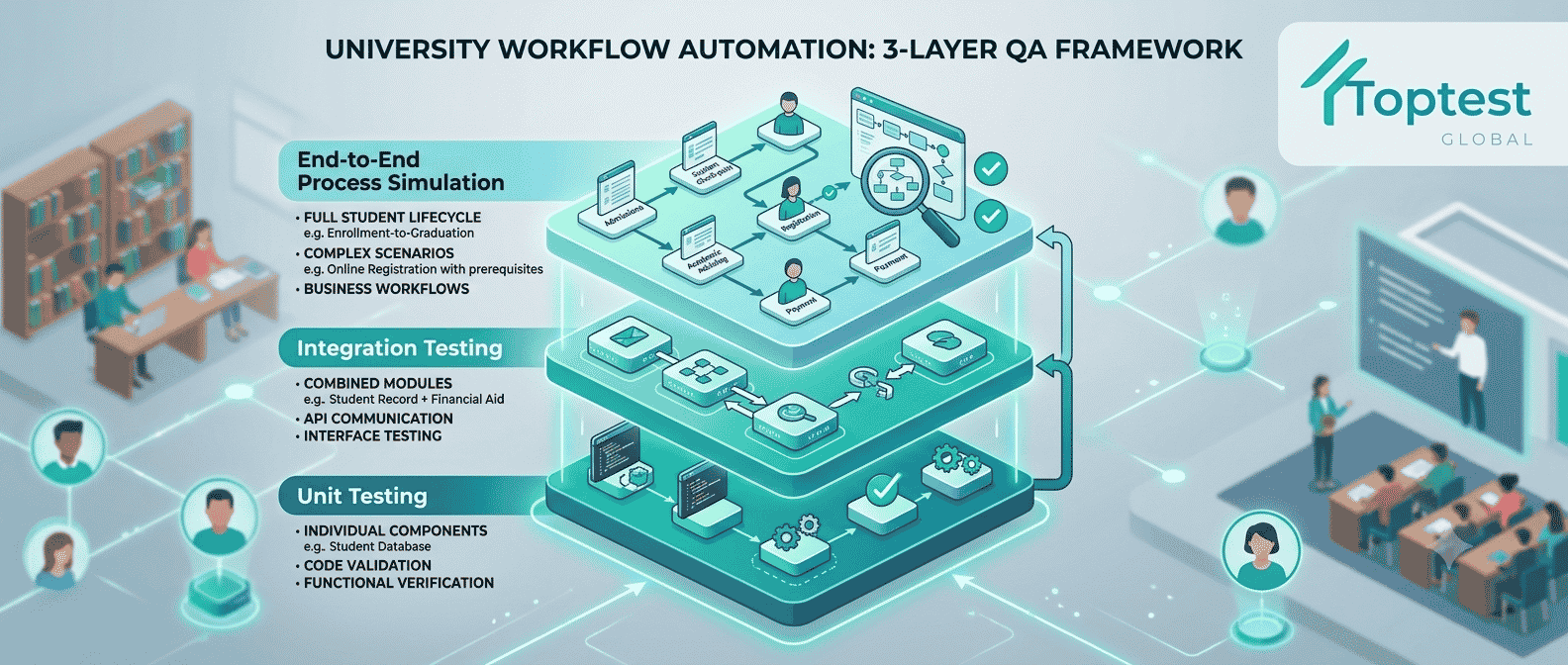
Based on our hands-on experience implementing QA-driven workflow automation for universities across Asia-Pacific, we enforce a three-layer quality gate:
- Unit Testing of Academic Business Rules — Every conditional branch, approval matrix, and escalation trigger is tested in isolation using Playwright automation and custom test frameworks. We simulate scenarios like “international student with conditional offer” and “faculty sabbatical with course reassignment.”
- Integration Testing Across Campus Systems — We validate data flows between your SIS, LMS, finance system, HR platform, and research administration tools before any workflow touches live student data.
- End-to-End Process Simulation Under Load — Complete BPMN process mapping scenarios are executed with synthetic data to confirm zero-bottleneck automation performance during enrollment peaks, grading periods, and graduation workflows.
This is process automation in software project management applied to higher education administration. The same engineering discipline we bring to enterprise software delivery — we bring to your campus operations.
The 6 Critical University Workflows That Demand Automation
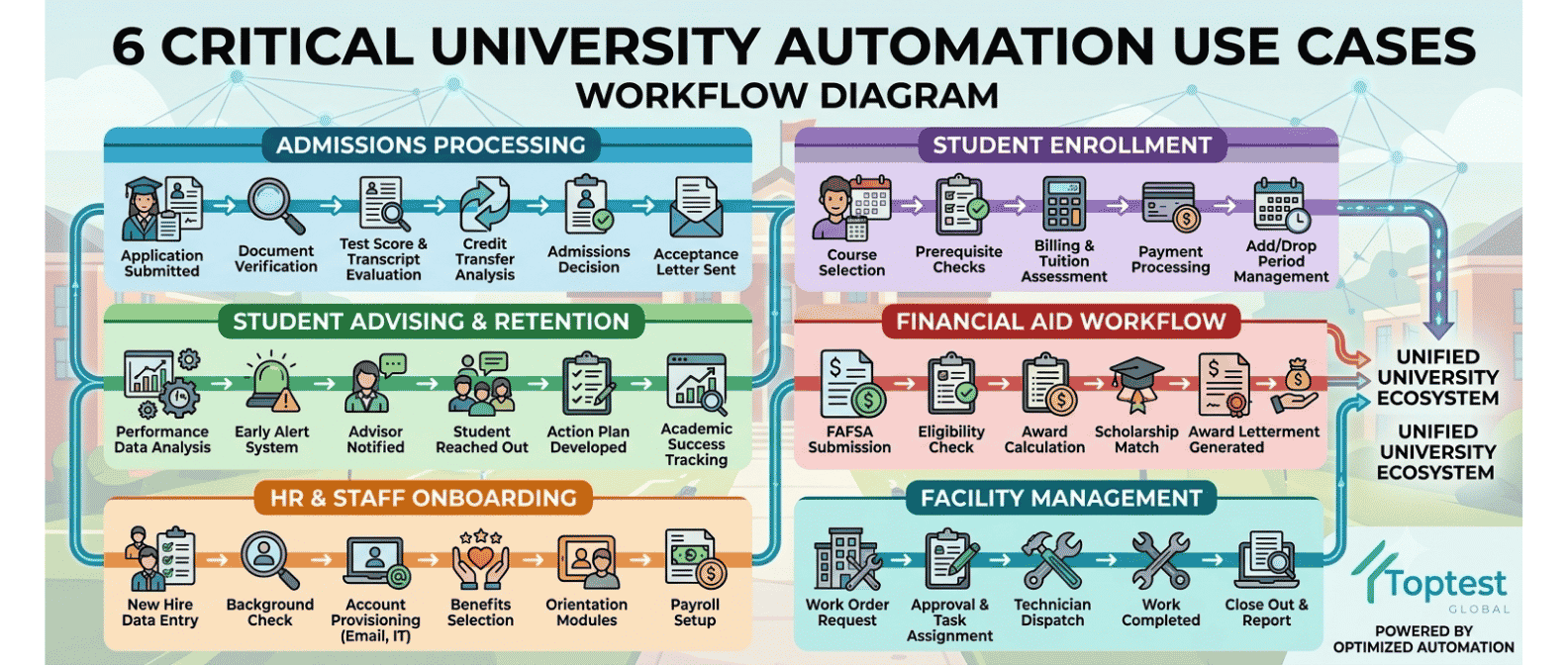
Not all administrative processes deliver equal ROI when automated. In our 100+ projects, these six workflows consistently generate transformative impact for academic institutions:
1. Student Admissions and Enrollment
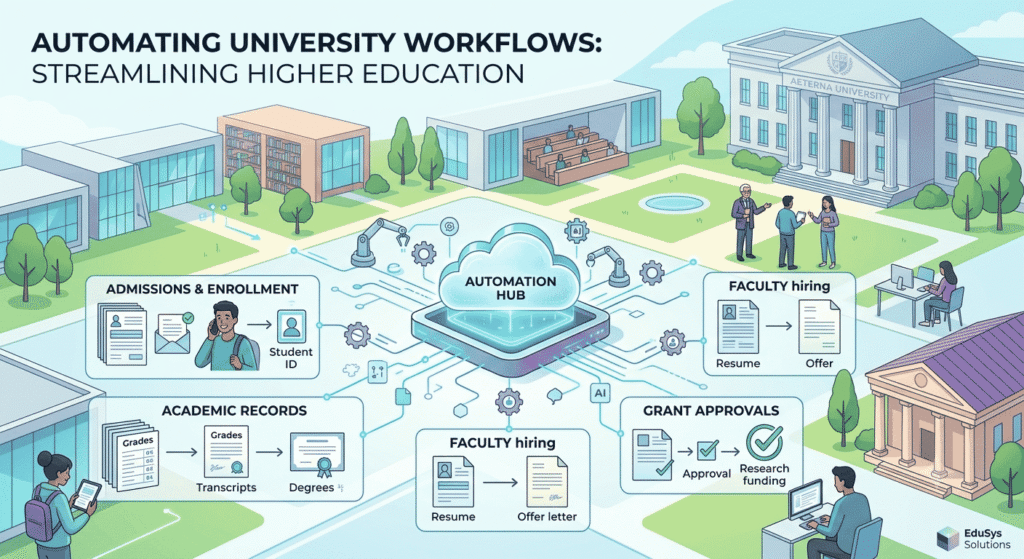
The admissions cycle is the highest-stakes workflow automation for universities use case. A typical manual process involves 20+ touchpoints across admissions officers, academic reviewers, finance, international student services, and IT provisioning.
With a visual workflow builder and proper BPM software, this becomes a seamless digital pipeline:
- Application submission → automatic eligibility pre-screening against program requirements
- Document completeness check → automated notification to applicants with missing materials
- Academic review completion → conditional offer generation with acceptance deadline tracking
- Deposit receipt → enrollment confirmation and SIS record creation
- Visa documentation trigger → international student services workflow activation
- Course registration window opening → automatic LMS access provisioning
- Orientation scheduling → personalized calendar invitation based on program and campus
We’ve implemented this for universities using n8n integration with Banner, Ellucian, Salesforce Education Cloud, and custom SIS platforms — always with Playwright automation end-to-end testing to ensure no admitted student experiences a broken enrollment journey.
2. Faculty and Staff Onboarding
Automated employee onboarding isn’t just for corporate HR. University faculty onboarding involves unique complexity: research lab access, ethics committee registration, grant account setup, course scheduling, and library privileges.
A robust business rules engine can orchestrate these parallel workstreams based on faculty type (tenure-track, adjunct, visiting, research), department, and funding source — eliminating the 3–4 week delays that frustrate new academics and delay research output.
3. Research Grant Administration
Research universities live and die by grant funding. Workflow automation for universities transforms grant management from email chaos into auditable, compliant processes:
- Pre-award: Proposal routing through faculty, department head, research office, and compliance review with automatic deadline escalation
- Award acceptance: Automatic account creation, budget allocation, and reporting schedule generation
- Post-award: Expenditure approval workflows, milestone tracking, and funder report generation
- Closeout: Automatic reconciliation triggers and residual fund disposition
4. Student Financial Services
Financial aid appeals, scholarship disbursement, fee waiver requests, and payment plan applications are high-emotion, high-compliance processes. HR process automation principles — adapted for student financial services — ensure consistent decision-making, transparent status tracking, and complete audit trails.
5. Academic Records and Transcript Services
Transcript requests, degree verification, enrollment certification, and credential evaluation workflows benefit enormously from digital process automation. Integration with blockchain credentialing platforms and third-party verification services creates modern, trustworthy student record management.
6. Accreditation and Quality Assurance Reporting
Perhaps the most strategically critical use case, accreditation workflows require multi-stakeholder input, evidence compilation, and regulatory submission. No-code/low-code workflow automation platforms with BPMN process mapping make these previously “too complex to systematize” processes achievable and repeatable.
Technology Stack Selection for University Workflow Automation
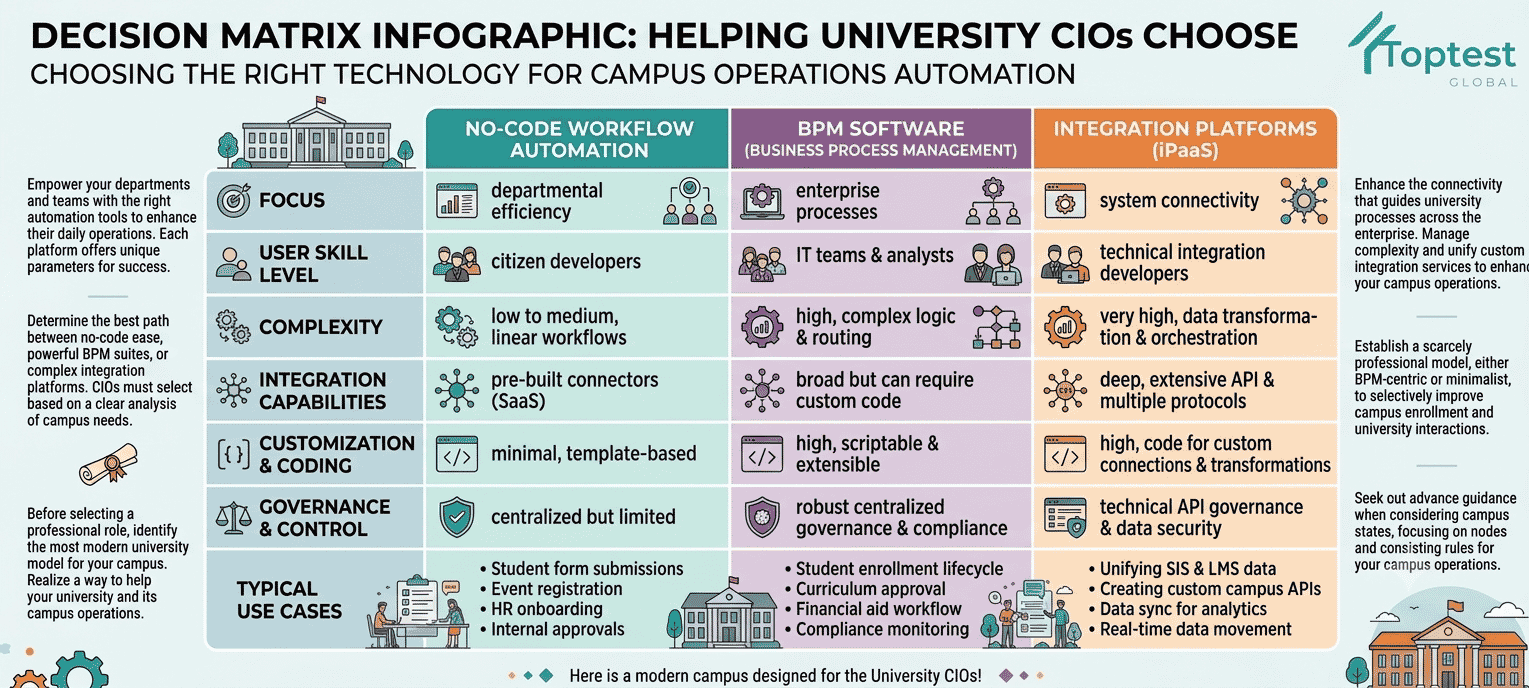
The process automation software landscape for higher education is diverse. Here’s how we guide university CIOs and registrars to make architecturally sound choices:
| Category | Best For | Key Considerations |
|---|---|---|
| No-code/low-code workflow automation | Mid-size universities with lean IT teams | Rapid deployment, visual workflow builder, but requires governance to prevent departmental fragmentation |
| BPM software with BPMN process mapping | Research-intensive universities with complex, regulated processes | Superior audit trails and compliance, longer implementation but enterprise-grade resilience |
| n8n integration platforms | Universities with diverse, best-of-breed system landscapes | Highly flexible, open-source options, requires technical expertise for custom connectors |
| Cflow integration and cloud-native BPM | Institutions prioritizing quick wins and mobile accessibility | Fast time-to-value, strong mobile experience for faculty and students, subscription scalability |
Regardless of platform, our recommendation is absolute: every workflow must pass QA validation before production deployment. Student data integrity and accreditation compliance are non-negotiable.
👉 Explore our detailed evaluation of the best workflow automation software for academic institutions — tested and validated by our QA engineers against real university scenarios.
The Toptest Framework: QA-Driven Workflow Automation for Universities
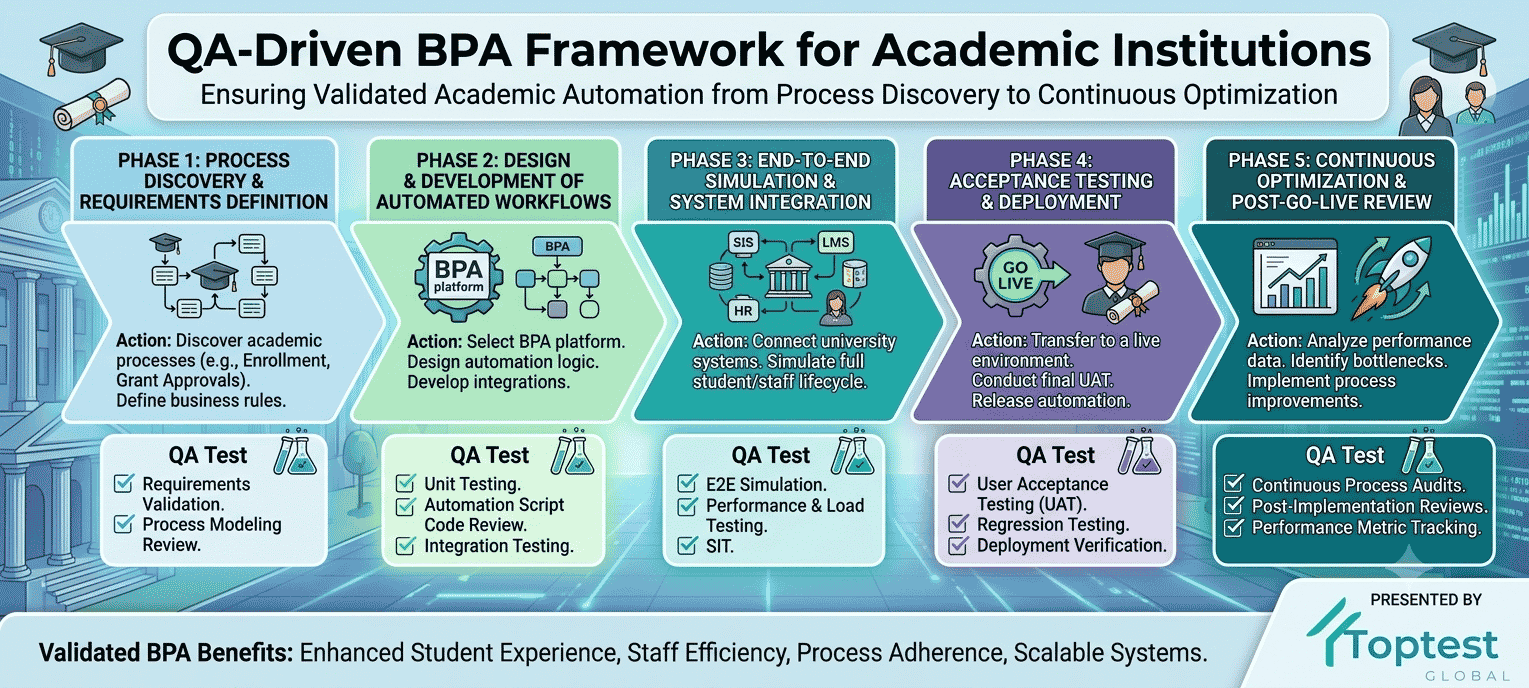
In our 100+ automation and QA projects, we’ve refined a repeatable framework for delivering zero-bottleneck automation in higher education environments. Here’s the methodology we execute at our Singapore and Hanoi delivery centers:
Phase 1: Academic Process Discovery & BPMN Mapping
We begin with BPMN process mapping — not flowchart sketches, but executable process models that serve as the institutional source of truth. This forces clarity on:
- Every academic decision gateway and business rule
- System touchpoints across SIS, LMS, finance, HR, and research platforms
- Exception paths for edge cases (conditional admits, academic probation, leave of absence)
- Regulatory compliance requirements and accreditation evidence points
- SLA definitions for student-facing and internal processes
Phase 2: Workflow Design in Visual Builder
Using visual workflow builder tools, we translate BPMN process mapping into executable workflows. This is where no-code/low-code workflow automation empowers academic stakeholders — registrars, department heads, and student services directors can validate logic without interpreting code.
Phase 3: Automated QA Testing & Validation
This is the Toptest differentiator. Before any workflow processes a real student record:
- Playwright automation tests simulate student, faculty, and administrator interactions across the workflow UI
- API-level integration tests validate data flows between campus systems
- Load testing confirms zero-bottleneck automation performance during enrollment peaks and grading periods
- Security testing validates FERPA compliance, role-based access, and data encryption
- Accessibility testing ensures WCAG 2.1 AA compliance for student-facing interfaces
Phase 4: Staged Deployment & Campus Rollout
We deploy to pilot departments first — typically a single faculty or student service unit — with real-time monitoring of workflow automation performance metrics. Only after validated stability and user acceptance do we proceed to institution-wide rollout.
Phase 5: Continuous Optimization & Academic Cycle Adaptation
Digital process automation in universities must adapt to academic calendars, regulatory changes, and enrollment fluctuations. We establish continuous improvement loops based on:
- Process cycle time metrics (application-to-decision, request-to-resolution)
- Error rates and exception frequency by workflow type
- Student and staff satisfaction scores
- Accreditation audit readiness indicators
- System integration health metrics
Real-World Impact: What QA-Driven Automation Delivers for Universities
University leaders need evidence, not promises. Here are representative outcomes from our academic client engagements:
| Metric | Before Automation | After QA-Driven Automation | Improvement |
|---|---|---|---|
| Average admissions decision time | 6–8 weeks | 10–14 days | 65% faster |
| Faculty onboarding completion | 3–4 weeks | 3–5 days | 80% reduction |
| Student service request resolution | 5–10 business days | Same-day to 48 hours | 75% faster |
| Research grant compliance errors | 8–12% of submissions | <1% of submissions | 90% reduction |
| Accreditation audit preparation | 3–4 months | Continuous readiness | Real-time compliance |
| Administrative cost per enrolled student | Baseline | 35–45% lower | Significant ROI |
These results emerge from combining workflow automation expertise with software QA automation discipline — the Toptest approach to higher education transformation.
Implementation Best Practices for University Workflow Automation
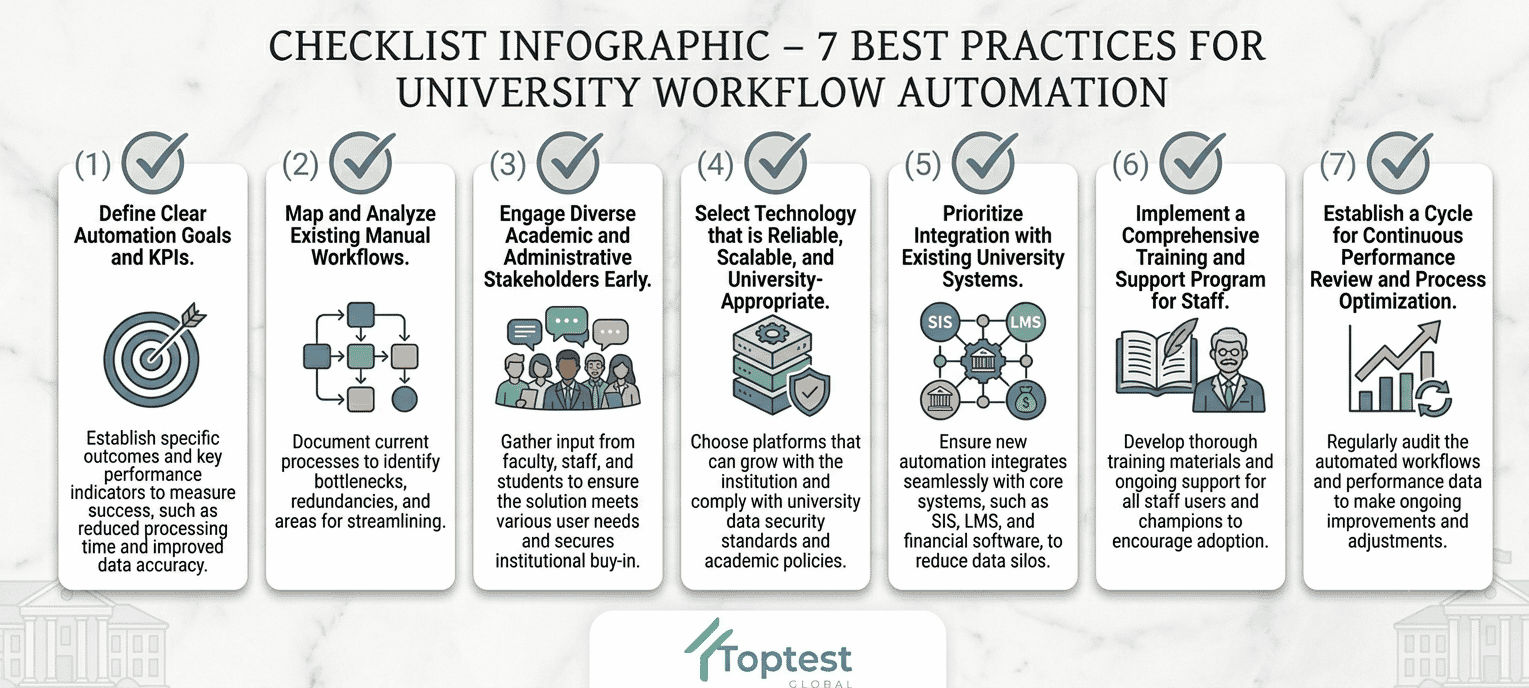
Based on our hands-on experience implementing QA-driven automation across diverse academic environments, these practices separate transformative deployments from expensive disappointments:
Start with High-Impact, Cross-Functional Processes
Student admissions and automated employee onboarding for faculty deliver quick wins that build institutional confidence before tackling complex research administration workflows.
Invest in Data Architecture Before Workflow Design
Universities are notorious for data silos. Clean your student master data, standardize program codes, and resolve identity management inconsistencies before workflow automation deployment. Automating bad data multiplies problems.
Design for Academic Calendar Peaks
Every business rules engine configuration must include load handling for enrollment periods, grading deadlines, and graduation workflows. What performs in July must survive October’s application tsunami.
Validate Accessibility and Internationalization
Student-facing workflows must meet WCAG 2.1 AA standards and support multi-language requirements for international student populations. Our automated QA testing software pipeline includes accessibility and i18n validation.
Test Like Accreditation Depends on It
Because it does. Every workflow automation for universities should have a corresponding test suite. This isn’t overhead — it’s institutional risk management.
Plan for Change Management Across Academic Culture
The most elegant visual workflow builder implementation fails if faculty resist new approval interfaces. Budget for training, change champions in each department, and hypercare support during academic transitions.
Measure and Optimize by Academic Cycle
Define KPIs before launch: time-to-decision, error rate, student satisfaction, staff productivity. Review per semester. Optimize annually.
Why Universities Choose Toptest Global for Workflow Automation
You have options for workflow automation partners. Here’s why university CIOs, registrars, and provosts choose Toptest Global:
- 100+ automation and QA projects delivered — We bring proven academic patterns, not experiments.
- QA-Driven by default — Every workflow is validated with Playwright automation and automated QA testing software before production. No exceptions, no excuses.
- Cross-border delivery excellence — Singapore strategic oversight + Hanoi development center execution for optimal cost-quality balance.
- 98% client retention rate — Our university partners stay because our automation works through enrollment peaks, accreditation cycles, and system migrations.
- Deep higher education domain expertise — From student admissions to research grant compliance, we understand the regulatory, cultural, and technical nuances of academic operations.
Our workflow automation services are designed for institutions that cannot afford administrative failure — research-intensive universities with compliance obligations, growing institutions with rapid enrollment expansion, and academic consortia requiring standardized processes across campuses.
We also bring specialized expertise in Playwright automation for testing complex SIS-LMS integrations, and our custom software development team builds bespoke connectors when off-the-shelf n8n integration isn’t sufficient for legacy academic systems.
Frequently Asked Questions
What is workflow automation for universities?
Workflow automation for universities is the strategic application of process automation software and digital process automation to eliminate manual handoffs, enforce academic business rules, and create self-executing administrative processes across admissions, student services, faculty management, and research administration. At Toptest Global, we implement QA-driven workflow automation that is rigorously tested with automated QA testing software before deployment.
How does QA-driven automation differ from standard university automation?
Standard workflow automation focuses on rapid deployment. QA-driven workflow automation adds a mandatory quality assurance layer — using Playwright automation and comprehensive test frameworks — to validate every workflow path, integration point, and exception handler before go-live. This prevents the silent failures, data sync issues, and peak-load collapses that plague traditional education technology deployments.
Which university processes should we automate first?
We recommend starting with student admissions and automated employee onboarding for faculty. These are high-volume, well-defined processes that deliver immediate ROI and build institutional confidence. Once validated, expand to research grant administration, student financial services, and accreditation reporting.
Can we use no-code tools for university workflow automation?
Yes. No-code/low-code workflow automation platforms with visual workflow builder interfaces are excellent for universities with lean IT teams. However, we strongly recommend pairing these tools with proper software QA automation governance — even “simple” academic workflows can fail catastrophically during enrollment peaks if untested.
How long does university workflow automation implementation take?
With Toptest’s QA-driven approach, a typical student admissions workflow takes 4–6 weeks from discovery to production — including full BPMN process mapping, workflow design, Playwright automation testing, and staged rollout. Complex enterprise BPM software implementations spanning multiple departments may extend to 10–14 weeks.
Is workflow automation for universities secure and compliant?
When implemented correctly, workflow automation for universities is more secure and compliant than manual processes. Our deployments include FERPA-compliant data flows, tamper-proof audit trails, role-based access control, and business rules engine enforcement of accreditation requirements. Every security and accessibility control is validated through automated QA testing software.
What platforms does Toptest recommend for university workflow automation?
We maintain platform-agnostic expertise across n8n integration, Cflow integration, enterprise BPM software, and custom academic system connectors. The right choice depends on your existing SIS/LMS ecosystem, process complexity, and governance requirements. See our detailed comparison or book a consultation for personalized guidance.
Ready to Transform Your University Operations? Let’s Talk.
Workflow automation for universities isn’t about replacing your dedicated administrative staff — it’s about liberating them from repetitive manual tasks so they can focus on student success, faculty support, and institutional strategy.
At Toptest Global, we’ve proven across 100+ projects that QA-driven workflow automation is the only reliable path to zero-bottleneck automation in higher education. Our university partners don’t just automate — they automate with confidence, knowing every workflow was stress-tested before it processed a single student record.
🎯 Book a Free 45-minute Automation & QA Audit
Our senior consultants will analyze your current administrative processes, identify the highest-ROI automation opportunities for your academic context, and provide a roadmap to zero-bottleneck campus operations. Schedule your audit now →
📥 Download our free University Workflow Optimization Checklist
A practical, 30-point framework for evaluating, planning, and executing workflow automation for universities — including our proprietary QA validation checklist used in every Toptest academic engagement. Get instant access →
Whether you’re modernizing your first admissions workflow or architecting institution-wide workflow automation for universities, Toptest Global delivers the expertise, quality discipline, and cross-border execution capability to make it succeed.
Based on our hands-on experience implementing QA-driven automation at our Singapore and Hanoi development centers for academic institutions across Asia-Pacific, we know what works in higher education — and we’re ready to prove it on your campus.