HR workflow automation is no longer a competitive advantage — it’s the foundation of every high-performing human resources department. In our 100+ automation and QA projects across Singapore, Hanoi, and global enterprise clients, we’ve seen one pattern repeat itself: organizations that treat HR as a manual, paper-driven function lose talent, compliance battles, and operational efficiency every single day.
At Toptest Global, we don’t just implement process automation software and walk away. We engineer QA-driven workflow automation systems that are rigorously tested with automated QA testing software before they ever touch your live HR environment. This is why our clients achieve zero-bottleneck automation — and why we maintain a 98% client retention rate across our cross-border delivery centers.
This guide will show you exactly how HR workflow automation works, why most implementations fail without proper quality assurance, and how to build a system that scales from your first automated employee onboarding to enterprise-wide HR process automation.
Why Manual HR Processes Are Costing You More Than You Think
Before we dive into solutions, let’s confront the real cost of doing nothing. In our audits at the Singapore and Hanoi development centers, we consistently find that mid-to-large enterprises waste 30–40% of HR capacity on repetitive administrative tasks.
These aren’t just “inefficiencies.” They’re strategic liabilities:
- Talent acquisition delays — Manual resume screening and interview scheduling stretch hiring cycles to 45+ days, causing top candidates to accept competing offers.
- Compliance exposure — Paper-based documentation and inconsistent approval chains create audit gaps that regulators love to find.
- Employee experience degradation — New hires waiting days for system access, managers chasing signatures, and payroll errors erode trust in HR as a strategic partner.
- Scalability ceiling — Every headcount increase requires proportional HR staff growth when processes remain manual.
The root cause isn’t laziness or lack of tools. It’s fragmented automation — point solutions that don’t talk to each other, workflows that break at edge cases, and systems deployed without rigorous software QA automation validation.
That’s where QA-driven workflow automation changes everything.
What Is HR Workflow Automation? A QA-Driven Definition
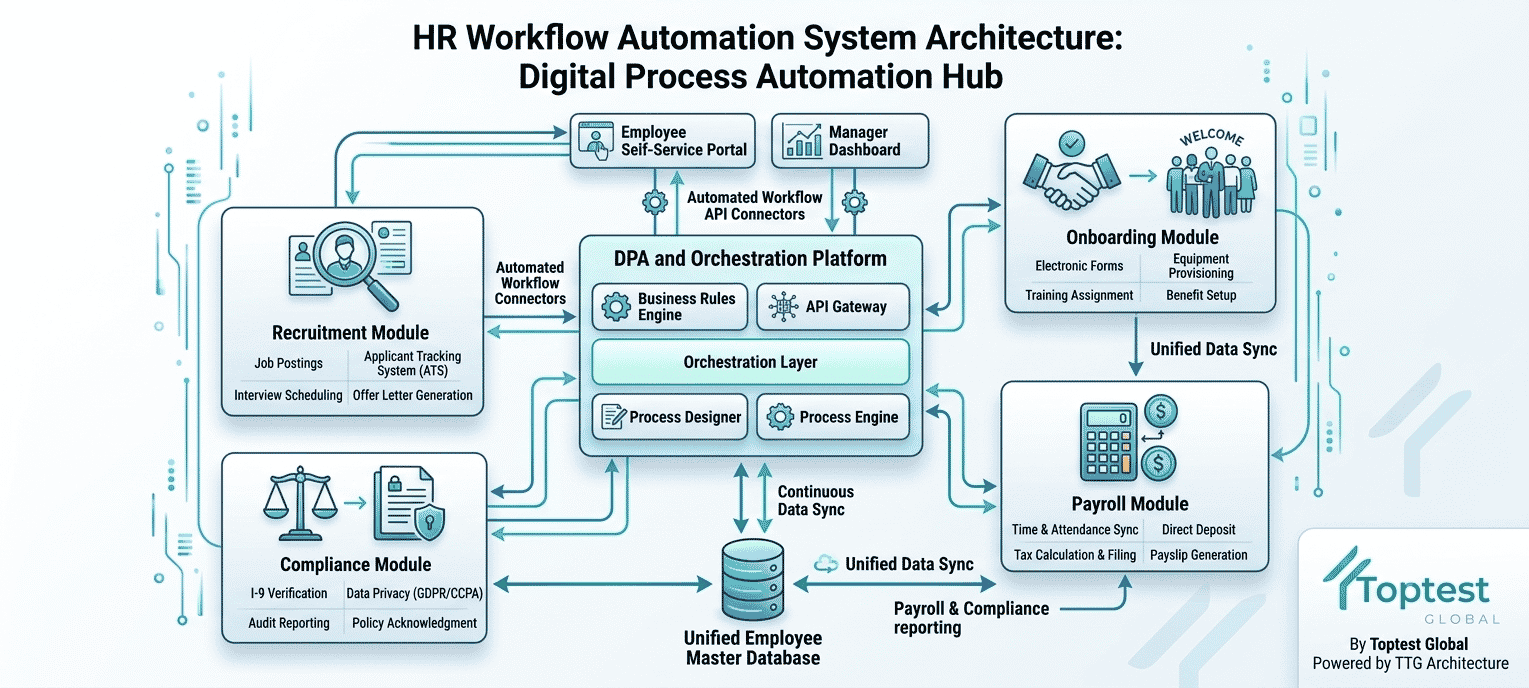
HR workflow automation is the application of business process automation (BPA) and digital process automation technologies to eliminate manual handoffs, enforce business rules, and create self-executing HR processes — from recruitment to offboarding.
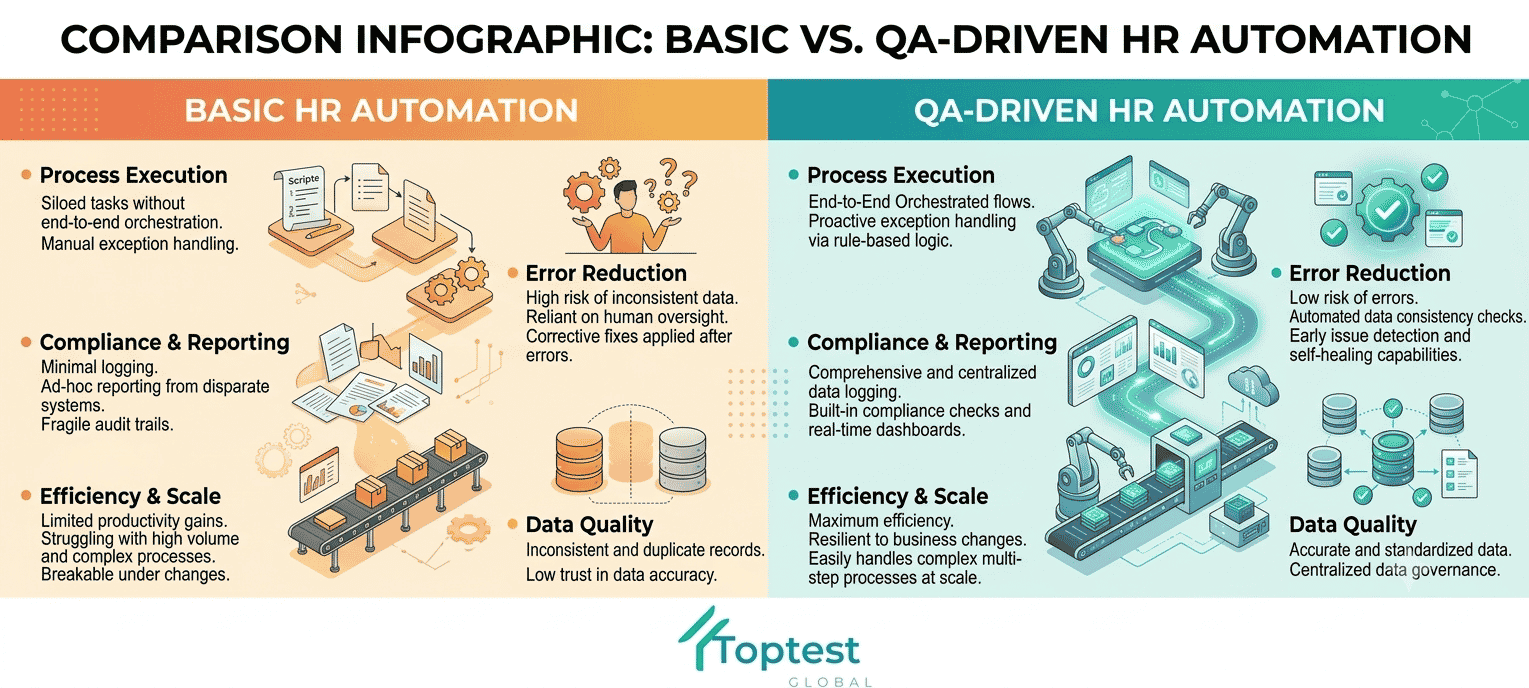
But here’s what separates enterprise-grade HR process automation from basic task automation:
| Basic Task Automation | QA-Driven HR Workflow Automation |
|---|---|
| Single-step triggers (e.g., auto-send email) | End-to-end process orchestration with exception handling |
| Fixed, hardcoded logic | Business rules engine with configurable conditions |
| Deployed without testing | Rigorously validated with automated QA testing software |
| Breaks when exceptions occur | Built-in error recovery and escalation paths |
| Isolated from other systems | Native n8n integration, API connectivity, and BPMN process mapping |
| High maintenance overhead | Zero-bottleneck architecture with continuous monitoring |
At our development centers in Singapore and Hanoi, every workflow automation deployment follows this QA-first methodology. We don’t believe in “move fast and break things” when your HR data, compliance posture, and employee experience are on the line.
Why Traditional Automation Often Fails (And How QA Prevents It)
We’ve inherited too many “automated” HR systems that were broken from day one. The symptoms are always the same:
- Workflows that stall silently — An approval sits in limbo because a condition wasn’t met, and nobody gets notified.
- Data sync failures — Employee records updated in the HRIS don’t propagate to payroll or access management systems.
- Permission drift — Role-based access rules become inconsistent as the org chart changes.
- Audit trail gaps — Critical decisions lack timestamped, tamper-proof documentation.
These failures share a common root cause: automation deployed without software QA automation. When you treat workflow logic as “configuration” rather than “code that needs testing,” you guarantee production failures.
The Toptest QA-First Deployment Model
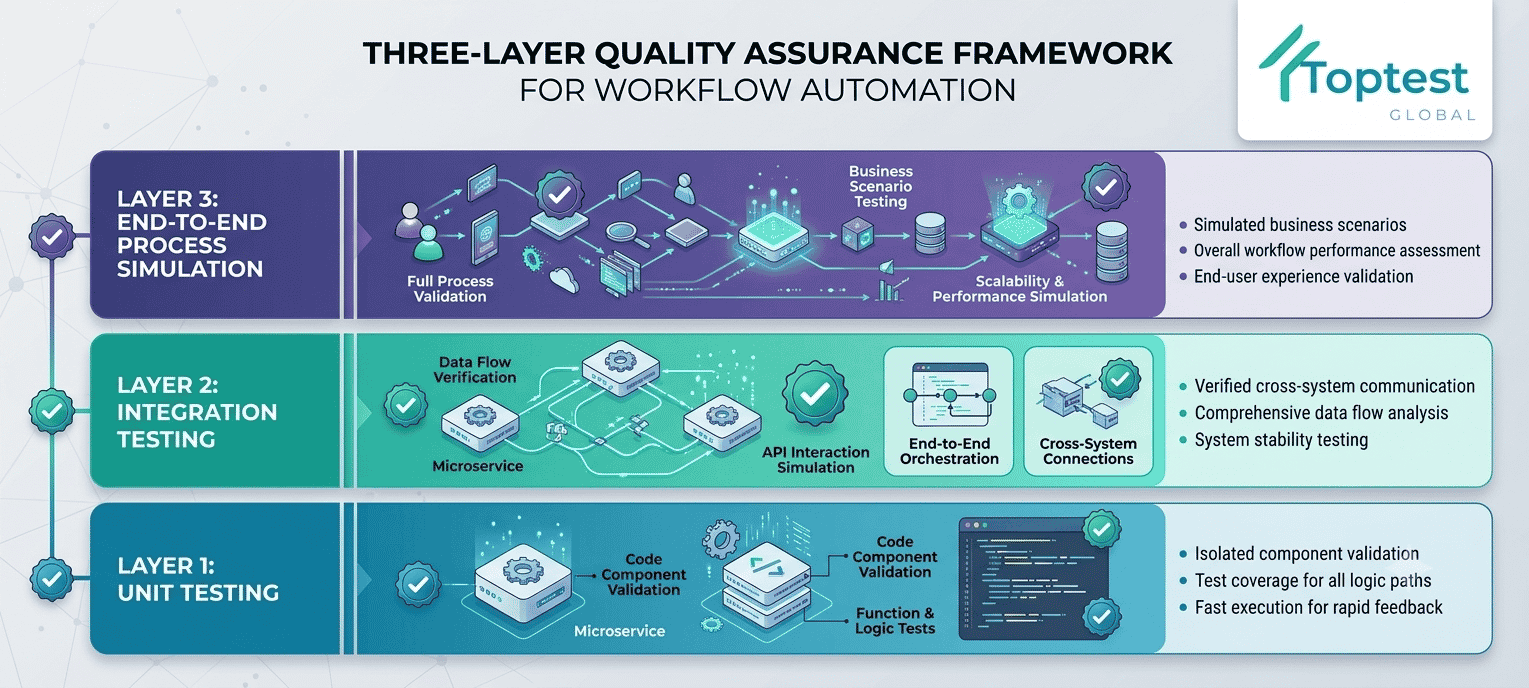
Based on our hands-on experience implementing QA-driven workflow automation for enterprise HR teams, we enforce a three-layer quality gate:
- Unit Testing of Business Rules — Every conditional branch, approval matrix, and escalation trigger is tested in isolation using Playwright automation and custom test frameworks.
- Integration Testing Across Systems — We validate data flows between your HRIS, payroll, document management, and identity systems before go-live.
- End-to-End Process Simulation — Complete BPMN process mapping scenarios are executed with synthetic data to confirm zero-bottleneck performance under realistic load.
This is process automation in software project management applied to HR operations. The same rigor we bring to software delivery — we bring to your business processes.
The 5 Core HR Workflows Every Organization Should Automate First
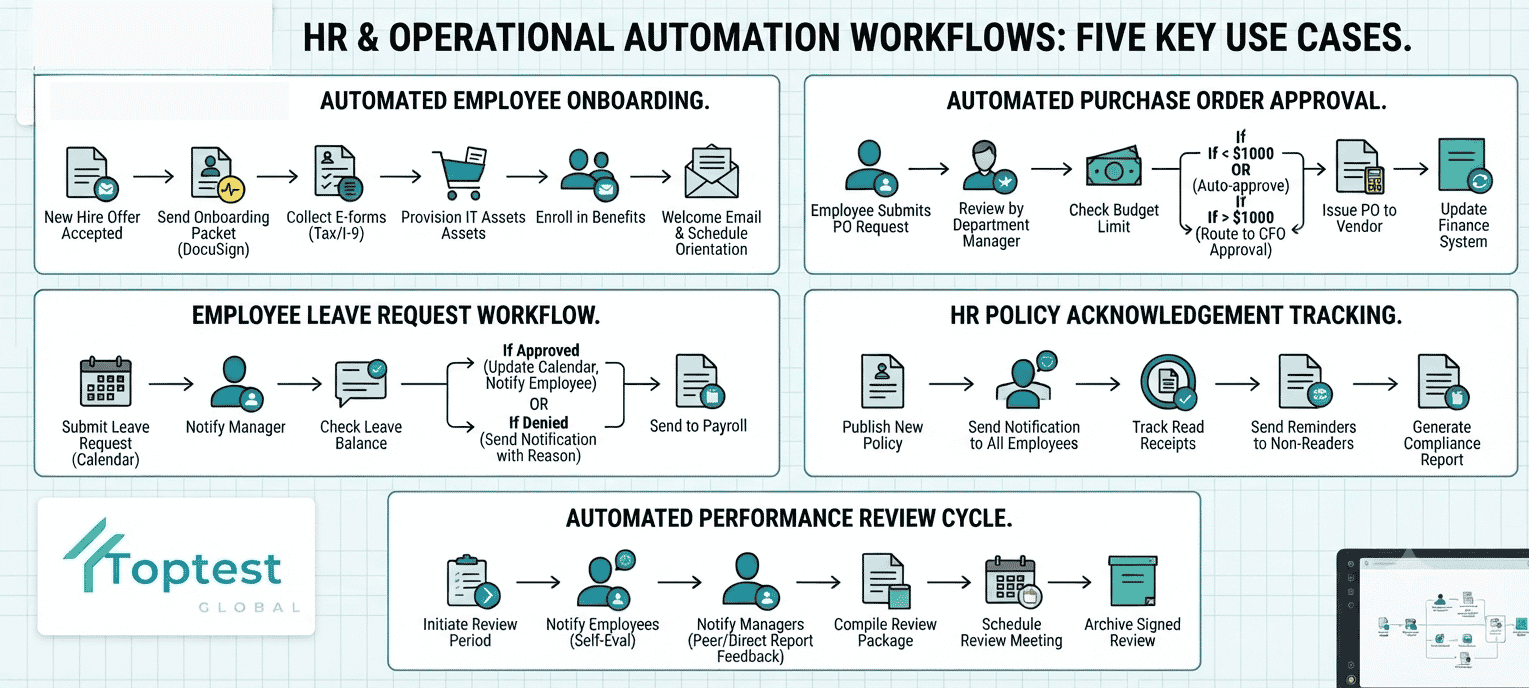
Not all HR processes deliver equal ROI when automated. In our 100+ projects, these five workflows consistently generate the highest impact:
1. Automated Employee Onboarding
Automated employee onboarding is the highest-ROI entry point for HR workflow automation. A typical manual onboarding sequence involves 15+ touchpoints across HR, IT, facilities, finance, and the hiring manager.
With a visual workflow builder and proper BPM software, this becomes a single triggered sequence:
- Offer acceptance → automatic background check initiation
- Clearance confirmation → IT provisioning ticket creation
- System readiness → welcome email with first-day instructions
- Day 1 arrival → digital document signing and policy acknowledgment
- Week 1 completion → manager check-in scheduling and 30-day milestone setup
We’ve implemented this for clients using n8n integration with Workday, BambooHR, and custom HRIS platforms — always with Playwright automation end-to-end testing to ensure no new hire falls through the cracks.
2. Automated Purchase Order Approval
While often classified under procurement, automated purchase order approval workflows are critical for HR departments managing training budgets, recruitment agency fees, and benefits vendor payments.
A robust business rules engine can route POs automatically based on amount thresholds, department budgets, and vendor approval status — eliminating the email chains that delay critical HR investments.
3. Client Onboarding Automation (For HR Service Providers)
For organizations delivering HR services externally, client onboarding automation ensures consistent service delivery, SLA compliance, and professional first impressions. This mirrors internal automated employee onboarding but with commercial contract integration and service catalog activation.
4. Leave and Attendance Management
Modern workflow management software transforms leave requests from email-and-spreadsheet chaos into rule-driven, audit-ready processes. Balance checks, overlapping-request detection, and manager delegation during PTO are all handled automatically.
5. Performance Review and Compensation Cycles
Perhaps the most complex HR process automation use case, performance cycles require multi-stage approvals, calibration committee routing, and compensation band validation. No-code/low-code workflow automation platforms make these previously “too complex to automate” processes achievable.
Choosing the Right Technology Stack for HR Workflow Automation
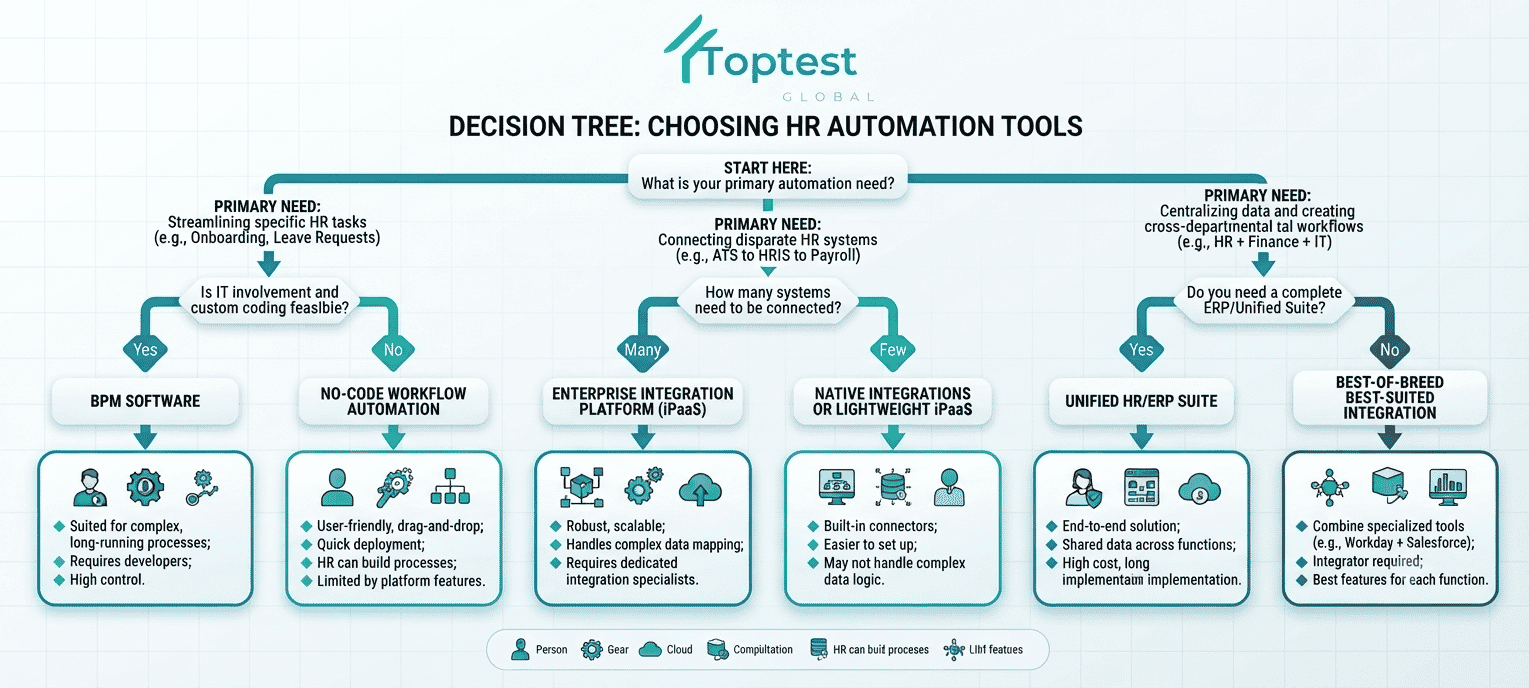
The process automation software landscape is crowded. Here’s how we guide clients at Toptest Global to make the right choice:
| Category | Best For | Key Considerations |
|---|---|---|
| No-code/low-code workflow automation | Mid-market HR teams with limited IT support | Rapid deployment, visual workflow builder, but requires governance to prevent “shadow automation” |
| BPM software with BPMN process mapping | Enterprise HR with complex, regulated processes | Superior audit trails and compliance, but longer implementation cycles |
| n8n integration platforms | Tech-savvy HR teams needing custom connectivity | Highly flexible, open-source options available, requires technical expertise |
| Cflow integration and similar cloud BPM | Organizations prioritizing quick wins and cloud-native delivery | Fast time-to-value, strong mobile experience, subscription-based pricing |
Regardless of platform choice, our recommendation is consistent: every workflow must pass QA validation before production deployment. This is non-negotiable for HR data integrity.
👉 Explore our curated comparison of the best workflow automation software for HR teams — tested and validated by our QA engineers.
How QA-Driven HR Workflow Automation Works: The Toptest Framework
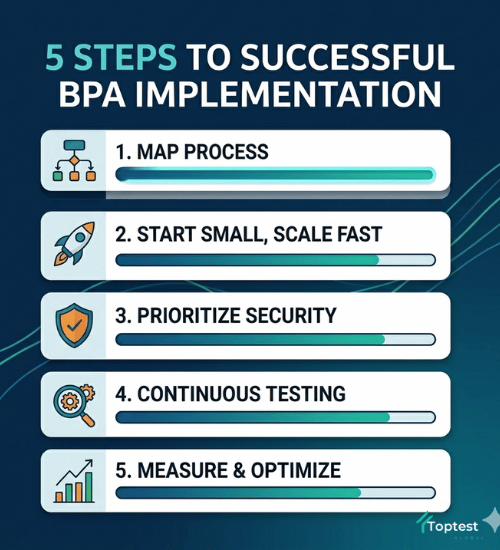
In our 100+ automation and QA projects, we’ve refined a repeatable framework for delivering zero-bottleneck automation in HR environments. Here’s the step-by-step process we follow at our Singapore and Hanoi delivery centers:
Phase 1: Process Discovery & BPMN Mapping
We start with BPMN process mapping — not whiteboard sketches, but executable process models that serve as the single source of truth. This forces clarity on:
- Every decision gateway and business rule
- System touchpoints and API requirements
- Exception paths and escalation triggers
- SLA definitions and monitoring points
Phase 2: Workflow Design in Visual Builder
Using visual workflow builder tools, we translate BPMN models into executable workflows. This is where no-code/low-code workflow automation platforms shine — business stakeholders can validate logic without reading code.
Phase 3: Automated QA Testing & Validation
This is where Toptest differentiates. Before any workflow goes live:
- Playwright automation tests simulate user interactions across the workflow UI
- API-level integration tests validate data flows between HR systems
- Load testing confirms performance under peak conditions (e.g., annual enrollment periods)
- Security testing validates role-based access and data encryption
Phase 4: Staged Deployment & Monitoring
We deploy to a subset of users first, with real-time monitoring of workflow automation performance metrics. Only after validated stability do we proceed to full rollout.
Phase 5: Continuous Optimization
Digital process automation is not “set and forget.” We establish continuous improvement loops based on:
- Process cycle time metrics
- Error rates and exception frequency
- User satisfaction scores
- Compliance audit results
Real-World Results: What QA-Driven HR Automation Delivers
Numbers matter to B2B decision-makers. Here are representative outcomes from our client engagements:
75% efficiency gain
| Metric | Before Automation | After QA-Driven Automation | Improvement |
|---|---|---|---|
| Average onboarding time | 5–7 business days | 1–2 business days | 70% reduction |
| Leave request processing | 3–5 days (email chains) | Same-day approval | 80% faster |
| Payroll error rate | 2–3% monthly | <0.2% monthly | 90% reduction |
| HR admin time per employee | 8–12 hours/month | 2–3 hours/month | |
| Compliance audit preparation | 2–3 weeks | Real-time readiness | Continuous compliance |
These results aren’t theoretical. They’re the product of combining workflow automation expertise with software QA automation discipline — the Toptest approach.
Implementation Best Practices for HR Workflow Automation
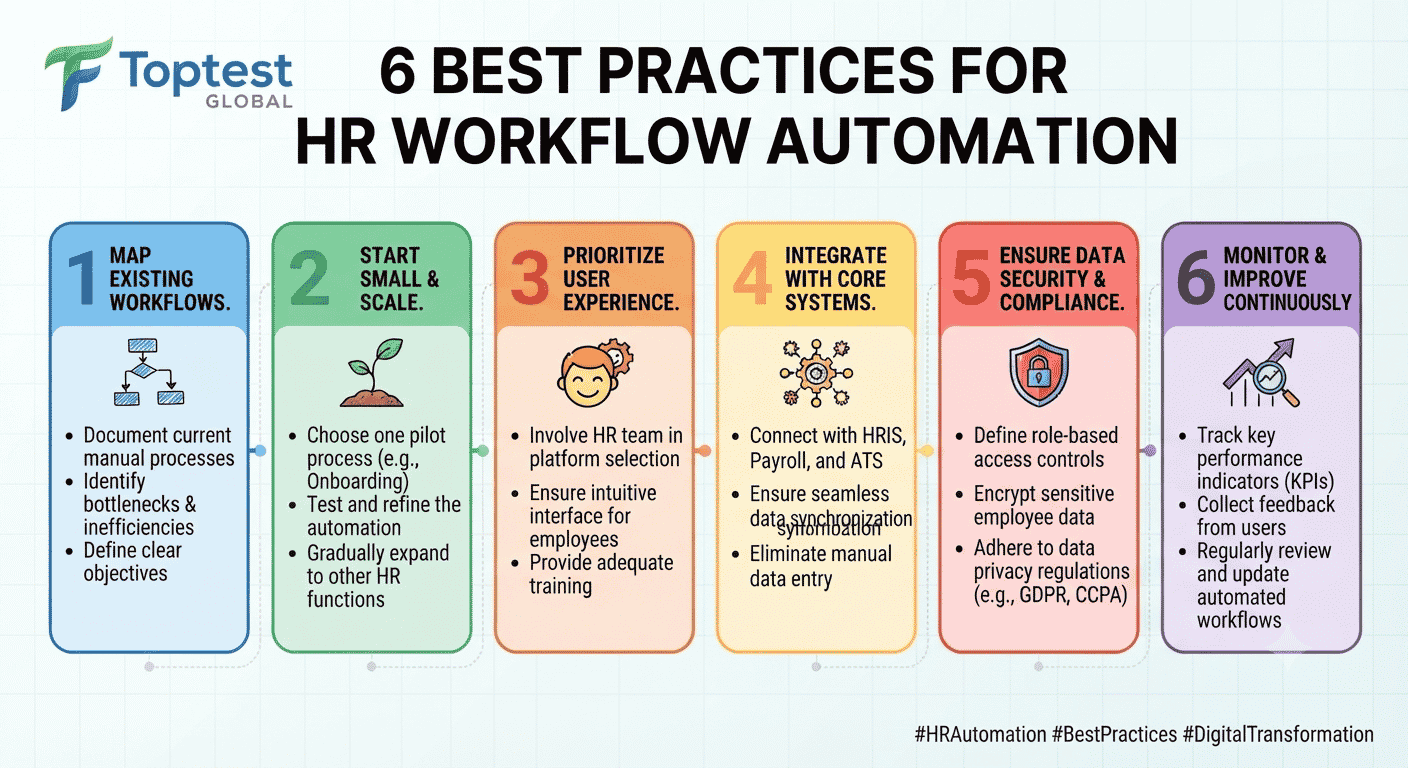
Based on our hands-on experience implementing QA-driven automation across diverse HR environments, here are the practices that separate successful deployments from expensive failures:
Start with High-Volume, Low-Complexity Processes
Automated employee onboarding and leave management deliver quick wins that build organizational confidence before tackling complex compensation workflows.
Invest in Data Quality Before Automation
Automating a bad process just makes bad things happen faster. Clean your employee master data, standardize role definitions, and resolve access management inconsistencies before workflow deployment.
Design for Exceptions, Not Just Happy Paths
Every business rules engine configuration must include exception handling. What happens when an approver is on extended leave? When a new hire’s background check delays start date? When a system API is temporarily unavailable?
Test Like Your Compliance Audit Depends on It
Because it does. Every HR process automation workflow should have a corresponding test suite in your automated QA testing software pipeline. This isn’t overhead — it’s insurance.
Plan for Change Management
The most elegant visual workflow builder implementation fails if managers don’t understand their new approval dashboards. Budget for training, documentation, and hypercare support.
Measure and Iterate
Define KPIs before launch: cycle time, error rate, user satisfaction, cost per transaction. Review monthly. Optimize quarterly.
Why Toptest Global for Your HR Workflow Automation Initiative
You have options for workflow automation partners. Here’s why enterprise HR leaders choose Toptest Global:
- 100+ automation and QA projects delivered — We bring battle-tested patterns, not experiments.
- QA-Driven by default — Every workflow is validated with Playwright automation and automated QA testing software before production. Zero exceptions.
- Cross-border delivery excellence — Singapore strategic oversight + Hanoi development center execution for optimal cost-quality balance.
- 98% client retention rate — Our clients stay because our automation works, scales, and adapts.
- Deep HR domain expertise — From automated employee onboarding to automated purchase order approval, we understand the regulatory and cultural nuances of HR operations.
Our workflow automation services are designed for organizations that can’t afford to get HR wrong — enterprises with compliance obligations, scaling startups with rapid headcount growth, and HR service providers delivering white-glove client experiences.
We also bring specialized expertise in Playwright automation for testing complex HR system integrations, and our custom software development team can build bespoke connectors when off-the-shelf n8n integration isn’t sufficient.
Frequently Asked Questions
What is HR workflow automation?
HR workflow automation is the use of process automation software and digital process automation technologies to execute human resources processes — such as onboarding, leave management, and approvals — without manual intervention. At Toptest Global, we implement QA-driven workflow automation that is rigorously tested with automated QA testing software before deployment to ensure reliability.
How does QA-driven automation differ from standard workflow automation?
Standard workflow automation focuses on building and deploying processes quickly. QA-driven workflow automation adds a mandatory quality assurance layer — using tools like Playwright automation and comprehensive test frameworks — to validate every workflow path, integration point, and exception handler before go-live. This prevents the silent failures and data sync issues that plague traditional deployments.
What HR processes should we automate first?
We recommend starting with automated employee onboarding and leave/attendance management. These are high-volume, well-defined processes that deliver immediate ROI. Once validated, expand to automated purchase order approval, performance cycles, and offboarding.
Can we use no-code tools for HR workflow automation?
Yes. No-code/low-code workflow automation platforms with visual workflow builder interfaces are excellent for mid-market HR teams. However, we strongly recommend pairing these tools with proper software QA automation governance — even “simple” workflows can break in production if untested.
How long does HR workflow automation implementation take?
With Toptest’s QA-driven approach, a typical automated employee onboarding workflow takes 3–4 weeks from discovery to production — including full BPMN process mapping, workflow design, Playwright automation testing, and staged rollout. Complex enterprise BPM software implementations may extend to 8–12 weeks.
Is HR workflow automation secure and compliant?
When implemented correctly, HR process automation is more secure and compliant than manual processes. Our deployments include encrypted data flows, tamper-proof audit trails, role-based access control, and business rules engine enforcement of regulatory requirements. Every security control is validated through automated QA testing software.
What platforms does Toptest recommend for HR workflow automation?
We maintain platform-agnostic expertise across n8n integration, Cflow integration, enterprise BPM software, and custom solutions. The right choice depends on your existing tech stack, process complexity, and governance requirements. See our detailed comparison or book a consultation for personalized guidance.
Ready to Eliminate HR Bottlenecks? Let’s Talk.
HR workflow automation isn’t about replacing your HR team — it’s about freeing them to focus on strategy, culture, and talent development instead of chasing signatures and updating spreadsheets.
At Toptest Global, we’ve proven across 100+ projects that QA-driven workflow automation is the only reliable path to zero-bottleneck automation. Our clients don’t just automate — they automate with confidence, knowing every workflow was battle-tested before it touched their live environment.
🎯 Book a Free 45-minute Automation & QA Audit
Our senior consultants will analyze your current HR processes, identify the highest-ROI automation opportunities, and provide a roadmap to zero-bottleneck operations. Schedule your audit now →
📥 Download our free Enterprise Workflow Optimization Checklist
A practical, 25-point framework for evaluating, planning, and executing HR workflow automation initiatives — including our proprietary QA validation checklist used in every Toptest engagement. Get instant access →
Whether you’re exploring your first automated employee onboarding workflow or scaling enterprise-wide HR process automation, Toptest Global delivers the expertise, quality discipline, and cross-border execution capability to make it succeed.
Based on our hands-on experience implementing QA-driven automation at our Singapore and Hanoi development centers, we know what works — and we’re ready to prove it in your environment.