AI driven software development services are no longer experimental. In 2026, they are the default operating model for teams that want to ship faster, reduce costs, and stay competitive. Yet for every B2B buyer excited by the promise of AI-assisted coding, there is a cautionary tale of projects that moved fast — then broke faster.
At Toptest Global, our development centers in Singapore and Hanoi have delivered 100+ automation and software projects. We have seen the full spectrum: teams that leverage AI to 10x their output, and teams that treat AI as a magic wand and end up with unmaintainable code, security vulnerabilities, and budget overruns. The difference is never the tool. It is the discipline behind it.
This guide is for decision-makers evaluating AI driven software development services in 2026. Whether you are a CTO exploring vibe coding for your next product, a procurement lead comparing vendor proposals, or a founder deciding between AI-augmented and traditional development, you will get the clarity you need — grounded in real project experience, current market data, and a framework for separating hype from results.
What AI Driven Software Development Services Actually Mean in 2026
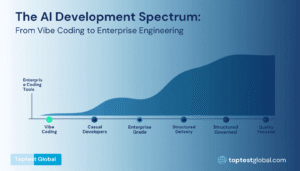
The term has evolved rapidly. In 2023, it meant GitHub Copilot suggesting the next line of code. In 2026, it encompasses a full spectrum of capabilities:
- AI pair programming: Tools like Cursor, Windsurf, and GitHub Copilot generating entire features from natural language prompts
- Autonomous coding agents: AI systems that scaffold projects, write tests, and debug with minimal human intervention
- Vibe coding: A methodology where developers describe intent in plain language and AI handles implementation — now a structured, production-ready approach rather than a casual experiment citeweb_search:2#0
- AI-powered QA and testing: Automated test generation, visual regression detection, and intelligent bug prediction
- Intelligent project orchestration: AI tools that manage dependencies, suggest architectural patterns, and optimize CI/CD pipelines
The numbers are staggering. 92% of U.S. developers now use AI tools daily, and 41% of global code is AI-generated. The global AI market is projected to reach $243.72 billion in 2025 and may grow to $826.73 billion by 2030 with a CAGR of 27.67%.
But here is what the headlines do not tell you: AI generates plausible code, not provably correct code. And in enterprise software — where a single logic error can expose 1.5 million API keys or corrupt a patient record in a digital health system — that distinction is everything.
The Vibe Coding Revolution: Opportunity and Risk
Vibe coding, coined by Andrej Karpathy in early 2025, has matured from a meme into a methodology. In 2026, it means developers write specifications in natural language, AI generates the implementation, and humans review, refine, and validate. The cycle is: Intent → Prompt → Generate → Review → Iterate → Ship.
The benefits are real. Projects that once took months now ship in days. Tedious scaffolding, CRUD routes, and UI components are automated. Non-technical stakeholders can prototype ideas without waiting for engineering bandwidth.
But the risks are equally real:
- Security vulnerabilities: Approximately 45% of AI-generated code may contain security flaws, including SQL injection, misconfigured databases, and missing authentication checks
- The “vibe coding hangover”: After three months, AI-generated codebases often become unmaintainable black boxes. Developers who did not write the code struggle to debug or extend it
- Performance debt: AI prioritizes functionality over efficiency. Code that passes tests may fail under production load, driving cloud costs skyward
- Regulatory exposure: In healthcare, finance, and other regulated industries, AI-generated code without human audit trails creates compliance liability
This is why the choice of AI driven software development services partner matters more than the choice of AI tool. The right partner treats AI as a force multiplier for skilled engineers, not a replacement for them.
Why Traditional AI-Only Development Often Fails — And What Works Instead
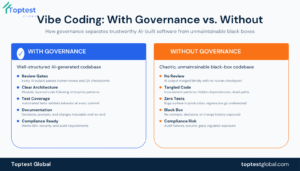
The failure mode we see most often is what we call “AI theater” — vendors who sell speed without selling quality. They demo rapid prototyping, impress stakeholders with how fast a feature appears, and then disappear when the production bugs emerge.
The Three Failure Patterns
After 100+ projects, we have identified three recurring failure patterns in AI-driven development:
| Failure Pattern | Symptom | Root Cause |
|---|---|---|
| The Black Box | Features work initially, but no one can debug or extend them | AI-generated code without human review, documentation, or test coverage |
| The Security Surprise | Data breach, API key exposure, or compliance audit failure | AI-generated authentication, authorization, or input validation without security review |
| The Performance Cliff | Application slows to a crawl at scale; cloud costs explode | AI prioritized “it works” over “it works efficiently under load” |
A 2026 study found that experienced developers were actually 19% slower on complex tasks when using AI tools, even though they believed they were 20% faster. Additionally, 63% of developers reported spending more time debugging AI-generated code than writing it themselves at least once.
Simon Willison, a respected voice in the developer community, captured it perfectly: “If an LLM wrote code and you then reviewed it, tested it, and made sure you could explain it to someone else — that’s not vibe coding. That’s just software development.”
The Toptest Global Approach: AI-Assisted, Human-Validated
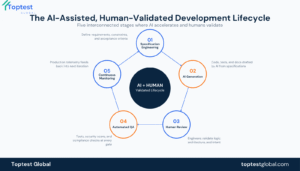
Our methodology is what we call “AI-Assisted, Human-Validated” — a structured framework that harnesses AI speed while preserving engineering rigor:
- Specification Engineering: Before any code is generated, we write detailed, unambiguous project specifications. The quality of AI output is directly proportional to the quality of human input. Vague prompts produce vague code.
- Architectural Guardrails: We define tech stack, coding standards, and security constraints in persistent context files (e.g.,
.cursorrules,CLAUDE.md) that AI agents reference before every interaction. citeweb_search:2#2 - Layered Code Review: Every line of AI-generated code is reviewed by senior engineers. Critical paths — authentication, payments, data access — are always hand-coded or heavily audited.
- Automated QA Integration: We implement comprehensive test suites, including AI-generated tests that are themselves validated for correctness. A test that validates wrong behavior is worse than no test at all.
- Continuous Monitoring: Post-deployment, we monitor for performance degradation, security anomalies, and model drift in AI-driven components.
This is not bureaucracy. It is how you turn AI speed into sustainable competitive advantage.
How AI Driven Software Development Services Work: A Step-by-Step Framework
Here is the exact framework we use at Toptest Global when delivering AI driven software development services to enterprise clients. It scales from MVPs to mission-critical systems.
Step 1: Discovery & Feasibility Assessment
Before writing a single prompt, we assess:
- Project complexity: Is this an MVP, a scalable product, or a regulated system? AI excels at the first two; the third demands additional governance.
- Domain constraints: Healthcare software requires HIPAA compliance. Financial systems need SOX audit trails. These constraints shape every architectural decision.
- Team readiness: Does your team have the engineering maturity to review and maintain AI-generated code? If not, we build that capability alongside the product.
- AI suitability score: We score each feature on its suitability for AI generation — CRUD operations score high; cryptographic implementations score zero.
For organizations in regulated industries like healthcare, our digital health software development services integrate AI acceleration with compliance-by-design — ensuring FDA, HIPAA, and HITECH requirements are met from day one.
Step 2: Tool Selection & Environment Setup
The AI development tool landscape in 2026 is rich. We match tools to project needs:
| Tool | Best For | Our QA Integration |
|---|---|---|
| Cursor | Professional developers, multi-file editing, IDE-native workflows | Composer mode review + custom linting rules + automated test generation |
| Windsurf | Legacy codebase modernization, collaborative coding | Cascade system validation + architectural pattern enforcement |
| GitHub Copilot | Inline completions, universal IDE support, team standardization | Workspace feature audit + code quality gates in CI/CD |
| Claude Code | Complex refactoring, large-scale architectural changes | Terminal-based test execution + 200K token context review |
| Bolt.new / v0.dev | Rapid prototyping, non-technical validation | Prototype-to-production migration planning + security hardening |
We are tool-agnostic because your business is unique. What we are not agnostic about is quality. Every tool choice is evaluated against its testability, auditability, and maintainability.
Step 3: Specification Engineering & Prompt Design
This is where most AI development projects succeed or fail. We do not ask AI to “build a login page.” We write structured specifications like this:
Objective: Build a JWT-based authentication system with refresh token rotation, rate limiting at 100 requests/minute per user, and brute-force protection.
Tech Stack: Node.js 22, Express 5, PostgreSQL 16, TypeORM, Zod validation, bcrypt hashing.
Constraints: All endpoints return JSON with consistent envelope { data, error, meta }. No ORM lazy loading. Parameterized queries only. No string concatenation in SQL.
Acceptance Criteria: All endpoints have Vitest integration tests. Auth middleware rejects expired tokens with 401. Rate limiting keyed on JWT sub claim, not IP.
This level of specificity eliminates the ambiguity that produces buggy AI output. It is the difference between a prototype and production software.
Step 4: AI-Assisted Development with Human Oversight
With specifications locked, our engineers use AI tools to generate code — but always within guardrails:
- Feature-by-feature iteration: One feature per AI session, with Git commits after each successful iteration. This prevents the “cascading error” problem that occurs when AI tries to fix multiple things at once.
- The “Karpathy Move”: When errors occur, we paste the full stack trace into the AI chat without commentary. The AI diagnoses and suggests fixes. If it fails after three attempts, we reset to the last known good commit and hand-code the fix.
- Context file discipline: Our
.cursorrulesandCLAUDE.mdfiles enforce coding standards, tech stack constraints, and security policies across all AI interactions.
Step 5: Comprehensive QA & Security Validation
This is our non-negotiable differentiator. Every AI-generated codebase undergoes:
- Static analysis: SonarQube, ESLint, and custom security linters catch vulnerabilities AI often misses
- Automated testing: Unit, integration, and end-to-end tests — including AI-generated tests that are themselves validated for correctness
- Security audit: Manual review of authentication, authorization, input validation, and data access patterns
- Performance profiling: Load testing to ensure AI-generated code does not create hidden bottlenecks
- Compliance verification: For regulated industries, automated checks against HIPAA, GDPR, SOX, or industry-specific requirements
Our automated QA testing software runs nightly regression suites, catching issues before they reach production. This is how we maintain the 98% client retention rate that defines our reputation.
Real-World Applications: Where AI Driven Software Development Services Deliver Results
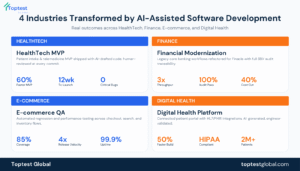
Theory is useful. Results are what matter. Here are four implementations from our project portfolio that illustrate how disciplined AI-assisted development transforms outcomes.
Application 1: Rapid MVP Development for a HealthTech Startup
Challenge: A Singapore-based HealthTech startup needed to validate a patient engagement platform concept with investors in 6 weeks. Traditional development estimates ranged from 4-6 months.
Solution: We used AI driven software development services to accelerate the build:
- AI-generated scaffolding: Cursor Composer generated the full-stack project structure (React frontend, Node.js API, PostgreSQL database) in 2 days
- Human-coded critical paths: Our senior engineers hand-built the patient data encryption, HIPAA-compliant audit trails, and role-based access control
- Automated QA pipeline: Playwright automation tested all user journeys; custom security tests validated PHI handling
Results:
- MVP delivered in 5.5 weeks — 65% faster than traditional estimates
- Zero security findings in pre-launch penetration test
- HIPAA compliance documentation ready for investor due diligence
- Codebase structured for clean handoff to the startup’s internal team
Application 2: Legacy System Modernization for a Financial Services Firm
Challenge: A Hanoi-based financial services client maintained a 12-year-old monolith in Java and Oracle. Feature delivery took 8-12 weeks. Technical debt was paralyzing innovation.
Solution: We implemented a hybrid modernization approach using Windsurf’s Cascade system for legacy pattern recognition:
- AI-assisted code analysis: The AI mapped 400,000+ lines of legacy code, identifying dead code, security anti-patterns, and modernization candidates
- Strangler Fig migration: We rebuilt services incrementally in modern TypeScript/Node.js, with AI generating boilerplate and our engineers architecting the boundaries
- Business rules engine preservation: Critical financial logic was extracted, documented, and validated — never blindly translated by AI
Results:
- Feature delivery time: 8-12 weeks → 2-3 weeks
- Technical debt reduced by 40% in the first 6 months
- Zero regression incidents in production during migration
- Full SOX audit trail maintained throughout
Application 3: AI-Powered QA Automation for an E-Commerce Platform
Challenge: A regional e-commerce client with 2M+ monthly users struggled with flaky test suites and delayed releases. Their manual QA cycle took 14 days per release.
Solution: We rebuilt their QA pipeline using AI-driven test generation and Playwright automation:
- AI-generated test cases: We used AI to analyze user stories and generate comprehensive test scenarios — then our QA engineers validated and refined them
- Visual regression testing: AI-powered visual diff detection caught UI inconsistencies across 12 browser/device combinations
- Self-healing selectors: AI-adaptive locators reduced test maintenance by 60% when the frontend evolved
Results:
- QA cycle time: 14 days → 2.5 days
- Test coverage increased from 54% to 91%
- Production incidents caused by untested code: Reduced by 78%
- Release frequency: Monthly → Weekly
Application 4: Cross-Border Digital Health Platform
Challenge: A client needed a digital health software development platform serving patients across Singapore and Vietnam, with multi-jurisdictional compliance (HSA, FDA, MOH Vietnam), real-time telemedicine, and EMR integration.
Solution: This was not a vibe-coding candidate. We used AI for acceleration, not replacement:
- AI-assisted architecture design: The AI analyzed compliance requirements and suggested architectural patterns; our architects made the final decisions
- AI-generated boilerplate: Routine CRUD, API documentation, and test scaffolding were AI-generated
- Human-coded everything critical: Encryption, audit trails, consent management, and clinical decision support were hand-built by specialists
- Continuous compliance monitoring: Automated scans verified regulatory adherence with every deployment
Results:
- Platform launched in 8 months — 30% faster than comparable projects
- Regulatory approvals obtained in both jurisdictions on first submission
- Zero data breaches or compliance violations in 18 months of operation
- Patient satisfaction score: 4.7/5.0
The 2026 AI Development Tool Stack: What We Recommend
The tool landscape is evolving weekly. Here is our current assessment for B2B buyers evaluating AI driven software development services:
For Professional Development Teams: Cursor
Cursor has become the IDE of choice for AI-assisted professional development. Its Composer mode enables multi-file editing, full codebase context, and terminal command execution. With 320+ reviews averaging 4.5/5 on G2, it is the tool we recommend for teams transitioning from traditional IDEs.
QA Integration: We enforce custom linting rules, require human review for all AI-generated authentication code, and run automated regression suites after every Composer session.
For Legacy Modernization: Windsurf
Windsurf’s Cascade system learns project architecture patterns after 48 hours of use, making it exceptional for legacy codebase work. At $15/month for Pro (vs. Cursor’s $20/month), it offers strong value for teams modernizing older systems. By early 2026, over 700,000 developers were using Windsurf.
QA Integration: We validate all Cascade-generated code against existing architectural patterns and run integration tests before merging.
For Universal IDE Support: GitHub Copilot
GitHub Copilot remains the adoption leader with 1.8 million paid subscribers. Its universal IDE support (VS Code, JetBrains, Neovim) and inline completion model make it ideal for teams with diverse tool preferences.
QA Integration: We audit Copilot’s Workspace features for architectural consistency and require senior review for all generated business logic.
For Rapid Prototyping: Bolt.new
Bolt.new runs entirely in the browser via WebContainers, eliminating local setup. It is our go-to for validating concepts with non-technical stakeholders before committing engineering resources.
QA Integration: Prototypes are explicitly labeled as non-production. Before any Bolt.new prototype moves to production, we rebuild it with full engineering discipline.
For Complex Architectural Tasks: Claude Code
Claude Code operates as a terminal-based CLI agent with a 200K+ token context window — ideal for large-scale refactoring and complex architectural tasks. As one developer noted: “Cursor is the best AI editor. Claude Code is the best AI engineer.”
QA Integration: We use Claude Code for analysis and planning, not direct production code generation. All architectural recommendations are validated by senior engineers before implementation.
Best Practices for Evaluating AI Driven Software Development Services
If you are evaluating vendors or building internal AI development capabilities, these seven practices will keep you on track.
1. Demand Specification Discipline
Vague requirements produce vague code — AI or human. Insist that your development partner writes detailed specifications before any AI tool is invoked. The IBM perspective on vibe coding emphasizes that the shift is in the medium of expression, not the elimination of engineering rigor.
2. Insist on Architectural Guardrails
Every AI development project needs persistent context files that enforce:
- Tech stack constraints (no unauthorized dependencies)
- Coding standards (naming conventions, error handling patterns)
- Security policies (parameterized queries, input validation, authentication requirements)
- Performance baselines (response time limits, memory constraints)
Without these guardrails, AI tools will make decisions that diverge from your architectural vision.
3. Require Layered Code Review
AI-generated code must pass the same review gates as human-written code — and then some. We recommend:
- Automated linting and static analysis: Catch syntax errors, security anti-patterns, and style violations
- Peer review: Senior engineers review all AI-generated business logic
- Security audit: Manual review of authentication, authorization, and data access patterns
- Architectural review: Ensure AI-generated code aligns with long-term system design
4. Validate AI-Generated Tests
AI can generate tests, but those tests must themselves be validated. A test that asserts incorrect behavior is worse than no test. We require:
- Human review of all AI-generated test cases
- Mutation testing to verify test effectiveness
- Coverage gates (minimum 80% for business logic, 100% for critical paths)
5. Plan for Maintainability from Day One
The “vibe coding hangover” is real. After three months, teams often find themselves unable to extend or debug AI-generated code. Prevent this by:
- Requiring documentation for all AI-generated modules
- Enforcing modular architecture (no 2,000-line AI-generated files)
- Maintaining a “human knowledge map” of which components are AI-generated vs. hand-coded
- Scheduling quarterly architecture reviews to identify technical debt
6. Match AI Usage to Project Risk Profile
Not every project is suitable for full AI generation. Use this risk matrix:
| Project Type | AI Suitability | Our Approach |
|---|---|---|
| MVP / Prototype | High | AI-generated with rapid iteration; rebuild for production |
| Internal Tools | High | AI-generated with standard review gates |
| E-Commerce / SaaS | Medium-High | AI for scaffolding and CRUD; human-coded business logic |
| Digital Health / FinTech | Medium | AI for analysis and boilerplate; hand-coded critical paths |
| Safety-Critical Systems | Low | Minimal AI usage; formal verification required |
7. Choose Partners with QA DNA
The most important decision you will make is not which AI tool to use, but which partner to trust. Look for:
- Proven QA integration: Do they test AI-generated code with the same rigor as human-written code?
- Security expertise: Can they identify and remediate AI-generated vulnerabilities?
- Regulatory experience: For healthcare, finance, and other regulated industries, have they delivered compliant software before?
- Cross-border capability: Can they scale teams across time zones and jurisdictions?
- Transparent processes: Do they show you the AI-generated code, or hide it behind a black box?
At Toptest Global, our development centers in Singapore and Hanoi combine AI acceleration with the engineering discipline that 100+ projects have taught us. We do not hide behind AI. We show you the code, explain the decisions, and validate every output.
The Future of AI Driven Software Development Services
Looking ahead, three trends will reshape how B2B buyers engage with AI development:
Trend 1: AI Agents, Not Just Assistants
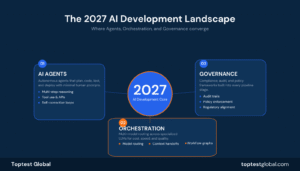
2026 tools like Cursor Agent and Claude Code are evolving from autocomplete to autonomous agents that plan, execute, and debug entire features. By 2027, Gartner predicts 75% of new enterprise applications will use low-code or no-code technologies, many with AI agents handling the underlying code generation.
The implication for buyers: your development partner must have governance frameworks for AI agent oversight, not just AI tool usage.
Trend 2: Multi-Model Orchestration
No single AI model excels at everything. The future belongs to workflows that route tasks to the optimal model — Claude for architecture, GPT-4 for documentation, CodeLlama for specific language tasks — with a human orchestrator ensuring coherence.
Trend 3: Regulatory Frameworks for AI-Generated Code
As AI-generated code becomes ubiquitous, regulators are taking notice. The EU AI Act, FDA guidance on AI in medical devices, and emerging SEC rules for AI in financial systems will require audit trails for AI-generated components. Partners who build compliance into their AI workflows today will save you from retrofitting tomorrow.
Frequently Asked Questions
What exactly are AI driven software development services?
AI driven software development services use artificial intelligence tools — from code generation assistants like GitHub Copilot to autonomous coding agents like Cursor Composer — to accelerate the software development lifecycle. At Toptest Global, we combine these AI tools with human engineering expertise, rigorous QA automation, and security validation to deliver production-ready software faster than traditional methods — without sacrificing quality.
Is vibe coding safe for enterprise software?
Vibe coding is safe when governed properly. The risk is not in the methodology itself, but in treating AI-generated code as final without human review, testing, and security validation. In our experience, vibe coding works excellently for scaffolding, UI components, and routine CRUD operations. For authentication, payment processing, encryption, and regulated logic, we always apply senior engineering oversight. As IBM’s analysis of vibe coding notes, the shift is in the medium of expression — developers still own quality, architecture, and security.
How much faster is AI-assisted development compared to traditional methods?
For suitable projects, AI-assisted development can reduce initial build time by 40-65%. However, this speed gain is only realized when paired with strong engineering discipline. Teams that skip review, testing, and documentation often find that their “fast” project becomes a maintenance nightmare that costs more in the long run. Our approach at Toptest Global is “fast to working, slow to production” — we use AI for speed, then apply human rigor before anything ships.
What industries should be cautious about AI-generated code?
Healthcare, financial services, aviation, and any safety-critical domain require extra caution. These industries demand audit trails, formal verification, and regulatory compliance that current AI tools cannot guarantee alone. Our digital health software development services use AI for acceleration in non-critical areas while maintaining hand-coded, formally reviewed logic for all patient-facing and compliance-critical components.
How do you prevent AI-generated code from becoming unmaintainable?
We prevent the “vibe coding hangover” through four practices: (1) modular architecture with strict file size limits, (2) comprehensive documentation requirements for all AI-generated modules, (3) quarterly architecture reviews to identify technical debt, and (4) a “human knowledge map” tracking which components are AI-generated. This ensures your team — or ours — can maintain and extend the codebase long after deployment.
What is the typical timeline and cost for AI driven software development services?
Timelines vary by complexity:
- MVP / Prototype: 4-8 weeks
- Scalable product: 3-6 months
- Enterprise platform: 6-12 months
Cost savings from AI acceleration typically range from 20-40% compared to traditional development — but only when quality is maintained. Beware vendors promising 80% cost reductions; they are almost certainly cutting corners on testing, security, or maintainability.
Can AI-generated code pass security audits and compliance checks?
Yes — if it is properly reviewed and tested. AI-generated code is not inherently less secure than human-written code; the issue is that AI sometimes generates plausible-looking but vulnerable patterns (e.g., SQL injection via string interpolation, missing authentication checks). Our security audit process catches these issues before deployment. For regulated industries, we provide full audit trails showing which components were AI-generated, which were hand-coded, and what validation each underwent.
How do I choose the right AI development partner?
Look for these five signals:
- They show you the code: Transparency about AI usage, not black-box delivery
- They have QA integration: Automated testing, security audits, and performance validation are part of their standard process
- They understand your domain: Healthcare, finance, and regulated industries require specialized knowledge
- They scale across borders: Our Singapore-Hanoi model ensures 24/7 progress with cultural alignment
- They have a retention track record: Our 98% client retention rate reflects delivery quality, not just speed
Conclusion: Speed Without Sacrifice Is the Only Sustainable Path
AI driven software development services are transforming how enterprise software is built. The tools are powerful, the speed is real, and the competitive pressure to adopt them is only intensifying. But speed without quality is not progress — it is deferred catastrophe.
In our 100+ projects across Singapore, Vietnam, and global markets, the pattern is clear: organizations that treat AI as a force multiplier for skilled engineers achieve sustainable competitive advantage. Those that treat it as a replacement for engineering discipline accumulate technical debt, security exposure, and eventually, project failure.
The data supports this. 41% of global code is now AI-generated, and 92% of developers use AI tools daily — but 63% of developers have spent more time debugging AI-generated code than writing it themselves. The winners in 2026 and beyond will be those who harness AI speed while maintaining human accountability.
At Toptest Global, we have built our reputation on one principle: we ship fast, but we never ship untested. Every line of AI-generated code is reviewed. Every critical path is validated. Every deployment is monitored. That is the difference between AI theater and AI engineering.
Ready to explore AI driven software development services that deliver real results?
→ Book a Free 45-Minute AI Development Strategy Session
Our senior architects will assess your project, recommend the right AI tool stack, and map a quality-first development roadmap — no obligation, no sales pressure, just expert insight from 100+ delivered projects.
A 52-point framework covering tool selection, specification engineering, QA integration, security validation, and compliance preparation — based on our real-world project experience.
Based on our hands-on experience delivering AI-assisted software across Singapore, Vietnam, and global enterprise clients, we are confident this guide gives you the strategic foundation to evaluate AI development partners, ask the right questions, and make decisions that balance speed with the quality your business demands.