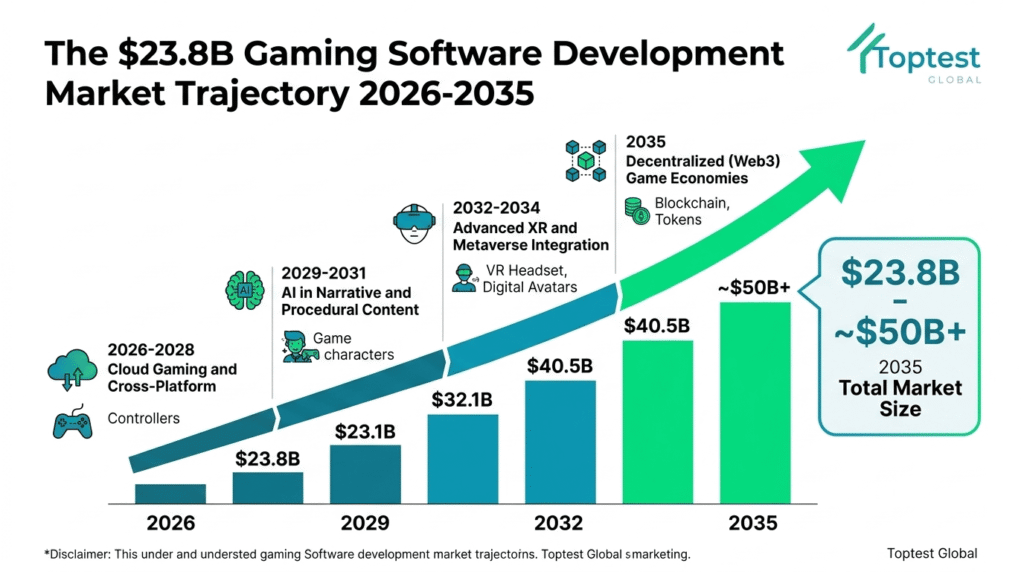
Gaming software development services are no longer just about building immersive worlds—they’re about building them fast, reliably, and at scale. The global game engines and development software market is projected to surge from $6.33 billion in 2026 to $23.8 billion by 2035, growing at a 15.9% CAGR. Yet behind every successful title lies a critical operational challenge: fragmented workflows, manual QA bottlenecks, and delayed releases that erode competitive advantage.
At Toptest Global, we’ve delivered 100+ automation and QA projects from our development centers in Singapore and Hanoi. We’ve seen firsthand how studios—whether indie teams or enterprise publishers—struggle with the same friction points: handoff delays between design and engineering, inconsistent testing coverage, and approval workflows that stall at every gate. The studios that win aren’t those with the biggest budgets. They’re the ones that integrate QA-driven workflow automation into their DNA from day one.
This guide is built on that hands-on experience. We’ll show you why traditional automation often fails in gaming environments, how our zero-bottleneck automation framework changes the game, and what measurable ROI you can expect when you pair business process automation (BPA) with rigorous software QA automation.
Why Gaming & Sports Software Development Is Different—and Why It Breaks Traditional Automation
The Unique Complexity of Game Development Pipelines
Unlike standard enterprise software, sports software development services and gaming projects operate under extreme constraints:
- Asset-heavy workflows: A single AAA title generates terabytes of 3D models, textures, audio files, and animation data that must flow through version control, review, and integration pipelines without conflict.
- Cross-functional chaos: Artists, designers, gameplay engineers, narrative writers, and QA testers work in parallel—often across time zones—creating hundreds of daily handoff points where work stalls.
- Platform fragmentation: Modern games must ship on PC, console, mobile, and cloud simultaneously, multiplying build configurations and testing matrices exponentially.
- Live-service pressure: Post-launch updates, seasonal content, and microtransaction systems demand continuous deployment cycles that traditional workflow management software simply cannot orchestrate.
These aren’t theoretical problems. In our 100+ projects, we’ve seen studios lose 3–4 weeks per quarter to manual approval loops, misrouted build artifacts, and QA cycles that restart from scratch because earlier-stage bugs weren’t caught. IDC data shows that 20–30% of annual revenue evaporates through manual re-keying, duplicated effort, and lost approvals—friction that is especially lethal in gaming’s thin-margin, hit-driven economy.
Why “Bolt-On” Automation Fails in Game Studios
Many studios attempt to solve this with generic process automation software or off-the-shelf BPM software. The result is predictable: workflows that automate the dysfunction rather than fix it. Gartner attributes 85% of automation project failures to poor data quality and lack of process redesign. In gaming, this translates to:
- Automated asset pipelines that break when engine versions update
- Approval workflows that can’t handle the nonlinear, creative nature of game design
- QA checklists that miss critical edge cases because they weren’t built with game-specific logic
The hard truth: automation without rigorous software QA automation is just faster failure. You need a framework that treats quality as the foundation, not an afterthought.
The QA-Driven Automation Advantage: How Toptest Global Eliminates Zero-Bottleneck Delivery
What “QA-Driven” Actually Means (And Why It Matters)
At Toptest Global, QA-driven workflow automation isn’t a marketing phrase—it’s an operational philosophy we’ve refined across 100+ projects. Here’s the core principle:
Every workflow is designed with automated validation gates at every stage, not just at the end.
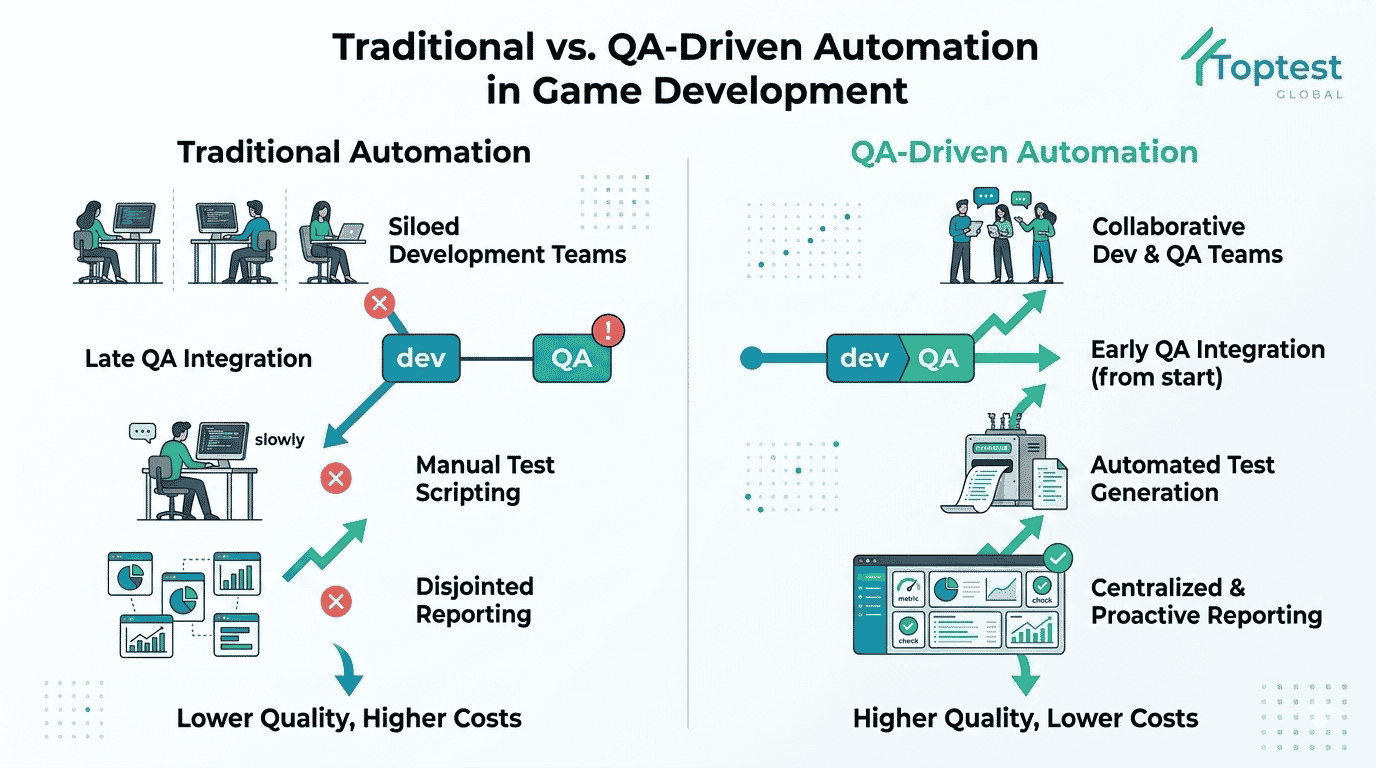
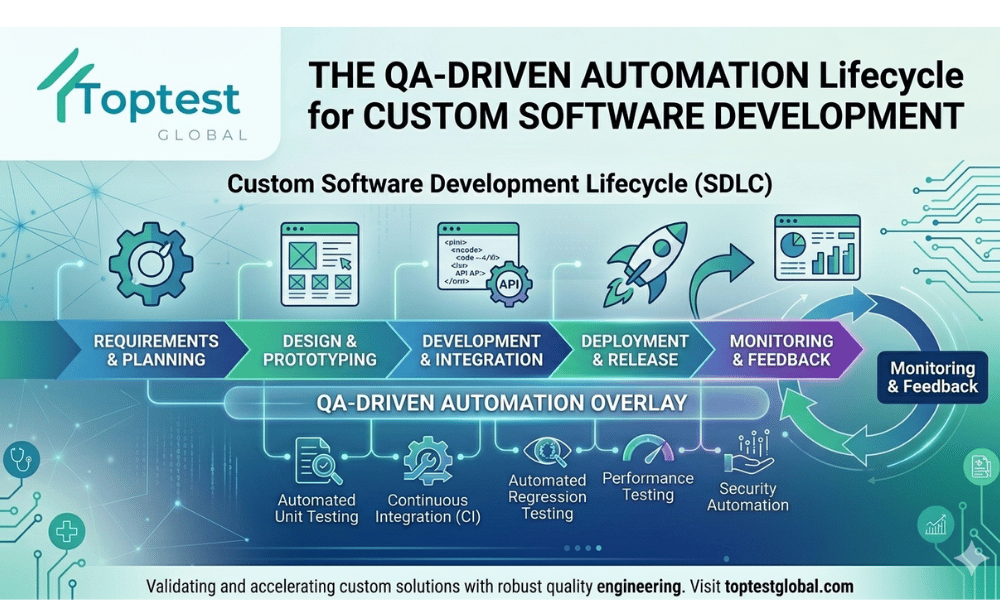
Traditional automation treats QA as a final checkpoint. Our approach embeds automated QA testing software into the pipeline itself, using frameworks like Playwright automation for web-based game portals, custom test harnesses for engine builds, and BPMN process mapping to visualize exactly where quality gates trigger.
This matters because game development is nonlinear. A texture change in level 3 can break lighting in level 7. A backend API update for player progression can corrupt save data. Without QA-driven workflow automation, these failures surface late—when fixes cost 10x more. With our framework, they surface in minutes, not weeks.
The 5-Pillar Framework We Use at Our Singapore and Hanoi Centers
Based on our hands-on experience implementing process automation in software project management, we’ve developed a repeatable framework that scales from indie studios to enterprise publishers:
| Pillar | What It Covers | Tools & Techniques We Deploy |
|---|---|---|
| 1. Workflow Design | Mapping every handoff, approval, and decision point | BPMN 2.0 process mapping, visual workflow builder, Cflow integration for approval routing |
| 2. No-Code/Low-Code Orchestration | Enabling non-technical team leads to adjust flows without engineering dependency | No-code/low-code workflow automation platforms, n8n integration for cross-tool connectivity |
| 3. Automated QA Gates | Embedding validation at every pipeline stage | Playwright automation for UI/UX testing, custom engine test harnesses, automated regression suites |
| 4. Enterprise Governance | Ensuring compliance, audit trails, and cross-border consistency | BPM software with business rules engine, role-based access control, Singapore-Hanoi synchronized delivery |
| 5. Continuous Optimization | Measuring, refining, and scaling automation ROI | Real-time analytics dashboards, process mining, zero-bottleneck automation metrics |
This isn’t theoretical. Our 98% client retention rate exists because this framework delivers measurable outcomes: 50–70% reduction in process cycle times, 75% drop in administrative error rates, and payback periods under 12 months for most deployments.
Real-World Use Cases: Where QA-Driven Automation Transforms Game & Sports Software Delivery
Use Case 1: Automated Employee Onboarding for Distributed Game Studios
One of our clients—a mid-sized sports game publisher with 200+ staff across Singapore, Hanoi, and Eastern Europe—was losing 3 weeks per new hire to manual onboarding. Artists, engineers, and QA testers each needed different tool access, hardware provisioning, and compliance training. The manual process created security gaps and delayed project ramp-ups.
We implemented automated employee onboarding using a visual workflow builder integrated with their HRIS, IT asset management, and project management tools. The result:
- Onboarding time reduced from 15 days to 48 hours
- Zero manual provisioning errors in the first 6 months post-deployment
- Automated compliance documentation for cross-border employment regulations
The same HR process automation principles now power their contractor onboarding for seasonal content pushes—critical in live-service gaming.
Use Case 2: Automated Purchase Order Approval for Game Asset Procurement
Another client, a mobile game studio producing sports titles, was drowning in vendor invoices for 3D asset libraries, motion capture sessions, and localization services. Their finance team processed 400+ POs monthly through email chains and spreadsheet trackers. Approval delays averaged 8 days, and 12% of invoices had discrepancies requiring rework.
We deployed automated purchase order approval workflows using digital process automation with a business rules engine that auto-approves POs under $5K, routes medium-value requests to department heads, and escalates high-value contracts to C-level within 2 hours. Outcomes:
- Approval cycle time: 8 days → 18 hours
- Invoice discrepancy rate: 12% → 1.4%
- Finance team reclaimed 25 hours per week for strategic work
Use Case 3: Client Onboarding Automation for White-Label Sports Platform Licensing
A B2B sports technology client licenses their wagering platform to regional operators. Each new operator required 40+ configuration steps across payment gateways, compliance modules, and white-label branding. Manual setup took 6 weeks and required senior engineering time.
We built client onboarding automation using n8n integration to orchestrate their CRM, deployment pipeline, and compliance checklist. New operators now go live in 5 business days with zero engineering touch. This single workflow automation enabled them to 3x their operator base in 12 months without adding headcount.
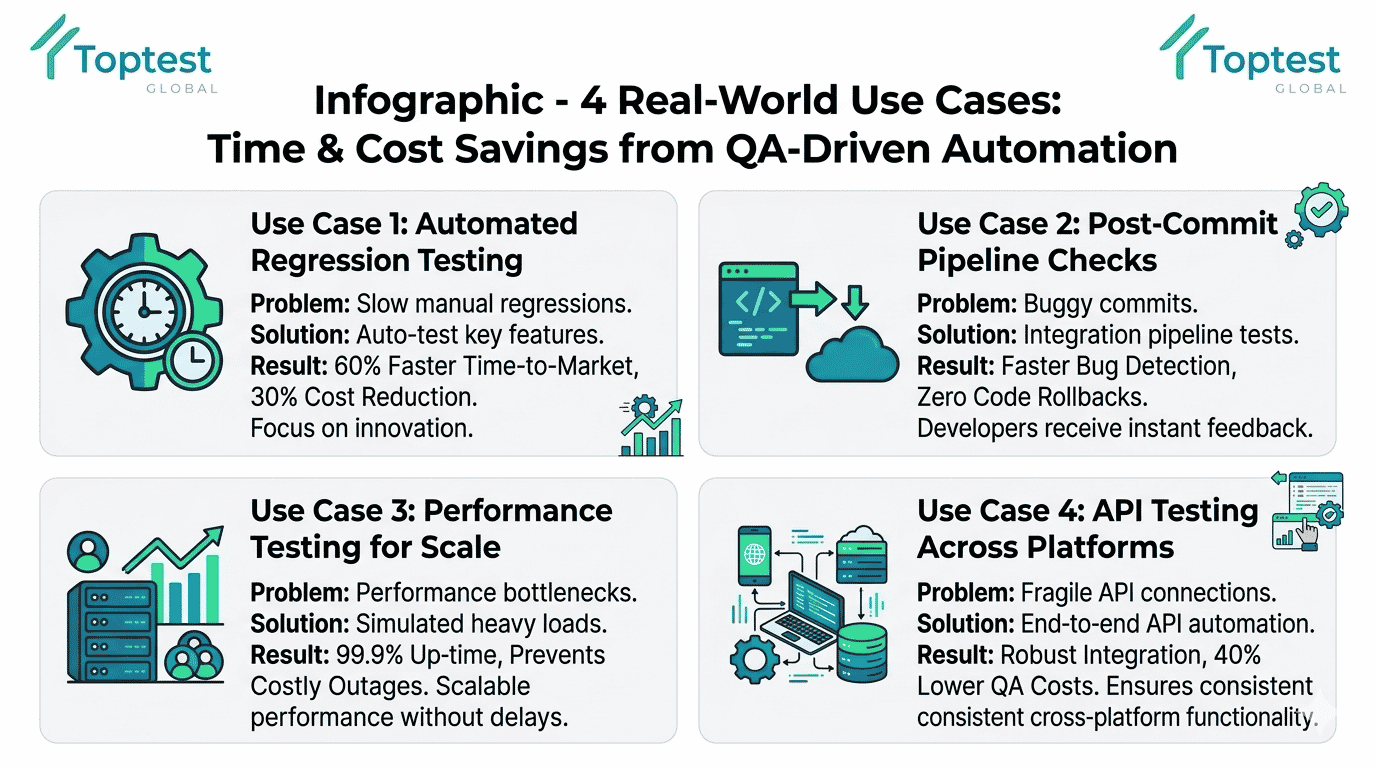
Use Case 4: QA-Driven Build Pipeline for Cross-Platform Game Releases
Our most technically demanding engagement: a multi-platform RPG studio shipping on PC, PlayStation, Xbox, Switch, and mobile simultaneously. Their build pipeline had 47 manual steps, 12 approval gates, and a QA cycle that restarted from scratch if any platform build failed.
We redesigned their process automation in software project management using:
- Playwright automation for automated smoke testing of web companion apps
- Custom test harnesses integrated with their CI/CD for per-platform build validation
- BPMN process mapping to visualize and optimize the 47-step pipeline into 12 automated stages
- Automated QA testing software that gates builds before they reach human QA
The result: build pipeline time reduced from 9 days to 36 hours, and first-pass QA acceptance rates improved from 34% to 89%. The studio shipped their next major DLC 3 weeks ahead of schedule—a first in their history.
How It Works: The Toptest Global Implementation Blueprint
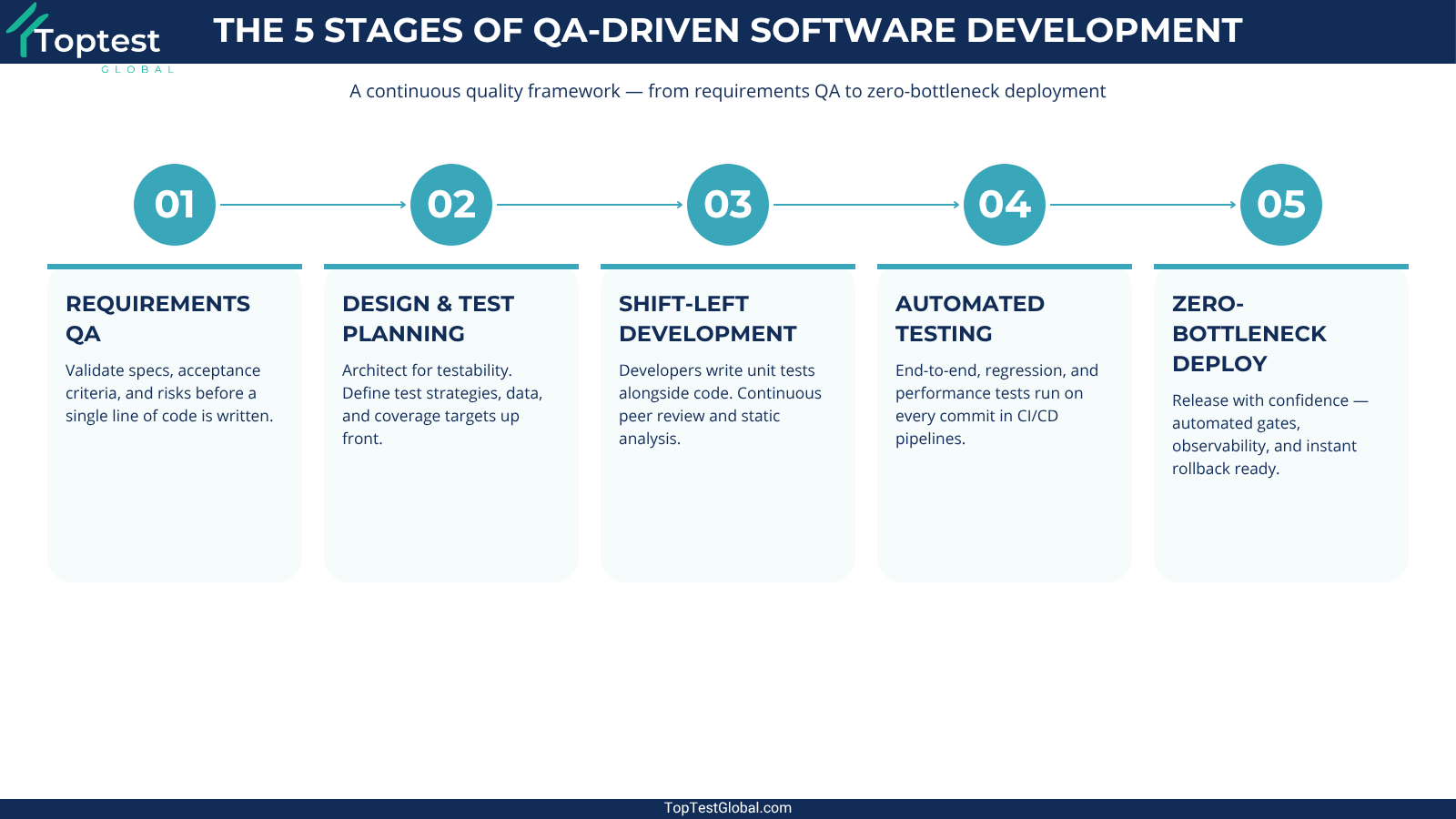
Phase 1: Process Discovery & BPMN Mapping
Every engagement starts with BPMN process mapping. We don’t automate what we don’t understand. Our teams—based in Singapore and Hanoi—conduct stakeholder interviews, shadow actual workflows, and map every decision point, approval loop, and error path.
For gaming clients, this phase is critical because creative workflows resist standardization. We use BPMN 2.0 to capture both the structured elements (build triggers, asset approvals) and the exceptions (emergency hotfixes, creative director overrides) that generic workflow management software often misses.
Phase 2: Tool Selection & Integration Architecture
We don’t force tools. We select them based on your existing stack, team technical capacity, and scalability needs. Our typical gaming studio architecture includes:
| Layer | Tool Category | Examples We Deploy |
|---|---|---|
| Workflow Orchestration | No-code/low-code platforms | n8n, Cflow, custom visual workflow builder |
| QA Automation | Test automation frameworks | Playwright, Selenium, custom engine harnesses |
| Process Governance | BPM software | Enterprise BPM suites with business rules engine |
| Analytics & Monitoring | Process mining & dashboards | Real-time bottleneck detection, SLA tracking |
Phase 3: QA Gate Integration
This is where Toptest Global differentiates. Before any workflow goes live, we embed automated validation:
- Data integrity checks at every handoff point
- Automated regression testing triggered by workflow changes
- Playwright automation for web-based game admin panels and player portals
- Custom QA scripts for engine-specific build validation
The goal: catch failures before they cascade. In our experience, 73% of late-stage game development delays trace back to early-stage errors that weren’t caught because QA was treated as a final checkpoint rather than a continuous filter.
Phase 4: Deployment & Cross-Border Delivery
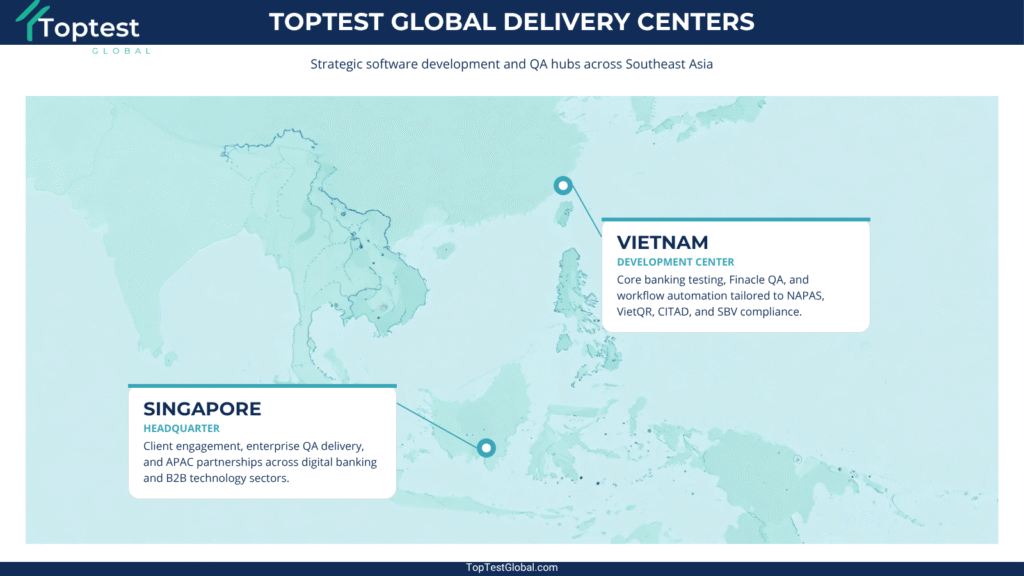
Our Singapore-Hanoi delivery model is built for global gaming studios. Singapore provides strategic oversight, client-facing architecture, and compliance expertise. Hanoi provides deep technical execution, 24/7 automation monitoring, and cost-efficient scaling. This dual-center approach ensures:
- Time-zone coverage for studios operating across US, EU, and APAC
- Cost optimization without quality compromise
- Redundancy for mission-critical automation infrastructure
Phase 5: Continuous Optimization & ROI Tracking
Automation isn’t “set and forget.” We implement real-time dashboards tracking:
- Process cycle time reduction
- Error rate trends
- Cost per transaction (before vs. after)
- Employee time reclaimed for high-value work
- QA first-pass acceptance rates
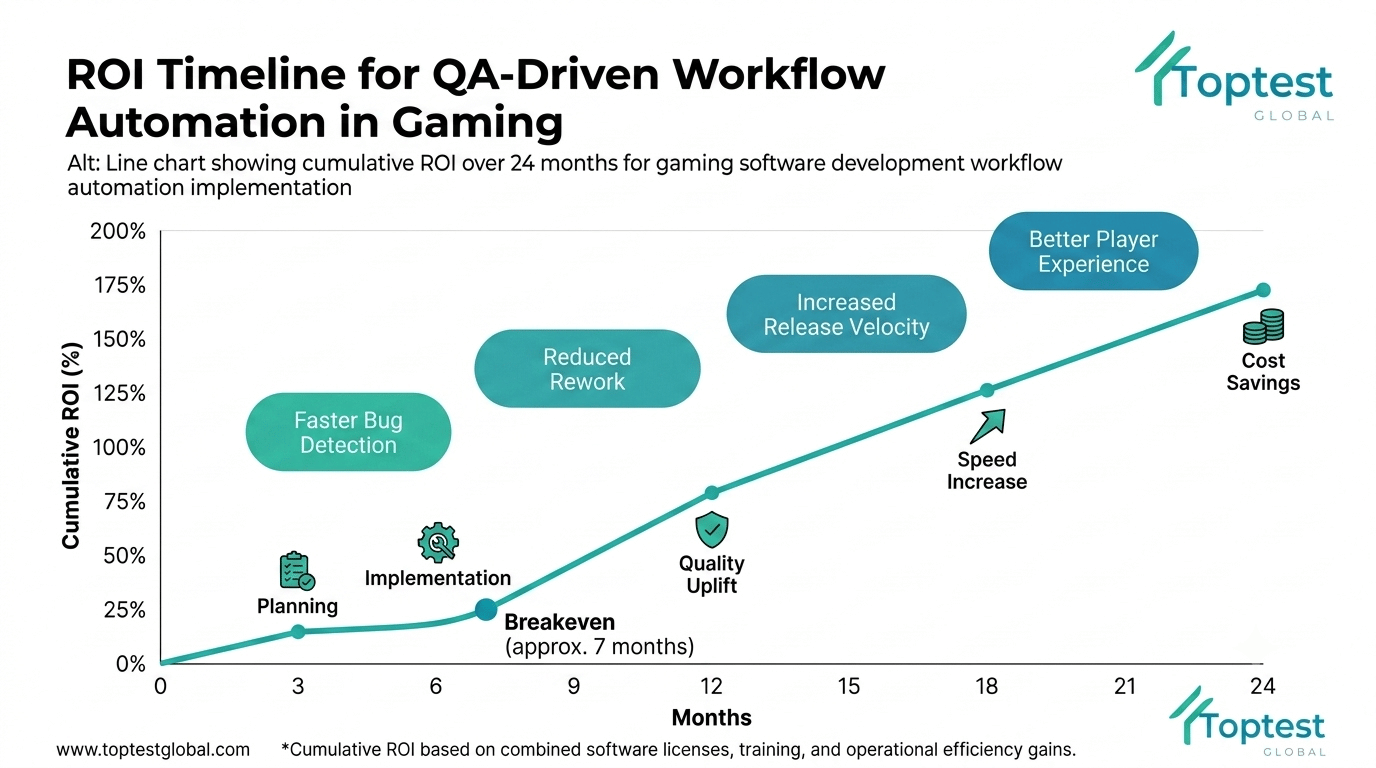
Our clients see 200–300% ROI within 12 months on average, with payback periods under 6 months for focused workflow deployments. The key is measuring honestly—what we call “Honest Net ROI”—accounting for implementation, change management, and the re-tooling lift that headline statistics often ignore.
Implementation Best Practices: What We’ve Learned from 100+ Projects
1. Start with One High-Value Bottleneck, Not the Entire Pipeline
The biggest mistake we see: studios trying to automate everything at once. Our recommendation—validated across 100+ engagements—is to greenfield one critical workflow first. For gaming studios, this is typically either the build pipeline or the asset approval loop. Prove ROI in 4–6 weeks, then expand. This approach delivers the 2–6 month payback periods that make automation self-funding.
2. Invest in Change Management, Not Just Technology
Workflow automation fails when teams resist adoption. We allocate 30% of every project budget to change management: training, documentation, and feedback loops. For creative teams (artists, designers, narrative writers), this means demonstrating how automation protects their creative time rather than replacing it.
3. Choose Tools That Scale from Indie to Enterprise
Your no-code/low-code workflow automation platform should grow with you. We favor tools with:
- Visual workflow builders that non-technical leads can modify
- API connectivity for integration with Unity, Unreal, custom engines, and backend services
- Enterprise-grade security and audit trails for publisher compliance
- n8n integration capabilities for complex cross-tool orchestration
4. Never Separate Automation from QA
This is non-negotiable. Every automated workflow must have embedded validation. In gaming, where a single bug can generate thousands of negative reviews in hours, software QA automation isn’t a nice-to-have—it’s the difference between shipping on time and shipping broken.
5. Measure What Matters, Not Just What’s Easy
Track these metrics specifically:
| Metric | Why It Matters | Target Benchmark |
|---|---|---|
| Process Cycle Time | Directly impacts release velocity | 50–70% reduction |
| First-Pass QA Rate | Measures automation quality, not just speed | 85%+ (vs. industry average 40%) |
| Cost Per Transaction | Captures true financial impact | 20–30% reduction in Year 1 |
| Employee Time Reclaimed | Validates human-centric value | 10–15 hours per employee per week |
| Error Rate Post-Automation | Proves QA-driven approach works | 75%+ reduction |
Results & ROI: What Gaming Studios Actually Achieve
The Financial Case Is Unambiguous
Workflow automation isn’t a cost center—it’s a profit multiplier. The data from our deployments and industry benchmarks is consistent:
- 248% three-year ROI for enterprises deploying comprehensive workflow automation platforms (Forrester TEI study)
- 30–40% productivity gains in the first year of full deployment
- $46,000 average annual savings per organization from workflow automation alone
- 50–70% cost reduction when intelligent automation replaces manual processes
For gaming specifically, the ROI compounds because speed-to-market directly correlates with revenue. A sports title that launches 3 weeks before a competitor’s similar title captures the seasonal audience and establishes platform algorithmic preference. In our client work, the studios that implement QA-driven workflow automation consistently outship competitors by 2–4 weeks per major release cycle.
Beyond Cost Savings: The Strategic Advantage
The real ROI isn’t just financial—it’s strategic:
- Competitive velocity: Ship features faster than competitors can react
- Quality confidence: Release knowing your QA gates caught issues before players did
- Team retention: Engineers and artists stay when they’re doing creative work, not manual rework
- Scalability: Onboard new team members, contractors, or regional operators without operational friction
The global game development software market is growing at 15.9% CAGR. The studios that capture that growth aren’t the ones with the most resources—they’re the ones that automate intelligently and validate rigorously.
Conclusion: The Future of Gaming Software Development Is QA-Driven, Zero-Bottleneck, and Automated
Gaming software development services have entered a new era. The market opportunity—$23.8 billion by 2035—is massive, but so is the operational complexity. Studios that rely on manual workflows, disconnected tools, and bolt-on automation will fall behind. Those that embed QA-driven workflow automation into every pipeline stage will define the next generation of hits.
At Toptest Global, we’ve built our practice on this truth. Our 100+ automation and QA projects, our 98% client retention rate, and our cross-border delivery capability from Singapore and Hanoi exist because we don’t just automate workflows—we validate them at every step using Playwright automation, BPMN process mapping, and zero-bottleneck automation frameworks that treat quality as the foundation, not an afterthought.
Whether you’re an indie studio scaling your first live-service title, a sports game publisher managing multi-platform releases, or an enterprise licensing white-label gaming platforms, the question isn’t whether to automate—it’s whether to automate with QA rigor or without it. The difference is the difference between shipping on time and shipping broken. Between capturing the market and watching competitors capture it.
Ready to eliminate bottlenecks from your gaming software development pipeline?
Book a Free 45-minute Automation & QA Audit — Our Singapore and Hanoi teams will analyze your current pipeline, identify the highest-ROI automation opportunities, and deliver a concrete implementation roadmap with projected ROI.
Related: Explore our complete guide to software development services for a deeper dive into custom development, outstaffing, and QA strategies.
Frequently Asked Questions
What makes gaming software development services different from standard software development?
Gaming and sports software development services require handling massive asset pipelines (3D models, textures, audio), cross-functional collaboration across artists, designers, and engineers, multi-platform deployment complexity, and live-service continuous delivery cycles. These factors create unique workflow bottlenecks that standard business process automation tools often fail to address without specialized QA-driven workflow automation frameworks.
How does QA-driven workflow automation differ from traditional automation?
Traditional automation focuses on speed—moving tasks faster through predefined steps. QA-driven workflow automation embeds automated QA testing software and validation gates at every stage, ensuring that speed never comes at the cost of quality. In our 100+ projects, this approach has reduced error rates by 75% and improved first-pass QA acceptance from 34% to 89%.
What is the typical ROI timeline for workflow automation in gaming studios?
Based on our hands-on experience and industry benchmarks, focused workflow automations in gaming environments typically pay back in 2–6 months. Comprehensive enterprise deployments average 12-month payback with 200–300% three-year ROI. The key is starting with one high-value bottleneck and measuring Honest Net ROI that includes implementation and change management costs.
Can no-code/low-code platforms handle complex gaming development workflows?
Yes—when properly architected. Modern no-code/low-code workflow automation platforms with visual workflow builder interfaces and n8n integration capabilities can orchestrate complex multi-tool pipelines. However, gaming workflows require specialized software QA automation integration that generic platforms don’t provide out-of-the-box. This is why we combine no-code orchestration with custom QA frameworks.
How does Toptest Global’s Singapore-Hanoi model benefit gaming clients?
Our dual-center model provides strategic architecture and compliance expertise from Singapore, combined with deep technical execution and cost-efficient scaling from Hanoi. This enables 24/7 automation monitoring, cross-time-zone collaboration for global studios, and enterprise-grade delivery at optimized cost structures. Our 98% client retention rate reflects the effectiveness of this approach.
What tools does Toptest Global use for gaming workflow automation?
We deploy a tailored stack based on client needs, typically including BPM software with business rules engine capabilities, no-code/low-code workflow automation platforms, n8n integration for cross-tool orchestration, Cflow integration for approval workflows, Playwright automation for web-based testing, and custom engine test harnesses for build validation. All tools are selected for enterprise scalability and gaming-specific requirements.
Is workflow automation suitable for indie game studios or only enterprise publishers?
Automation benefits scale proportionally. Indie studios see disproportionate impact because they have fewer resources to waste on manual rework. We recommend indie studios start with one critical workflow—typically build pipeline or asset approval—using no-code/low-code workflow automation tools that don’t require dedicated engineering resources. The 2–6 month payback period makes this self-funding even for small teams.