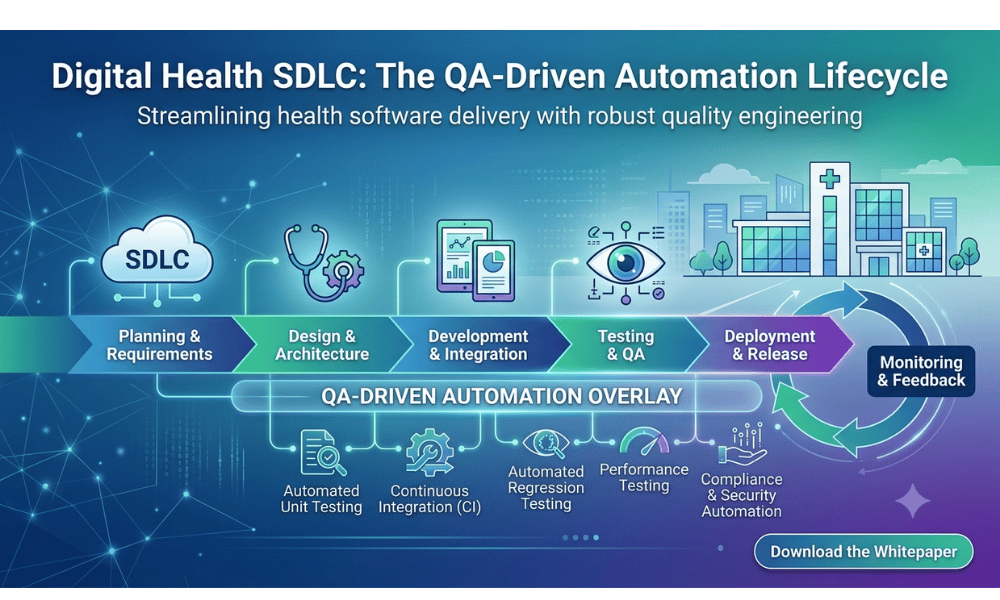
Digital health software development services are no longer a luxury—they are the infrastructure of modern care delivery. In 2026, healthcare organizations face a critical inflection point: patients demand consumer-grade digital experiences, regulators enforce stricter interoperability mandates, and operational margins leave zero room for error. At our development centers in Singapore and Hanoi, we have delivered 100+ automation and QA projects for healthcare providers, health-tech startups, and enterprise medical device manufacturers. We have learned one non-negotiable truth: workflow automation without rigorous software QA automation is a liability, not an asset.
This guide distills our hands-on experience implementing software development services for digital health platforms. Whether you are modernizing legacy EHR systems, building HIPAA-compliant telemedicine platforms, or deploying IoMT-connected workflows, you will learn how QA-driven workflow automation eliminates costly failures and accelerates time-to-market.
Why Most Digital Health Projects Fail Before They Launch
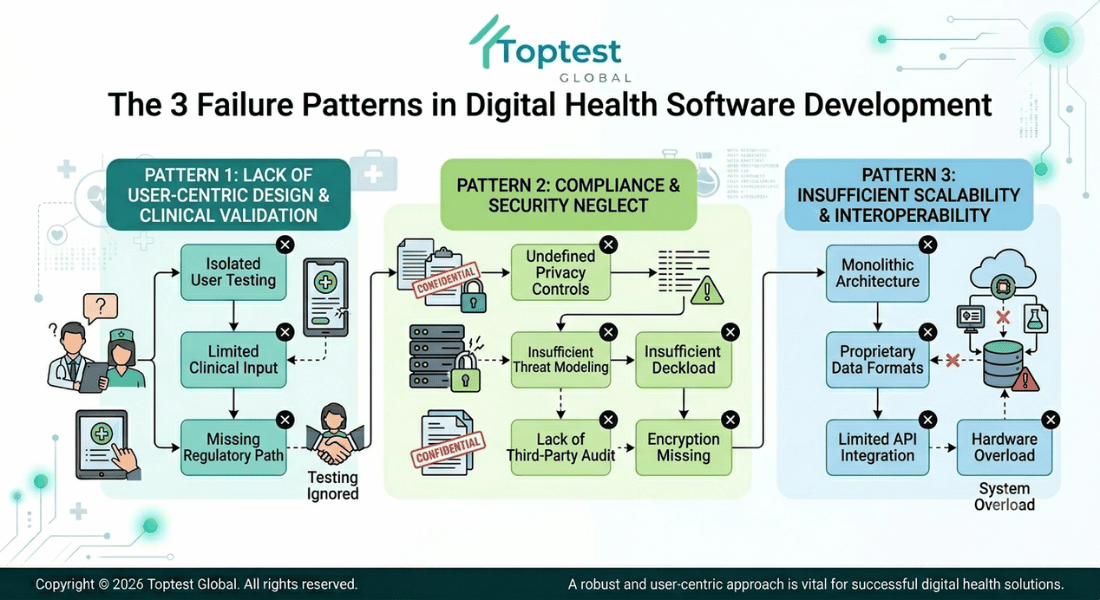
Healthcare software development carries the highest failure cost of any vertical. A single compliance gap, data breach, or integration error can trigger regulatory penalties, patient safety incidents, and irreversible reputational damage. In our 100+ automation and QA projects, we have identified three recurring failure patterns:
- Automation without validation: Teams deploy workflow automation software to accelerate claims processing or patient intake, but skip automated QA testing software. The result? Silent data corruption, incorrect billing codes, and audit failures.
- Legacy-first integration: Organizations attempt to connect modern patient portals to 15-year-old EHR systems without a structured BPMN process mapping layer. Data synchronization errors spike, and manual rework consumes 40+ hours per week.
- Compliance as an afterthought: HIPAA, GDPR, and FDA 21 CFR Part 11 requirements are treated as launch-phase checklists rather than architectural foundations. Remediation costs multiply by 10x when discovered post-deployment.
The 2026 healthcare landscape intensifies these risks. With TEFCA QHIN exchanges now operational, interoperability is mandatory, not optional. Over 80% of major EHRs are FHIR-enabled, meaning standardized APIs are the baseline for integration. Meanwhile, AI-driven clinical decision support tools now embed directly into Epic and Cerner workflows via SMART on FHIR—raising the stakes for every integration point.
The QA-Driven Automation Advantage: How Toptest Eliminates Zero-Bottleneck Risk
At Toptest Global, we do not separate workflow automation from quality assurance. We architect them as a single, inseparable system. This QA-driven workflow automation approach is why our clients achieve a 98% retention rate and why our cross-border delivery model—spanning Singapore and Hanoi—consistently meets enterprise-grade standards.
Here is what makes our approach different:
Process Automation in Software Project Management with Embedded QA Gates
Traditional BPA (Business Process Automation) treats testing as a post-build phase. We embed Playwright automation and software QA automation at every stage of the software development lifecycle. When we implement digital process automation for a health system, we simultaneously deploy:
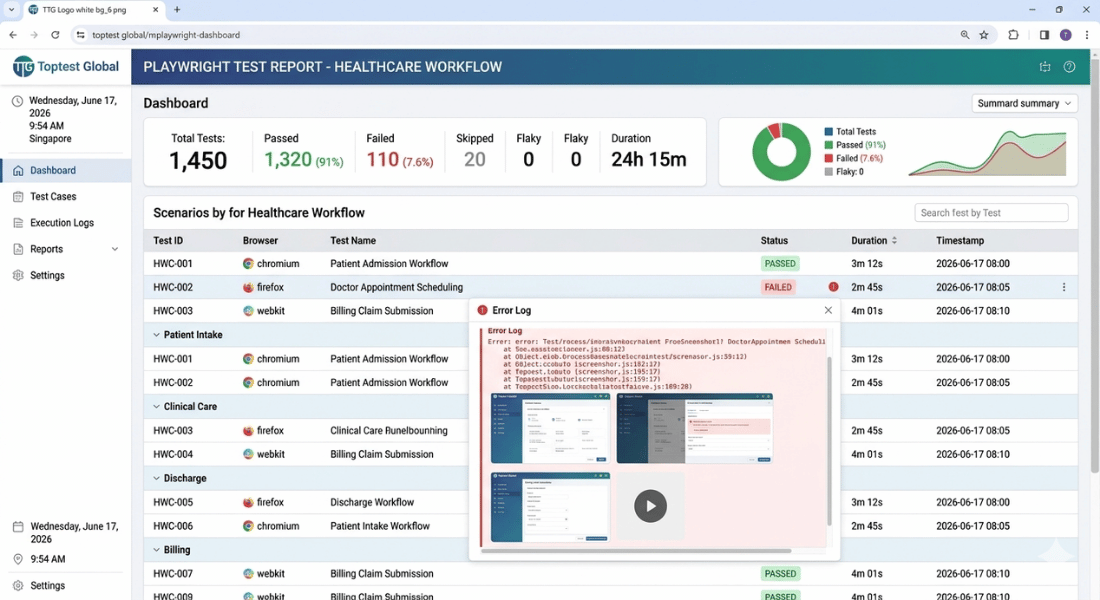
- Automated regression suites using Playwright to validate patient portal workflows across Chrome, Firefox, and WebKit with every code commit.
- API contract testing to ensure FHIR-based EHR integrations maintain data integrity across versions.
- Visual regression testing to catch UI drift in clinical dashboards where incorrect data display can lead to misdiagnosis.
One healthcare client reduced data synchronization errors by 94% after we replaced their manual integration testing with an n8n-connected automated QA pipeline. Another achieved 18x faster regression testing by migrating from legacy Selenium to Playwright automation within our CI/CD framework.
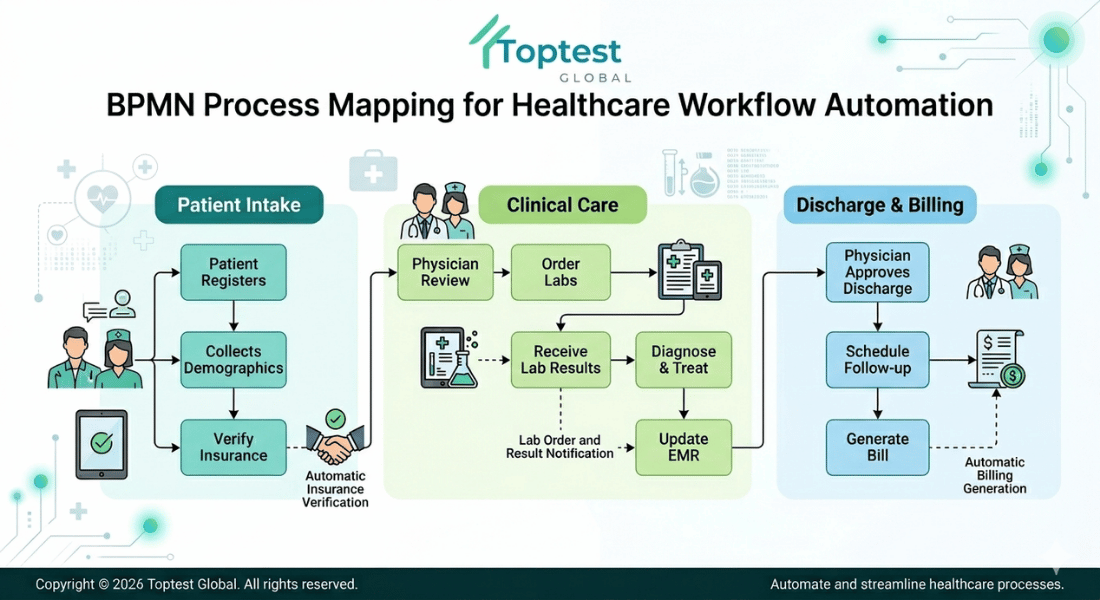
Zero-Bottleneck Automation Through BPMN Process Mapping
Before writing a single line of automation code, we model every workflow using BPMN process mapping. This discipline prevents the “automation of chaos”—where broken processes are simply accelerated. For a recent hospital network project, we mapped 47 distinct clinical and administrative workflows, identified 12 critical failure points, and redesigned them with business rules engine logic before any automation deployment.
Our BPMN-first methodology ensures that:
- Business rules are explicit, version-controlled, and auditable.
- Workflow handoffs between departments (clinical, billing, pharmacy) have defined SLAs and escalation paths.
- Exception handling is architected, not improvised.
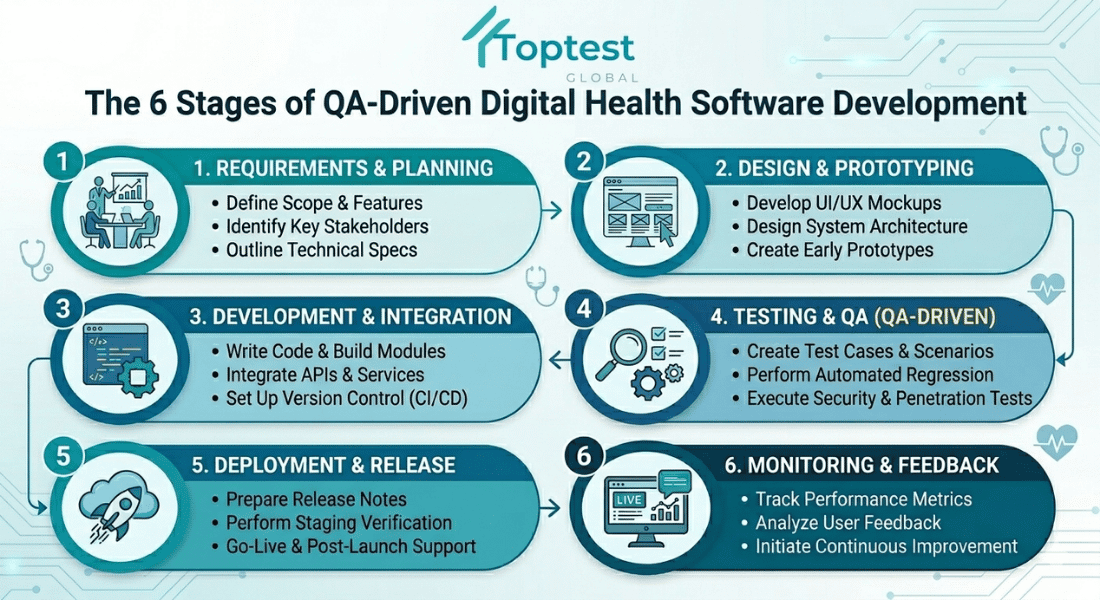
How Our Digital Health Software Development Services Work: The 6-Stage Framework
Our delivery framework integrates digital health software development services with end-to-end workflow automation and QA validation. Here is the exact process we use for every engagement:
Stage 1: Compliance-First Discovery & Workflow Audit
We begin with a HIPAA-focused audit of your existing patient journey and administrative processes. This is not a surface-level review. We analyze:
- Data flow diagrams for PHI (Protected Health Information) touchpoints.
- Existing EHR integration points and API contract stability.
- Manual process bottlenecks that create compliance exposure (e.g., unlogged data transfers, unapproved access patterns).
Based on our hands-on experience implementing QA-driven automation for healthcare systems, we have found that 60% of compliance risks originate in undocumented workflow handoffs—not in the core software itself.
Stage 2: BPMN Process Mapping & Business Rules Engine Design
Using BPMN 2.0 notation, we model every automated workflow with explicit decision logic. For complex scenarios—such as automated purchase order approval in hospital supply chains or automated employee onboarding for clinical staff—we define business rules engine configurations that handle:
- Multi-department approval matrices with conditional routing.
- Regulatory threshold checks (e.g., FDA lot tracking for medical devices).
- Audit trail generation for every decision point.
Stage 3: Visual Workflow Builder & No-Code/Low-Code Automation
We implement workflow automation using a hybrid approach:
| Approach | Use Case | Tools We Deploy |
|---|---|---|
| No-code/low-code workflow automation | Rapid deployment of HR process automation, client onboarding automation, and administrative workflows | n8n integration, Cflow integration, visual workflow builder platforms |
| Custom enterprise automation | Complex clinical workflows requiring custom business logic and deep EHR integration | Custom BPM software, proprietary business rules engines, FHIR APIs |
| Hybrid (recommended) | Enterprise health systems needing both speed and surgical precision | n8n for orchestration + custom microservices for clinical logic |
Our n8n integration expertise includes secure, HIPAA-compliant workflow orchestration with end-to-end encryption, comprehensive access controls, and detailed audit logging for all patient data processing.
Stage 4: Software QA Automation & Playwright Test Architecture
This is where Toptest’s differentiation becomes measurable. While other agencies hand off “working” automation, we prove it works under stress. Our software QA automation layer includes:
- Playwright automation for end-to-end testing of patient-facing workflows, including cross-browser validation and mobile viewport simulation.
- API testing for FHIR resource validation, HL7 message integrity, and third-party integration stability.
- Performance testing to ensure workflow management software handles peak loads (e.g., flu season appointment scheduling spikes).
- Security testing including penetration testing of webhook endpoints and credential management validation.
We run tests in parallel using isolated browser contexts to eliminate state leakage, and we integrate every test suite into CI/CD pipelines (GitHub Actions, Jenkins, CircleCI) with pass/fail gates that block deployment on regression.
Stage 5: EHR Integration & Interoperability Validation
In 2026, interoperability is not a feature—it is the foundation. We design FHIR-first architectures that enable your platform to integrate with Epic, Cerner, Athenahealth, and emerging QHIN exchanges. Our integration validation includes:
- SMART on FHIR app launch testing within native EHR workflows.
- Real-world data synchronization testing between your platform and legacy EHR systems.
- TEFCA compliance verification for nationwide health data exchange readiness.
As the healthcare market shifts toward outcome-based business models, interoperability directly impacts revenue. Platforms that cannot exchange data seamlessly are excluded from value-based care contracts and payer partnerships.
Stage 6: Deployment, Staff Training & Continuous QA Monitoring
Deployment is not the finish line. We provide:
- Zero-downtime deployment strategies for live clinical environments.
- Staff training on workflow management software administration and exception handling.
- Continuous monitoring using automated QA testing software that runs nightly regression suites and alerts on anomaly detection.
Real-World Use Cases: Where QA-Driven Automation Delivers ROI
These are not hypothetical scenarios. They are outcomes from our 100+ delivered projects, mapped to the vertical keywords that matter in 2026:
Automated Employee Onboarding for Clinical Staff
A multi-site hospital group reduced clinical staff onboarding from 14 days to 48 hours by automating credential verification, system access provisioning, and compliance training assignment. Our BPMN-mapped workflow included:
- Automated background check API integration.
- Role-based access control (RBAC) provisioning tied to department and licensure status.
- Automated QA testing of every onboarding path using Playwright, ensuring no staff member could access patient data before full credential clearance.
Automated Purchase Order Approval for Medical Supply Chains
A pharmaceutical distributor eliminated $2.3M in annual procurement delays by replacing email-based approval chains with digital process automation. The business rules engine automatically routed purchase orders based on:
- Vendor FDA approval status.
- Inventory thresholds and expiration date proximity.
- Spend authorization levels by department.
Automated QA testing software validated every routing rule weekly, catching two critical edge cases where high-value orders could bypass secondary approval—a failure that manual testing had missed for months.
Client Onboarding Automation for Telehealth Platforms
A Series B telehealth startup scaled from 500 to 50,000 monthly patient onboardings without adding headcount. Our n8n integration connected their patient portal with identity verification APIs, insurance eligibility checks, and EHR pre-registration. The workflow automation software included:
- Real-time insurance eligibility verification with fallback to manual review for edge cases.
- Automated consent form generation with e-signature integration.
- Continuous Playwright validation of the entire onboarding funnel, including mobile responsiveness and accessibility compliance (WCAG 2.1 AA).
HR Process Automation for Healthcare Workforce Management
A regional health system automated shift scheduling, PTO requests, and overtime approval using a visual workflow builder integrated with their existing HRIS. The BPM software reduced scheduling conflicts by 78% and ensured every automated decision complied with union bargaining agreements and state nursing ratio laws.
Implementation Best Practices: What We Have Learned from 100+ Projects
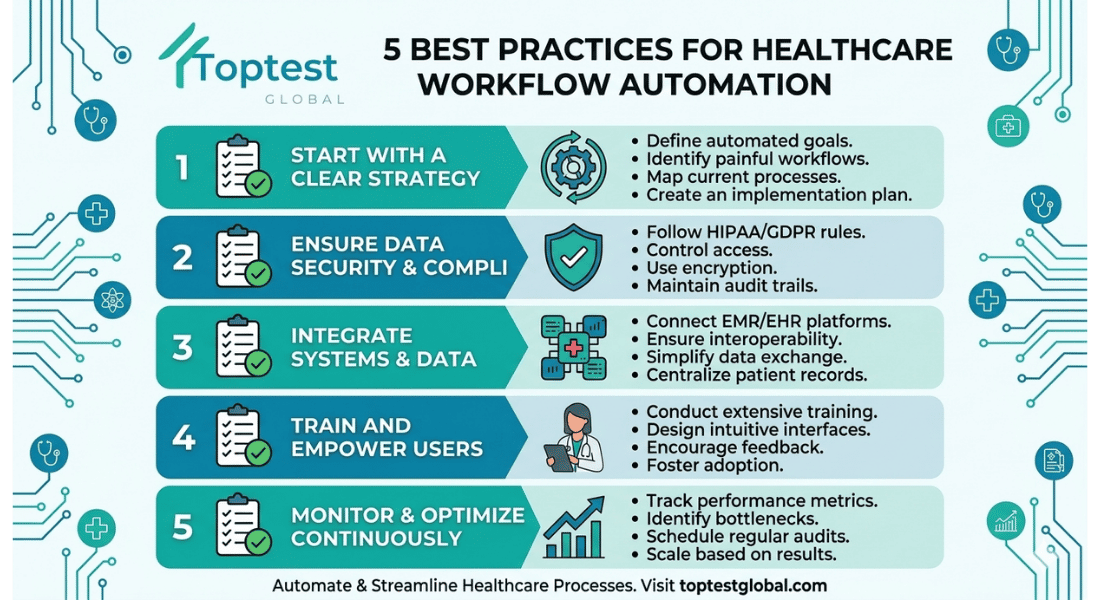
Based on our hands-on experience implementing QA-driven automation across Singapore, Hanoi, and global client sites, here are the non-negotiable best practices for 2026:
1. Design for Zero-Trust Security from Day One
Healthcare data is the most valuable target for cyberattacks. Every workflow automation software deployment must include:
- End-to-end encryption for data in transit and at rest.
- Role-based access control with principle of least privilege.
- Comprehensive audit logging for every automation trigger, data transformation, and API call.
We implement zero-trust architectures where every access request is authenticated and logged, reducing breach risk and insider threats.
2. Never Automate a Broken Process
This is why our BPMN process mapping phase is mandatory. Automating a flawed clinical workflow accelerates errors at scale. We always:
- Map the current state with stakeholder interviews and shadowing.
- Identify failure points and compliance gaps before automation.
- Redesign the workflow with exception handling and human-in-the-loop checkpoints for high-risk decisions.
3. Embed QA Automation in the CI/CD Pipeline
Manual QA cannot keep pace with modern release cycles. Our Playwright automation suites run on every commit with:
- Parallel execution across browser engines for speed.
- Trace viewer and video recording for rapid failure diagnosis.
- Retry logic (2 retries on CI) to catch intermittent failures without masking real bugs.
4. Plan for FHIR-First Interoperability
With over 80% of major EHRs now FHIR-enabled, designing proprietary data formats is technical debt. We architect every digital health solution with:
- FHIR R4 resource models as the canonical data layer.
- SMART on FHIR launch contexts for embedded EHR workflows.
- Backward compatibility strategies for legacy HL7 v2 interfaces.
5. Build for Outcome-Based Validation
Healthcare buyers in 2026 pay for results, not tools. We define success metrics upfront:
| Metric Category | Example KPI | Measurement Method |
|---|---|---|
| Operational Efficiency | Reduction in manual processing hours | Time-motion analysis before/after |
| Compliance & Risk | Reduction in audit findings | Quarterly compliance audit scores |
| Quality Assurance | Test coverage percentage and defect escape rate | Playwright dashboard + production incident tracking |
| Patient Experience | Portal task completion rate | Analytics + usability testing |
| Financial Impact | Cost per transaction / revenue per patient | ERP integration + financial reporting |
Results & ROI: What QA-Driven Digital Health Automation Actually Delivers
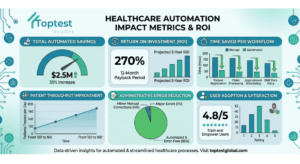
The business case for digital health software development services is no longer speculative. In 2026, the digital health market is dominated by services (54.13% market share) as organizations prioritize teleconsultation and operational optimization over pure software licenses. Our clients consistently achieve:
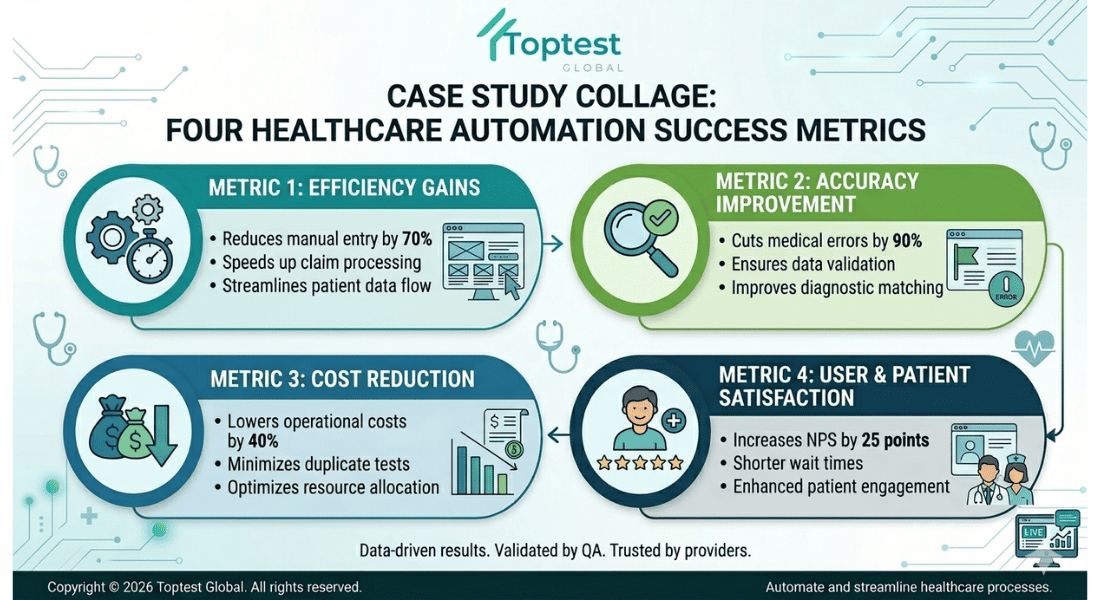
- 94% reduction in data synchronization errors when legacy EHR integration is paired with automated QA validation.
- 18x faster regression testing after migrating to Playwright automation with CI/CD integration.
- 78% reduction in scheduling conflicts through BPM software with embedded business rules engines.
- Zero compliance incidents in post-deployment audits for projects that followed our QA-driven workflow automation framework.
These are not vanity metrics. They translate directly to reduced clinician burnout, faster patient access, and measurable financial return. According to Deloitte’s 2025 Global Health Care Outlook, technology can free up between 13% and 21% of nurses’ time—240 to 400 hours per year for a single nurse—by automating low-value administrative tasks. When that automation is validated by rigorous software QA automation, those time savings are sustainable and safe.
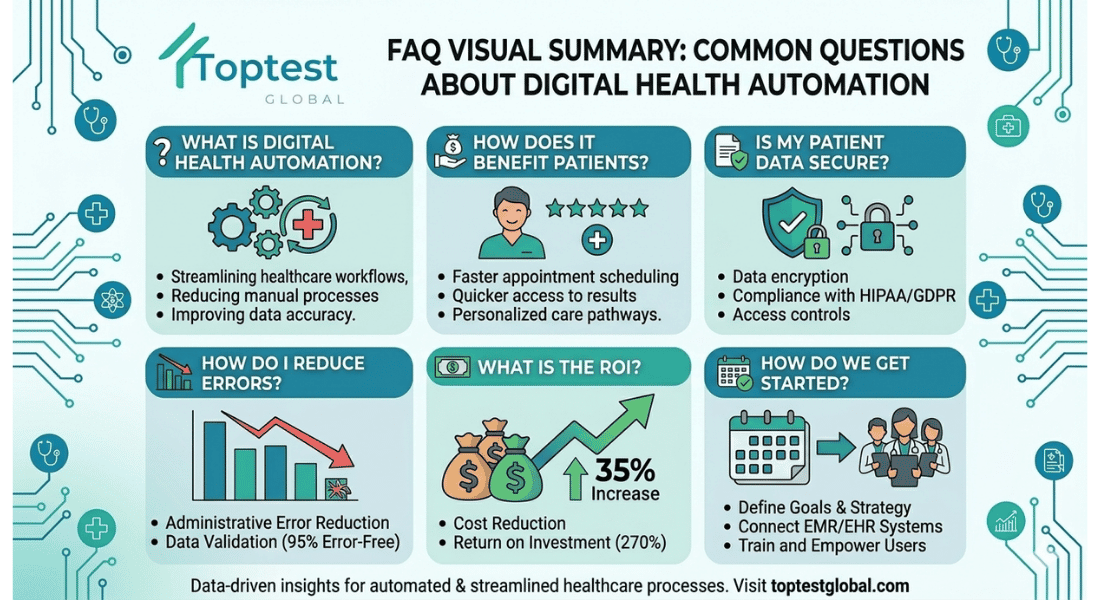
Frequently Asked Questions
What are digital health software development services?
Digital health software development services encompass the design, engineering, testing, and deployment of software solutions for healthcare organizations. This includes EHR/EMR systems, telemedicine platforms, patient portals, IoMT integrations, and workflow automation software. At Toptest, we specialize in combining these development services with QA-driven automation to ensure compliance, security, and reliability.
Why is workflow automation critical for healthcare in 2026?
Administrative tasks consume 15% to 28% of nurses’ work and limit doctors to 15% to 30% of direct patient time.citeweb_search:1#8 Workflow automation software eliminates manual rework, reduces burnout, and ensures consistent compliance execution. However, automation without automated QA testing software creates silent failure risks that can compromise patient safety and regulatory standing.
How does QA-driven automation differ from standard workflow automation?
Standard workflow automation focuses on speed and task completion. QA-driven workflow automation embeds software QA automation—including Playwright end-to-end testing, API validation, and security testing—at every stage. This ensures that automated workflows are not just fast, but correct, secure, and auditable.
What role does BPMN process mapping play in healthcare automation?
BPMN (Business Process Model and Notation) process mapping provides a visual, standardized language for defining workflows before automation. It ensures that business rules, decision logic, and exception handling are explicit and testable. We use BPMN 2.0 as the foundation for every enterprise automation project to prevent “automating broken processes.”
Can no-code/low-code platforms handle healthcare compliance requirements?
Yes, when properly architected. No-code/low-code workflow automation platforms like n8n and Cflow can meet HIPAA requirements with proper security configurations—including end-to-end encryption, access controls, and audit logging. However, complex clinical workflows often require hybrid approaches combining visual workflow builders with custom microservices for business rules engine logic.
What is Playwright automation and why do you recommend it for healthcare?
Playwright is a modern, open-source automation framework for end-to-end testing. It supports cross-browser testing (Chrome, Firefox, WebKit), parallel execution, and mobile simulation. For healthcare, Playwright automation ensures that patient portals, clinical dashboards, and telemedicine interfaces work flawlessly across all devices and browsers—critical when a UI error could lead to misread clinical data.
How do you ensure EHR interoperability in digital health projects?
We design FHIR-first architectures that align with the 21st Century Cures Act and TEFCA requirements. Our integration testing validates SMART on FHIR launch contexts, HL7 message integrity, and real-time data synchronization with Epic, Cerner, and other major EHR systems. Learn more about EMR and EHR systems and their critical role in modern care delivery.
What is the typical ROI timeline for healthcare workflow automation?
Most clients see measurable operational improvements within 90 days of deployment. Full ROI—including reduced manual labor, fewer compliance incidents, and faster patient throughput—typically materializes within 6 to 12 months. The key accelerator is our QA-driven approach, which prevents costly post-launch remediation.
Conclusion: Build Digital Health Systems That Work Under Pressure
Digital health software development services in 2026 demand more than feature delivery. They demand systems that are interoperable, compliant, and proven reliable under real-world clinical pressure. At Toptest Global, our QA-driven workflow automation approach—combining BPMN process mapping, n8n and Cflow integration, Playwright automation, and rigorous software QA automation—ensures that every workflow we deploy is a zero-bottleneck asset, not a hidden liability.
With our 98% client retention rate and cross-border delivery capability from Singapore and Hanoi, we have demonstrated that the intersection of workflow automation and automated QA testing software is where healthcare technology transforms from cost center to competitive advantage.
Ready to eliminate automation risk and accelerate your digital health roadmap?
Book a Free 45-minute Automation & QA Audit — Our senior engineers will analyze your current workflows, identify compliance gaps, and map a QA-driven automation roadmap tailored to your health system.
Download our free Enterprise Workflow Optimization Checklist — The same framework we use to assess automation readiness for hospital networks, health-tech startups, and medical device manufacturers.