In 2026, global spending on software development services is projected to exceed $1.2 trillion as enterprises race to digitize operations, startups build AI-native products, and mid-market companies replace legacy systems. Yet 70% of software projects still fail — not because of bad ideas, but because of poor execution, inadequate quality assurance, and development teams that treat testing as an afterthought.
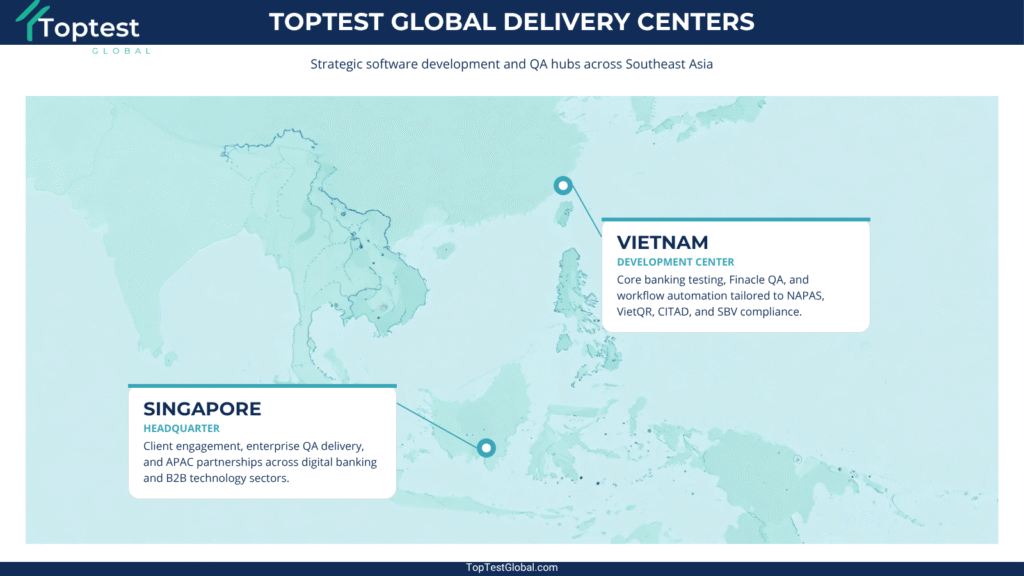
At Toptest Global, software development services are not just about writing code. In our 100+ automation and QA projects delivered from our development centers in Singapore and Hanoi, we have learned one immutable truth: software that is not built with QA from day one becomes technical debt that bleeds budget and erodes trust. This guide distills everything we have learned — from custom enterprise builds to AI-driven applications — so you can choose the right software development services with confidence.
By the end of this guide, you will understand the five types of software development services, how to evaluate providers, what pricing to expect across regions, and why a QA-driven development approach is the only reliable path to zero-bottleneck delivery.
What Are Software Development Services? (And Why They Matter in 2026)
Software development services encompass the full lifecycle of building, testing, deploying, and maintaining software applications — from initial requirements gathering through post-launch support. These services include custom application development, enterprise system integration, AI and machine learning solutions, mobile and web development, QA automation, DevOps, and ongoing maintenance.
What separates high-performing software development services from commodity coding shops is not technical skill alone. It is the systematic integration of quality assurance into every phase of the development process. In our experience, projects that embed automated QA testing from requirements analysis deliver 40% faster time-to-market and 60% fewer production defects than those that bolt on testing at the end.
Three forces are accelerating demand for professional software development services in 2026:
- AI integration pressure: Every enterprise is exploring how AI can automate decisions, personalize customer experiences, and optimize operations. Building AI-capable software requires specialized expertise that most in-house teams lack.
- Legacy modernization urgency: Core systems built in the 2000s are reaching end-of-life. Replacing them without disrupting operations demands careful architecture and rigorous testing.
- Regulatory complexity: From HIPAA in healthcare to PCI-DSS in fintech to GDPR in Europe, compliance requirements are tightening. Software must be built with audit trails, encryption, and access controls from the ground up.
These forces mean that choosing the right software development services provider is no longer a procurement decision. It is a strategic competitive decision.
The 5 Types of Software Development Services Every Business Needs
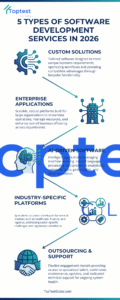
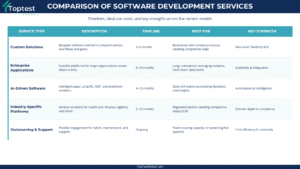
Not all software development services are created equal. Depending on your business size, industry, and technical maturity, you will need a different mix of capabilities. Below are the five categories we deliver at Toptest Global, each with distinct use cases and success metrics.
1. Custom Software Development Services
Custom software development services build applications tailored to your exact business processes, data flows, and user requirements. Unlike off-the-shelf SaaS products that force you to adapt your workflow to their limitations, custom solutions adapt to you.
We recommend custom software development services when:
- Your workflow contains proprietary logic that no existing product supports
- You need deep integration with legacy systems or specialized hardware
- Data security requirements exceed what SaaS vendors can guarantee
- You want full ownership of source code and intellectual property
At Toptest, our custom software development services follow a QA-integrated Agile methodology. Every two-week sprint includes automated unit tests, integration tests via Playwright, and manual exploratory testing. This is not optional — it is how we guarantee that what we build works before it reaches your users.
2. Enterprise Software Development Services
Enterprise software development services address the complexity of large organizations: multi-department workflows, legacy system integration, strict compliance requirements, and the need for 99.9% uptime. These projects typically span 6–18 months and require architecture planning before a single line of code is written.
Enterprise software development services demand:
- Scalable microservices architecture that handles millions of transactions
- API-first design for integration with ERP, CRM, and legacy databases
- Role-based access control (RBAC) and audit logging for compliance
- Disaster recovery and failover planning baked into infrastructure design
In our enterprise engagements across Singapore and Australia, we have observed that the biggest risk is not technical complexity — it is organizational misalignment. That is why our enterprise software development services include stakeholder workshops, change management planning, and phased rollout strategies alongside the technical build.
3. AI Software Development Services
AI software development services transform raw data into intelligent applications — from predictive analytics and natural language processing to computer vision and generative AI integration. In 2026, AI is no longer experimental. It is operational.
However, AI software development services carry unique risks that traditional development ignores:
- Data quality issues corrupt model outputs silently
- Model drift degrades accuracy over time without monitoring
- Algorithmic bias creates legal and reputational exposure
- Integration fragility breaks when upstream data changes
Our AI software development services address these risks through a QA-driven ML pipeline: data validation before training, A/B testing for model selection, automated bias detection, and continuous performance monitoring in production. We do not just build AI. We build reliable AI.
4. Industry-Specific Software Development Services
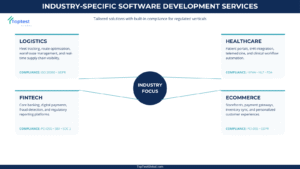
Generic software fails in regulated industries because compliance, data formats, and operational rhythms are domain-specific. Our industry-focused software development services include:
- Logistics software development services: Transportation management systems (TMS), warehouse management systems (WMS), route optimization algorithms, and real-time fleet tracking. These systems must handle high-frequency data streams, integrate with IoT sensors, and comply with customs and trade regulations.
- Healthcare software development services: Electronic health record (EHR) integration, telehealth platforms, patient portals, and HIPAA-compliant data pipelines. Security and interoperability are non-negotiable.
- Fintech software development services: Payment processing, fraud detection, regulatory reporting, and open banking APIs. These systems require PCI-DSS compliance, real-time transaction handling, and cryptographic security.
Each vertical demands domain expertise that generalist developers lack. At Toptest, we assign teams with relevant industry experience and enforce sector-specific QA protocols — from HL7/FHIR validation in healthcare to SWIFT message testing in fintech.
5. Software Development Outsourcing Services
Software development outsourcing services provide access to specialized talent, faster scaling, and cost optimization without the overhead of permanent hiring. The global outsourcing market for software development exceeds $500 billion annually, driven by talent shortages in North America, Western Europe, and Australia.
However, outsourcing fails when communication gaps, timezone mismatches, and quality inconsistency erode trust. Our software development outsourcing services solve this through:
- Cross-border delivery model: Singapore-based project management with Hanoi-based execution teams. You get timezone-friendly communication and competitive rates without sacrificing quality.
- Embedded QA teams: Every outsourced project includes dedicated QA engineers who report directly to you, not just to the development team.
- Transparent sprint delivery: Weekly demos, automated test reports, and real-time progress dashboards. No black boxes.
Our 98% client retention rate across outsourcing engagements is not accidental. It is the result of treating outsourced teams as extensions of your in-house capability, not as disposable contractors.
Why Traditional Software Development Often Fails (And How to Avoid It)
After delivering 100+ projects, we have identified three failure patterns that plague traditional software development services. Understanding them will save you months of frustration and hundreds of thousands of dollars.
The Hidden Cost of Skipping QA in Software Development
The most expensive decision in software development is not hiring the wrong developer. It is deferring quality assurance until the end of the project. When QA is treated as a final gate rather than a continuous practice, defects compound, architectural flaws go undetected, and rework consumes 30–50% of the total budget.
Consider this data from our project history:
| QA Approach | Average Defects in Production | Rework Cost (% of Budget) | Client Satisfaction |
|---|---|---|---|
| QA bolted on at end | 12–18 critical defects | 35–50% | Low |
| QA integrated mid-project | 5–8 critical defects | 15–25% | Medium |
| QA-driven from day one (Toptest) | 0–2 critical defects | <5% | High (98% retention) |
The difference is not tooling. It is culture. QA-driven software development services treat every requirement as testable, every feature as verifiable, and every deployment as reversible.
Why “Fast and Cheap” Creates Technical Debt
Speed and cost are legitimate constraints. But when they become the primary selection criteria for software development services, the result is technical debt — shortcuts in architecture, missing documentation, untested edge cases, and fragile integrations that collapse under scale.
We have inherited projects where previous vendors delivered “working” software in record time, only for the client to discover that:
- The database schema could not handle 10x user growth
- APIs had no authentication, creating security exposure
- Code had zero test coverage, making changes prohibitively expensive
- Documentation was nonexistent, so knowledge walked out the door with the original developers
Technical debt is not free. It is a loan with compounding interest, and the interest payments are paid in delayed releases, emergency fixes, and lost customer trust. Our QA-driven approach prevents this by enforcing architectural standards, automated testing gates, and comprehensive documentation from sprint one.
The QA-Driven Software Development Advantage: Toptest’s Proven Framework
At Toptest Global, we do not separate development from quality assurance. We fuse them. Our QA-driven software development framework ensures that every line of code is written with verification in mind, every feature is tested before it is declared complete, and every deployment is reversible.
This is not theoretical. In our development centers in Singapore and Hanoi, this framework has delivered 100+ successful projects across workflow automation, enterprise systems, AI applications, and mobile platforms.
How We Combine Software QA Automation with Agile Development
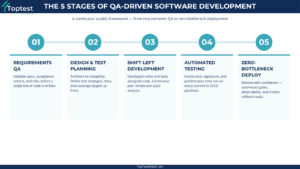
Traditional Agile treats testing as a phase within each sprint. Our approach treats testing as a continuous pipeline that runs in parallel with development. Here is how it works:
- Sprint Planning: Every user story includes acceptance criteria written in Gherkin syntax (Given-When-Then), making requirements testable by definition.
- Development: Developers write unit tests before implementation (TDD). Code cannot be merged without passing automated unit and integration tests.
- Continuous Integration: Every commit triggers a CI pipeline that runs Playwright end-to-end tests, API contract tests, and security scans.
- Sprint Review: Features are demonstrated with test coverage reports. No feature ships without 80%+ automated test coverage.
- Release: Blue-green deployment with automated rollback triggers. If error rates exceed thresholds, the deployment reverts automatically.
This pipeline is not optional overhead. It is how we achieve zero-bottleneck delivery — where releases happen on schedule, defects are caught before users see them, and technical debt never accumulates.
Playwright Automation: Ensuring Zero-Bottleneck Delivery
Playwright automation is the backbone of our web application testing strategy. Unlike older tools that struggle with modern JavaScript frameworks, Playwright provides reliable cross-browser testing with a single codebase — Chrome, Firefox, Safari, and Edge.
In our software development services, Playwright automation delivers:
- Cross-browser consistency: Identical tests run across all major browsers in parallel, cutting test execution time by 70%.
- Visual regression testing: Screenshots captured during every test run detect UI changes that functional tests miss.
- API testing integration: Backend validation runs alongside frontend tests, ensuring full-stack reliability.
- CI/CD native: Playwright integrates seamlessly with GitHub Actions, GitLab CI, Jenkins, and Azure DevOps.
For one enterprise client in logistics, our Playwright automation suite reduced regression testing from 3 days of manual work to 45 minutes of automated execution — while improving defect detection by 40%.
Our 98% Client Retention Rate: What It Means for You
Client retention is the only metric that cannot be gamed. A vendor can manipulate portfolio screenshots, inflate case study numbers, and buy fake reviews. But they cannot force clients to renew contracts.
Our 98% client retention rate across software development services engagements reflects three commitments:
- Transparency: Real-time access to code repositories, test results, and project dashboards. You see what we see.
- Accountability: Fixed sprint deliverables with clear acceptance criteria. If we miss, we fix it on our time.
- Quality as default: Not an upsell. Not a separate line item. QA is embedded in every hour we bill.
This is why clients who start with a single project expand to multi-year partnerships. They discover that software development services can be predictable, reliable, and genuinely partnership-oriented.
Software Development Services by Industry: Real-World Applications
Theory matters less than execution. Below are two industry examples where our software development services delivered measurable business outcomes.
Logistics Software Development Services
A regional logistics provider in Southeast Asia approached us with a fragmented technology stack: Excel-based route planning, manual invoice processing, and no real-time visibility into fleet locations. They needed logistics software development services that could unify operations without disrupting daily deliveries.
Our solution:
- Transportation Management System (TMS): AI-powered route optimization that reduced fuel costs by 22% and delivery times by 18%.
- Warehouse Management Integration: Real-time inventory tracking with barcode scanning and automated reorder triggers.
- Driver Mobile App: GPS tracking, delivery confirmation with photo capture, and instant proof-of-delivery.
- Automated QA: Playwright end-to-end tests for the driver app, API contract tests for TMS integrations, and load testing for peak season simulation.
The result: 40% reduction in operational overhead within six months of deployment, with zero critical defects in production.
Healthcare & Fintech Software Development
For a digital health startup building a telehealth platform, compliance was existential. HIPAA violations carry penalties up to $1.5 million per year, and a single data breach destroys patient trust permanently.
Our healthcare software development services included:
- End-to-end encryption: All patient data encrypted at rest (AES-256) and in transit (TLS 1.3).
- Role-based access control: Doctors, nurses, administrators, and patients each see only authorized data.
- Audit logging: Every data access logged with user ID, timestamp, and action for compliance reporting.
- QA validation: Automated security scanning (OWASP ZAP), penetration testing, and HIPAA checklist verification before every release.
For fintech clients, we apply the same rigor to PCI-DSS compliance, SWIFT message validation, and real-time fraud detection model testing.
How to Choose the Right Software Development Services Provider
Selecting a software development services provider is a high-stakes decision. The wrong choice wastes budget, delays market entry, and creates technical debt that outlasts the vendor relationship. Use this framework to evaluate providers objectively.
7-Point Evaluation Checklist
| Criteria | What to Look For | Red Flag |
|---|---|---|
| 1. QA Integration | Automated testing from day one, test coverage metrics, CI/CD pipeline | “We test at the end” or no QA team mentioned |
| 2. Technical Depth | Modern stack expertise (Node.js, Python, React, cloud-native), not just legacy skills | Only offers outdated technologies |
| 3. Industry Experience | Relevant case studies in your sector with measurable outcomes | Generic portfolios with no metrics |
| 4. Communication | Daily standups, weekly demos, real-time dashboards, timezone compatibility | Vague communication plans or language barriers |
| 5. Scalability Planning | Architecture reviews, load testing, cloud-native design patterns | No discussion of future growth or performance |
| 6. IP & Security | Source code ownership in contract, NDAs, security certifications | Unclear IP terms or no security discussion |
| 7. Post-Launch Support | SLAs, maintenance plans, monitoring, and incident response | “Handover and goodbye” approach |
Red Flags That Signal a Risky Partnership
Beyond the checklist, watch for these warning signs during vendor evaluation:
- Fixed-price quotes without detailed scope: This guarantees either scope creep or corner-cutting. Professional software development services require discovery before pricing.
- No testing strategy in the proposal: If QA is not mentioned in the sales phase, it will not exist in the delivery phase.
- Offshore-only with no local presence: Timezone gaps and cultural misalignment kill projects. Look for hybrid models with local project management.
- Portfolio full of “similar” projects but no metrics: “We built an app for a healthcare client” means nothing without outcomes like “reduced patient wait time by 35%.”
- Pressure to sign before technical due diligence: Urgency is a sales tactic, not a project management strategy.
Software Development Services Pricing: What to Expect in 2026
Pricing for software development services varies by region, complexity, engagement model, and team composition. Below is a realistic framework based on our 2026 rate card and market benchmarks.
Regional Cost Comparison
| Region | Hourly Rate (USD) | Typical Team Size | Best For |
|---|---|---|---|
| United States | $120 – $250 | 5–15 | Onsite collaboration, regulated industries |
| Western Europe | $100 – $200 | 5–12 | GDPR compliance, local language requirements |
| Australia | $100 – $180 | 5–10 | APAC timezone, English-native communication |
| Singapore | $80 – $150 | 5–20 | Regional HQ, bilingual teams, strong IP protection |
| Vietnam (Hanoi) | $25 – $45 | 10–50 | Cost optimization, scalable teams, strong engineering talent |
| India | $20 – $40 | 10–100+ | Maximum scale, established outsourcing infrastructure |
Our Singapore-Hanoi delivery model combines Singapore-based project management and client-facing expertise with Vietnam-based execution teams. You get enterprise-grade quality at 40–60% lower cost than pure onshore development.
Engagement Models
- Fixed Price: Best for well-defined scopes with stable requirements. Risk: scope changes trigger change orders.
- Time & Material: Best for evolving requirements and R&D projects. Risk: requires trust and transparency.
- Dedicated Team: Best for long-term partnerships and product development. Risk: requires active product management from client side.
We recommend Time & Material with sprint-based milestones for most software development services engagements. It balances flexibility with accountability.
HSN Code for Software Development Services (India Compliance)
For businesses operating in India or invoicing Indian clients, understanding the HSN code for software development services is essential for GST compliance:
- 998313: Information technology consulting and support services
- 998314: Information technology design and development services (software)
- GST Rate: 18% (9% CGST + 9% SGST for intra-state; 18% IGST for inter-state)
Always verify HSN classification with your tax consultant, as specific service descriptions may affect categorization. Toptest Global ensures all invoices to Indian clients include correct HSN codes and GST documentation.
The Toptest Global Difference: QA-First, Results-Always
After 100+ projects, we have learned that software development services are only as good as the quality assurance behind them. A beautifully designed application that crashes under load, leaks data, or fails compliance audits is not a success. It is a liability.
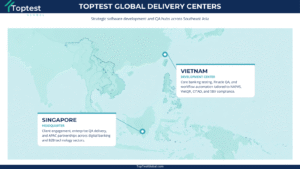
From Our Development Centers in Singapore and Hanoi
Our dual-location model is not about cost arbitrage. It is about capability arbitrage:
- Singapore: Client-facing architects, project managers, and domain experts who understand your business context, regulatory environment, and competitive pressures.
- Hanoi: Deep engineering talent — full-stack developers, AI/ML engineers, DevOps specialists, and QA automation engineers who build and test with precision.
This model gives you timezone-friendly communication (Singapore is 0–3 hours from most APAC business centers), cultural alignment (English-proficient teams, Agile-native work culture), and scalability (ramp from 3 to 30 engineers in 30 days).
Cross-Border Delivery, Enterprise-Grade Quality
Whether you are a startup in Sydney building your first MVP, an enterprise in Singapore modernizing legacy systems, or a logistics firm in Ho Chi Minh City optimizing operations, our software development services deliver the same standard: zero-bottleneck quality.
This means:
- No surprises in sprint reviews
- No critical defects in production
- No technical debt that blocks future growth
- No communication gaps that derail timelines
It is not magic. It is methodology. And it is available to every client who works with us.
Frequently Asked Questions
What is included in software development services?
Software development services typically include requirements analysis, UI/UX design, coding, quality assurance testing, deployment, and ongoing maintenance. At Toptest Global, we integrate automated QA testing from day one, ensuring that what we build works reliably before it reaches your users. Our services also include project management, technical documentation, and post-launch support with defined SLAs.
How much do software development services cost?
Costs vary by region, complexity, and engagement model. In 2026, hourly rates range from $20–$40 in India and Vietnam to $100–$250 in the US. A typical MVP project costs $25,000–$75,000, while enterprise systems can range from $150,000 to $500,000+. Toptest’s Singapore-Hanoi model delivers enterprise quality at 40–60% lower cost than pure onshore development. Contact us for a tailored estimate.
What is the HSN code for software development services?
The primary HSN code for software development services in India is 998314 (Information technology design and development services), with 998313 used for IT consulting. The applicable GST rate is 18%. Always confirm with your tax advisor, as service descriptions can affect classification. Toptest includes correct HSN documentation on all invoices to Indian clients.
What is the difference between custom and enterprise software development?
Custom software development builds applications tailored to specific business needs, regardless of organization size. Enterprise software development addresses the complexity of large organizations: multi-department integration, legacy system compatibility, strict compliance, and massive scale. At Toptest, both follow our QA-driven methodology, but enterprise projects include additional architecture planning, stakeholder alignment, and phased rollout strategies.
How does QA-driven development reduce project risk?
QA-driven development catches defects early, prevents architectural flaws, and eliminates technical debt before it accumulates. Our framework includes automated testing at every commit, Playwright end-to-end validation, security scanning, and performance testing. The result: 0–2 critical defects in production versus 12–18 for traditional approaches, and less than 5% rework cost versus 35–50%.
Why choose a software development services private limited company?
A software development services private limited structure offers limited liability protection, professional credibility, regulatory compliance, and transparent financial governance. For clients, this means contractual enforceability, intellectual property protection, and accountability. Toptest Global operates with full legal transparency, clear IP ownership terms, and enterprise-grade security standards.
How long does a typical software development project take?
Timelines depend on scope and complexity: MVP projects take 2–3 months, custom business applications take 3–9 months, and enterprise systems take 6–18 months. Our Agile approach delivers working software every two weeks, so you see progress continuously rather than waiting for a big-bang release. We provide detailed timelines after requirements analysis.
Ready to Build Software That Actually Works? Let’s Talk.
Software development services should not be a gamble. They should be a predictable, measurable investment that delivers business outcomes on schedule and within budget.
At Toptest Global, we have spent years refining a QA-driven development framework that eliminates the uncertainty, technical debt, and production failures that plague traditional software projects. From our development centers in Singapore and Hanoi, we deliver custom, enterprise, AI, and industry-specific solutions with a 98% client retention rate and a commitment to zero-bottleneck quality.
Your next step is simple.
Book a Free 45-minute Automation & QA Audit
Or, if you prefer to explore first:
Download our free Enterprise Software Development Checklist
Whether you need custom software development services for a startup MVP, enterprise software development services for a legacy modernization, or AI software development services to integrate machine learning into your operations — we are ready to build with you.
Software development services that work. From day one. Every time.